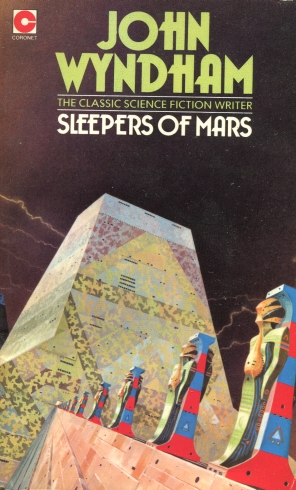
Sleepers Of Mars
- Автор: Уиндем Джон Паркс Лукас Бейнон Харрис
- Год: 1977
- Язык: английский
- Год: Coronet Books/Hodder & Stoughton Ltd
- ISBN: 0340173262
- Жанр: Научная фантастика

Электронная книга - «Sleepers Of Mars». Краткое содержание книги:
Of course, we are now well used to the idea of Man On The Moon, we have become blasé as to the possibilities of inter-planetary travel. But imagine two expeditions to Mars, one British, the other Russian, both in the process of discovering a mechanical race, invented and produced by the Martians as they believe their specie to be dying.
The other four novellas in this collection give further evidence of John Wyndham’s genius at invention, characterisation and sense of movement.
Food need cause them no worry. It was chemically produced and they had yet to find out how it tasted, but he had been told that it existed in great quantities for them to take as they wished. They could get it at any time from one of the machines stationed in the basement of the building.
‘But why should they leave all this stuff here to rot?’ Vinski wanted to know. ‘They obviously didn’t desert the place in a sudden emergency.’
‘But why not leave it?’ Platavinov countered. ‘They had a dwindling population. They were moved from here to fill up another city where there was already more than the inhabitants needed. It would be pointless for them to take more than just their personal belongings when they left here. Presumably everybody could have as much as he wanted of everything and the rest would be useless surplus, so it was just left behind. If necessary it could be fetched, I suppose, but as the birthrate clearly continued to fall, it never was necessary.’
Vinski nodded slowly. ‘Yes, I see. That would be so. In a rapidly shrinking community all values would be different, of course. It’s a bit difficult at first to see it from their angle when one has always thought in terms of expansion. The viewpoint-’
‘Would you mind leaving the viewpoint for a bit,’ Gordonov suggested. ‘Platavinov mentioned food. How do we get it?’ Platavinov crossed to a row of switches on the wall and studied the curious characters over each. He selected one, pressed it and spoke at the diaphragm above.
They waited perhaps half a minute. There was a click, and a rectangular panel in the wall fell open. In the cavity behind was a row of bowls with steam rising from them.
‘That’s service,’ said Gordonov admiringly. ‘I think I’m going to like this place.’
The meal was a success. The flavours of all the dishes were strange, but for the most part, not too strange. It was evident that the chemists responsible had kept well in mind the fact that a man who eats with zest is better fed than one who is bored by dull food. It remained to be seen if they were as good at sustaining appetite as they were at inducing it; if so, there would be little to complain at in their keep.
They followed the meal by an inspection of their rooms. Very little they could have wished for was lacking, though many of the appliances struck them as odd in design and obscure in their manner of operation until one got the trick of them; and quite a number of small devices left them baffled —much, they felt, as a man who had never seen a tin-can would be at a loss to understand the use of a simple tin-opener.
The greatest unfamiliarity lay in the bareness and austerity of the rooms. The Martian custom of building in everything which could be built in and leaving no more furniture than stools, table and divan in the open gave at first a suggestion of chilly institutionalism.
On their return to the main room, Platavinov looked thoughtfully at the grey glass panel on the inner wall.
‘What is it?’ Vinski asked.
‘Some kind of television instrument, I gather. The machine spoke about it, but I didn’t follow entirely. However, it’s worth having a shot at it.’
He found a small switchboard with a complicated array of controls. At the pressing of an obvious main switch the panel began to glow, but the further manipulation of the machine proved no easy matter. It was half an hour before he managed to get a steady, undistorted picture on the screen-—and that was no more than a vertical view of a stretch of desert.
He turned a knob cautiously, and the ground appeared to slide swiftly to one side. He tried another; the scene blurred and vanished in a swirl.
‘How does it work?’ asked Gordonov curiously.
‘As far as I gathered, it is quite different from the thing we use to talk to Soantin in that it needs no transmitter. The idea is that first you decide the place to be viewed, next the viewpoint—your own position, as it were—then you focus two beams, kind of negative and positive carriers, on to the subject and there you are.
‘The first difficulty seems to be to know which knob does what. Anyway, according to the machine, it will show you anything which is going on in this hemisphere, providing that it is out of doors; the buildings are screened against it.’
‘A nice tactful thought,’ said Gordonov. ‘Well, you might try to get us a close-up of the Tovaritch. I’d like to see what’s going on there.’
‘What about taking a look at this place Hanno, or whatever it’s called, and seeing how the Martians really live?’ Zhatkin suggested.
‘Seems to me that the first thing to do is to get a general idea of the layout of the country and the canals,’ said Vinski.
‘But even before that we’ve got to learn how to work the damn thing,’ the doctor protested, as he applied himself to the controls again.
CHAPTER FIVE
THE FATE OF THE MARTIANS
Vinski drifted into the room. Gordonov glanced at him, and then turned his eyes back to the visi-screen on the wall to attend to the details of the method by which the machines were busy relining the Tovaritch’s stern tubes. Vinski set down the glasslike helmet which he had been carrying under one arm, unfastened the oxygen pack from his shoulders, opened the silvery overall suit which covered him and let it slip to the floor.
Crossing to the wall, he flipped over a lever, spoke the one Martian word he had acquired into the diaphragm and waited. A bowl of liquid made its appearance in the delivery cupboard. He took it out and crossed over to sit beside the engineer on the divan.
‘How are they getting on?’
‘Pretty well,’ Gordonov told him. ‘They’ve been filling up with stores and doing something or other in the living-room. Once they’ve got the firing tubes fixed I imagine they’ll be able, to begin refuelling. Not more than a day or two’s work now, I should think.’
‘Thank Lenin for that,’ said Vinski, his eyes on the visi-screen. ‘The sooner we’re out of this morgue the better I’ll like it.’
Gordonov nodded. He, too, had found that existence in Ailiko was getting on his nerves. It was, he reckoned, the sense of futility which seemed to fill the deserted city. In the first few days they had been too busy exploring it, and discovering new devices, for it to have any appreciable effect on their spirits. The new adventure had warded off the feeling of desolation.
But as familiarity grew and the things about them ceased to be intriguing novelties, that defence was lowered. That was one of the reasons why he spent so much time at the visi-screen watching the machines at work: that was practical, constructive and hopeful work. While he could keep his attention on it he could forget the decay going on around him.
They had been in Ailiko now a mere seventeen days, but to each of them it had seemed a long slice of existence. The place continually provoked unwelcome speculations: a dead city upon a dying planet which was the home of a dwindling race.
Soantin had told Platavinov that the many millions of a few thousand years ago were now reduced to a mere handful working out their existences in seven cities far too big for their needs, in the face of the knowledge that a few more generations must see the end. They had no hope that conditions would change or that any natural upheaval could give them a new lease of life. They foresaw their children’s end as clearly as if it had been their own.
Yet they did not commit wholesale suicide. They knew what was bound to happen—and yet they went on to meet it. That to Gordonov—and to the rest—was one of the most deadening realisations. The people of Mars had made effort after stupendous effort to prolong their life; had irrigated the planet, had built these cities, had by these means and others pushed their survival far beyond its natural term. And yet the end would be the same as if they had made none of these efforts.