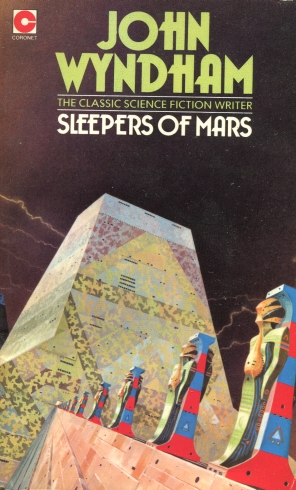
Sleepers Of Mars
- Автор: Уиндем Джон Паркс Лукас Бейнон Харрис
- Год: 1977
- Язык: английский
- Год: Coronet Books/Hodder & Stoughton Ltd
- ISBN: 0340173262
- Жанр: Научная фантастика

Электронная книга - «Sleepers Of Mars». Краткое содержание книги:
Of course, we are now well used to the idea of Man On The Moon, we have become blasé as to the possibilities of inter-planetary travel. But imagine two expeditions to Mars, one British, the other Russian, both in the process of discovering a mechanical race, invented and produced by the Martians as they believe their specie to be dying.
The other four novellas in this collection give further evidence of John Wyndham’s genius at invention, characterisation and sense of movement.
‘Dare?’ inquired Platavinov.
‘Yes, she must retain enough fuel to break her fall back to Earth. If she uses even one pound too much in an effort to accelerate, she’ll crash when she lands, and nothing can save her. Gordonov will back me up.’
‘I will that,’ the engineer agreed. ‘There’s not a doubt about it. But you don’t want 0.5 of a mile more. Man, that’s an awful lot. I’d say that 0.1 or even 0.10 will give us all the lead we’ll need over that distance. Zhatkin’ll be able to say exactly what it works out at.’
‘All right,’ Platavinov admitted. ‘It seems a waste that we should have come so far and found out so little; but your point about getting in first is sound. Certainly the second arrival will find his thunder stolen.’
‘And it’ll do that Curtance good to come off second best for once,’ Vinski added. ‘There’ll be quite a lot of satisfaction in that. Then, if the Gloria Mundi takes off, we do?’
Only Gordonov dissented. He still held that there ought to be some inspection of the rocket before they trusted her to take them through space again. Vinski shrugged his shoulders.
‘I know it would ease your careful mind, but if we are to be kept bottled up, you’ll have no chance of doing it however long we stay.’
‘Let’s hope we’re lucky,’ Gordonov grunted.
CHAPTER THREE
MAROONED ON MARS
Inside the Tovaritch there was a silence of expectation. The four men lay ready in sprung and padded hammocks. Gordonov lay gazing intently at a small circular mirror above his head; the starting and throttle control at the end of its flexible cable lay ready in his hands. The fear which had attended the outward journey, that the circular, fused quartz windows might not stand the strain, no longer troubled them. Accordingly, it had been thought safe to leave one of them unshuttered with its heavy cover screwed back to the wall, and the mirror had been so fixed that it gave him a view of the other rocket.
Zhatkin had emerged from his calculations with a figure which gave the take-off time as being identical (as far as it was possible to judge) with that indicated by the Martian machine. Every loose object had been stowed or fastened down, and the ship made ready for the journey. The men had fastened
themselves into their hammocks reluctantly, facing the prospect of eleven or twelve weeks more of close imprisonment in the flying rocket with gloomy resignation.
The machines, which had persistently hung about the base flanges during the last few hours, had now withdrawn to a respectful distance. Evidently they knew what to expect from a rocket blast. And now, as far as the Tovaritch was concerned, everything depended on whether the Gloria Mundi was going to obey the instructions to leave. If so, the Tovaritch would also take off and race her back to Earth; if not, she would stay to see what happened, confident that her extra reserve of power gave her the advantage over her rival in all ways.
Gordonov’s gaze never shifted for an instant from the small mirror. At any moment now she might start. There was the possibility of a few seconds, perhaps as much as a minute’s discrepancy between Zhatkin’s calculations and theirs. His fingers were on the starting knob, ready to twist it at the sight of the first flush of flame from the other rocket.
The rest waited anxiously, watching his right hand. The seconds crawled. Then came the moment.
Fire poured in a sudden flash between the other’s flanges; it streaked upwards into the purplish Martian day. The Gloria Mundi had gone like a meteor.
On the instant Gordonov turned the knob. The Tovaritch trembled and leapt. Weight fell on each man inside like a physical blow, sudden, breathtaking, and then was gone. The sky outside the window wheeled giddily. Eight hammocks swung across as one. There was a shock which set each bobbing and swinging on its springs. Alternately the men were crushed upon them, or held to them only by their straps.
Outside, sand and sky churned round in a whirl as the rocket swung and rolled. It was all over in the few nightmare seconds before Gordonov had the presence of mind to switch off.
The explosive bucking ceased at once. For a moment or two the rocket swayed, then slowly and quite deliberately the living-room began to go round and round. Only the eight hammocks on their universal swingings remained steady as lockers and panels and walls fled round them. Then, with a final, jolting lurch, the Tovaritch came to rest.
Gordonov lay sweating and rocking gently in his hammock.
‘It’s a pity,’ he said, with remarkable restraint, ‘that I couldn’t have a look at those firing tubes.’
‘We must have shot about the desert like a Chinese cracker. What happened?’ asked Vinski.
Gordonov shrugged. ‘At a guess I’d say that the stern tubes on one side fired, and the bunch on the other side didn’t—or only half of ’em did. Only a guess, though.’
‘Well, we’re lucky,’ put in Zhatkin. ‘At least we didn’t blow up.’
‘If you call it luck to be faced with spending the remainder of our lives—and not a very long remainder, at that—on Mars. I’m not sure that blowing up wouldn’t have been more satisfactory and less uncomfortable in the long run.’
Vinski released himself from his hammock-straps and made his way to the unshuttered window.
‘Here come those damned machines again. Hundreds of ’em,’ he said.
‘What’s it doing?’ asked Gordonov.
‘Signalling,’ said Vinski, at the window. ‘It looks as if it wants to come in. It’s holding some kind of tin box.’
‘Well, let’s have it in,’ Zhatkin advised. ‘If it can fit itself into the airlock, that is. We can’t stay here for ever. If the things mean to get us, they’ll do it sooner or later; and if they don’t, it’s about time we got on speaking terms with them.’
The others nodded.
It was twenty-four hours since the mishap to the Tovaritch. The knowledge that it was now impossible for them to get away had given a very different aspect to their imprisonment. Before, it had been only a matter of disappointment in that it prevented them from learning more of Mars; but now they knew that, unless some outside power should help them, they were faced with living just as long as the food, air and water in the ship could sustain them—-no longer.
Vinski agreed. Through the window he signed to the machine to go to the airlock, and crossed the room to pull the lever which released the bolts on the outer door. Half a minute later the machine entered with a clatter of its metal feet on the side of the rocket.
The Tovaritch’s crew inspected it with nervous apprehension. It was the first time that they had been able to examine one of the mechanical monsters at close quarters, but they learned little new. The hard, silvery metal might have been any one of many alloys, and externally there was no clue to the nature of the machinery contained in the coffinshaped body-case. Whatever it was, it was so efficient that at a yard’s distance it was impossible to distinguish any hum or sound of transmission.
The machine, however, had come neither to exhibit itself nor to indulge in an exchange of courtesies. Without waste of time, it advanced to the table and set down there the box it was carrying. Five sides of the cube were of metal, but that which faced the men was of pearly, smoky-grey glass. While one tentacle did something at the back of the box, the other reached towards a folding stool and placed it in front of the table. Then both tentacles curled back to rest by their owner’s sides.
An exclamation from Vinski drew the attention of the rest from the machine to the box on the table. The grey screen had cleared, and on it appeared the life-sized head of a man, depicted with the utmost reality of which two dimensions are capable.