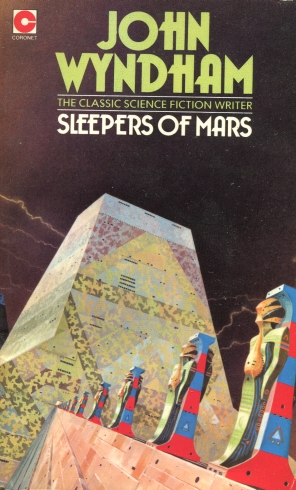
Sleepers Of Mars
- Автор: Уиндем Джон Паркс Лукас Бейнон Харрис
- Год: 1977
- Язык: английский
- Год: Coronet Books/Hodder & Stoughton Ltd
- ISBN: 0340173262
- Жанр: Научная фантастика

Электронная книга - «Sleepers Of Mars». Краткое содержание книги:
Of course, we are now well used to the idea of Man On The Moon, we have become blasé as to the possibilities of inter-planetary travel. But imagine two expeditions to Mars, one British, the other Russian, both in the process of discovering a mechanical race, invented and produced by the Martians as they believe their specie to be dying.
The other four novellas in this collection give further evidence of John Wyndham’s genius at invention, characterisation and sense of movement.
‘Beginning to get worried about you. Thought you might have had an accident,’ he said. ‘What the devil have you got there?’
They laid their burden on the ground. It was a long, glasslike container having both ends rounded, but one smaller than the other; a streamline shape, but for the bluntness of the narrow end.
‘A Martian,’ Platavinov said. ‘I want to have a good look at him,’ he explained.
Vinski bent over the container and peered down at it. It seemed to be filled with a slightly clouded, green liquid. Through it he could make out the form of a man, still swaying slightly from the movement. The body was entirely naked, and seen through the green fluid it seemed to him an even more unpleasant sight than the ordinary hospital cadaver in its tank. The cloudiness made it difficult to distinguish details, but he could see enough to judge that the proportions of the man differed from those of terrestrial types.
A nice ghoulish occupation you’ve found for yourselves. I should have thought this place was bad enough already, without taking up body-snatching as a pastime. Where did you get it?’
‘I’ll show you,’ Platavinov offered.
‘I don’t know that I’m keen. In fact, I’m not. What I need just now is cheering up, and a demonstration of how the Martians disposed of their dead isn’t my idea of hilarious entertainment.’
Platavinov grinned.
‘Nevertheless, I think you’ll be interested in this.’
Vinski gave in, reluctant but curious. They left the container where it was, and went back to the hospital entrance. Beyond the airlock, Platavinov pulled the switches which put the building on to the lighting mains. To Vinski’s surprise, he led the way past the first obvious lift to another at the end of a corridor. Vinski’s second surprise was that in it they travelled down instead of up.
A dozen feet or more lower they stopped, and emerged into a small bare room. Platavinov went to a ponderous door on the farther side and swung it open. He groped for a lever inside, and the darkness beyond was relieved by long rows of dim lights.
CHAPTER SIX
IN THE VAULT
Vinski exclaimed aloud as he stepped over the threshold. He was facing down an aisle which seemed to extend to infinity, until the row of lights ceased to be dots and became a thin, luminous line. To his left and his right the wall stretched out of sight.
The whole of the vast floor space, save that given up to aisles and supporting pillars, was taken up with just such glassy containers as the doctor and Zhatkin had been carrying. They rested there in their thousands—perhaps their hundred thousands—lying horizontal in five-tiered racks. In the closer ones it was possible to make out the pale forms, glimmering ghastly in their green covering.
But it was not entirely, nor even mainly, the great size of the place which had caused Vinski’s exclamation. His gaze had fallen upon a body which lay asprawl in the aisle on his left. Close by were two vacant spaces in one of the racks.
The body was that of a woman, still quite young. Close by were the fragments of a container which had obviously held her. The preservation was miraculous; there had been no wasting, no distortion of any kind. Vinski would have been prepared, in other circumstances, to believe that she had died no more than a few hours before. Even yet it appeared almost that she might stir and speak.
He looked questioningly at Platavinov. The doctor shook his head.
‘Yes, I’m afraid I’m responsible for that. When we opened the container I had no idea of the state of affairs here, and the poor woman died. It was most unfortunate.’
‘She—what?’ asked Vinski stupidly.
‘She died—there on the floor.’
Vinski stared at him. Slowly he turned his eyes away and let them wander over the vast hall with its acres of glass tubes. His gaze came back to the doctor.
‘Are you serious, Platavinov? Are you trying to tell me that all these are not—not dead?’
Platavinov nodded in a matter-of-fact way. ‘That is so. They are not dead; but neither are they alive.
‘Zhatkin and I found this place by accident; this and five more floors like it below. We thought at first that it was a burial-place, and that they had used some form of mummification. After all, many men on Earth have the vanity to believe in another life, so why not here? Here, we thought, were the Martian myriads waiting for the last trump. And as it seems to me extremely unlikely that there will be a last trump or a judgment day, I thought I’d have a look at one, just to see how like or unlike us they were.
‘Well, we broke open the casing, and the poor woman died there on the floor as I told you—died of suffocation before she could come to life again. It was most unfortunate.’
‘It was horrible,’ Zhatkin said, with a shudder.
Vinski still stared at them incredulously. ‘Are you really telling me the truth? I can’t believe it.’
‘I don’t blame you for that. I would certainly not believe it if I had not seen it myself.’
‘It was horrible,’ Zhatkin repeated.
But just what has been done to these people?’ Vinski demanded.
‘That’s what I wanted to know. So after that we went up to the hospital library to try to find out. I can’t tell you why, but didn’t take long to discover how. The stuff in the containers isn’t liquid; it’s a heavy gas. It has the property of arresting all organic processes in anything which is immersed in it. I can’t find an exact translation for the Martian name of the state it induces, because that state is unknown to us—catalepsy, suspended animation, hibernation, none of them quite meets the case.’
‘And for an indefinite length of time?’
‘So it appears. There’s no mention of any time limit.’
‘But when was it done, and why?’
‘I can’t answer either of those. But I can tell you that it was done on a tremendous scale, from the records up in the hospital proper.’
‘And all these,’ Vinski swept an arm to take in the entire vast vault; ‘all these can be revived?’
‘So it would seem—barring a few inevitable accidents, I suppose.’
‘And one who will never be revived,’ added Zhatkin, looking down at the body at their feet.
‘I can’t believe it.’
‘Nor can I, hardly,’ Platavinov agreed, ‘but I’m going to test it. However, as there is only the natural air here, we were taking that one along to our own building. We’d better be getting back to it now, hadn’t we?’
Vinski followed him out bemusedly. He envied Platavinov his matter-of-fact outlook. Of the four of them, the doctor had been least affected by his surroundings. He was making a number of interesting discoveries in a deserted city, and that, for him, seemed to be the long and the short of it—almost. At any rate, this sense of desolation and haunting despair which filled the place for the rest scarcely seemed to touch him.
Vinski was irritated at his own feelings. He had been brought up to think in terms of materialism, and to explain all phenomena on that basis, keeping emotional reactions in what he considered their rightful and secondary place. It disconcerted him to find them swamping him and distorting his judgment. Yet he felt that they were doing so. He felt almost ashamed of himself as he spoke again to the doctor, but he felt that he had to speak.
‘Do you think it’s wise to meddle with this?’
Platavinov looked at him curiously.
‘What do you mean, “wise”? How could it be unwise?’
‘I don’t know, but it seems to me unlikely that those people were left in their trance—or whatever it is—by accident. It must have been done on purpose; that is to say, someone has decided that they are not to wake. Do we know enough of this planet to interfere with that purpose? We don’t; and, candidly, I have a feeling that the whole thing would be better left alone.’