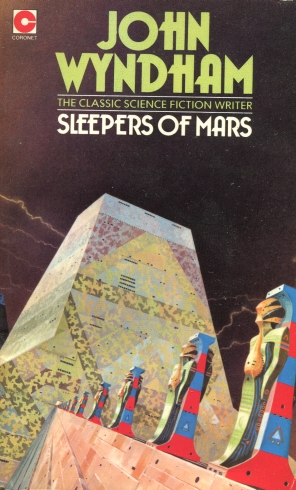
Sleepers Of Mars
- Автор: Уиндем Джон Паркс Лукас Бейнон Харрис
- Год: 1977
- Язык: английский
- Год: Coronet Books/Hodder & Stoughton Ltd
- ISBN: 0340173262
- Жанр: Научная фантастика

Электронная книга - «Sleepers Of Mars». Краткое содержание книги:
Of course, we are now well used to the idea of Man On The Moon, we have become blasé as to the possibilities of inter-planetary travel. But imagine two expeditions to Mars, one British, the other Russian, both in the process of discovering a mechanical race, invented and produced by the Martians as they believe their specie to be dying.
The other four novellas in this collection give further evidence of John Wyndham’s genius at invention, characterisation and sense of movement.
The doctor grunted contemptuously.
‘You’re getting superstitious, like Zhatkin. I am a man of science. I am interested in knowing how this thing has been done, and whether it has been successfully done. I do not intend to behave like an ignorant yokel. Furthermore, these people are going to be left in their “trance,” except for this one man whom I intend to examine.’
‘And the woman we killed,’ put in Zhatkin.
‘You seem to have got her on your mind. I assure you that she died without knowing anything about it. It was an unfortunate accident, that’s all.’
They came back to the main underground passage. The container still lay where they had left it. Vinski, more than half ashamed now of his illogical scruples, helped to carry it. To his earthly muscles it felt strangely light to contain a man’s body.
‘All ready?’ asked Platavinov.
The rest nodded, but not enthusiastically. It should have been a moment when active interest swamped all other feelings, but instead it found them rather fearful for reasons which none of them could explain.
Platavinov raised his hammer and brought it down on the glass casing. The container swayed on the table; the green contents swirled, the immersed body rocked gently, but the covering did not fracture.
It was twelve hours since they had brought it to their living-room. The doctor had insisted that it remain untouched for that long to enable the temperature to rise from the below zero of the vault to that of the surrounding air.
He struck again, slightly harder, but still without effect. The third blow was successful. The container split from end to end and the two halves fell apart. The heavy green gas flowed across the table-top and began to pour over the edge with an odd deliberation, like water seen on a slow-motion film. Gordonov stepped forward and filled an empty flask with it as it dripped down.
Platavinov dropped his hammer. He sprang forward. He and Vinski seized the body between them and held it upside down. The green gas streamed out of its mouth and nostrils. They carried it over to the divan and laid it there face downwards. The doctor began to work on it as if giving artificial respiration. Under the rhythmic pressure of his hands, more of the gas was expelled to drift in a thin stream to the floor.
Without pausing in his work, he instructed Zhatkin to hand him a ready-charged syringe. Swiftly he injected its contents, and then went on with his kneading.
Half an hour passed before he relaxed his efforts. The man was now breathing deeply and regularly, but consciousness had not returned. The doctor made another injection, and wrapped the body in a warm rug; then there was nothing to do but wait. The four sat round watching the man’s face for the first signs of consciousness.
‘He ought to be all right,’ Platavinov said. ‘I gather that they have a quicker method of revival, but I didn’t want to risk a strange technique, and this seems to have been quite effective.’ More than an hour passed before the man’s eyes opened. All four saw the lids flicker a little before they rose. No one spoke. For some seconds the eyes remained blank and unintelligent, staring at the ceiling, then with a motion made as if in spite of great weariness, the head turned to one side and the eyes met their own.
Surprise and bewilderment crept into them. The man made an effort to move. Platavinov put out a hand gently to quieten him, and said a few words which the others did not understand. The man relaxed obediently, but his eyes were still puzzled.
After a time he revived enough to speak. Platavinov understood him; the intonation was only slightly different from that he had learned from Soantin. He translated for the benefit of the rest.
‘Who are you?’ the Martian asked weakly.
‘Friends,’ the doctor told him. ‘We will explain later.’
‘What year is this? How long have I slept?’ the man wanted to know.
Platavinov could not tell him that. He had no idea of the basis of the Martian calendar. He replied:
‘A very long time. I don’t know how long.’
‘Three centuries?’ suggested the other. ‘They said it might be for three centuries.’
The doctor could only shake his head, a gesture which seemed to puzzle the other. There was a pause, then:
‘The canals? They’ve built the canals?’ the man asked. The doctor took it as a cue.
‘Oh yes. They’ve built the canals,’ he assured him.
‘That is good. Then it has been worth it,’ said the Martian. Seemingly satisfied, he let his eyes close. In a few minutes he was in a natural sleep.
Platavinov looked at the others with an expression of awe and amazement.
‘Before the canals were built’ he whispered. ‘How many thousands of years was that, I wonder?’
CHAPTER SEVEN
THE SLEEPER’S STORY
‘Come,’ said Platavinov. ‘It’s time you had some food.’
The Martian turned obediently back from the window. He came across the room as though he were not even yet fully awake.
‘This cannot be Ailiko,’ he repeated dazedly.
‘It is,’ the doctor assured him patiently for the third or fourth time.
‘But that desert out there; it seems to go on for ever. There was no desert at Ailiko. Where does it end?’
‘I don’t know. I don’t think it does. I think it is all desert except for little strips beside the canals.’
‘The canals; yes, the canals. But they were to be built to save the land. Why, then, is there all this desert?’ He paused, and looked at the four Earthmen. ‘And who are you? You are different: your arms and legs are thicker, your ears are small, your chests are smaller. Why?’
Platavinov explained what he could to him while he ate. Gordonov switched on the visi-screen to show the Tovaritch and the machines busy about her base.
‘From Earth?’ The Martian believed reluctantly. ‘But why have you come from Earth to revive me? Why not my own people?’
It was a question which Platavinov himself would have liked to have answered. He turned it by one of his own.
‘Tell me about yourself. We know practically nothing of this planet. What happened? Why were you in the state we found you?’
The Martian’s story was disjointed and needed much parenthetical explanation, but later Platavinov sorted it out for the rest and translated the man’s words as closely as possible.
‘It happened,’ said the young man, whose name, as nearly as it could be rendered, was Yauadin, ‘because Mars is over-populated—was over-populated, I suppose I mean, though it seems only yesterday that we went to the hospital. All our people existed only on a narrow margin. There was no doubt that the planet had begun to wear out.
‘The fertility was growing less. It was as much as we could do, by the most intensive cultivation, to produce enough food for ourselves. Then there came a year of bad harvests; our reserves soon went, and all over Mars people died of famine. The next year chanced to be better, but that was followed by another bad season, and then another.
‘A great committee of investigation was called. They announced that though the three bad years were probably exceptionally severe, there could be no doubt that the productivity of the land everywhere, save close to the rivers and seas, was rapidly declining; and, further, that the rivers and seas were themselves shrinking, so that the state of affairs must inevitably become worse. In short, that Mars, in her present state, could not hope to grow enough to feed her people.
‘It was a crisis too big and too easily capable of proof to be glossed over. Unless something could be done, we were facing a future of continual short rations for some, and actual starvation for the rest.