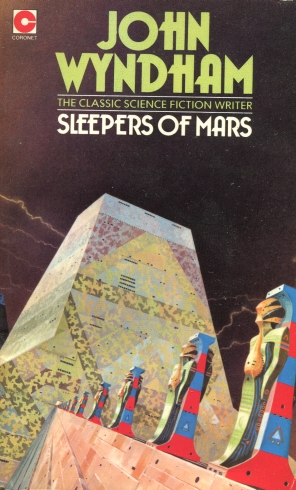
Sleepers Of Mars
- Автор: Уиндем Джон Паркс Лукас Бейнон Харрис
- Год: 1977
- Язык: английский
- Год: Coronet Books/Hodder & Stoughton Ltd
- ISBN: 0340173262
- Жанр: Научная фантастика

Электронная книга - «Sleepers Of Mars». Краткое содержание книги:
Of course, we are now well used to the idea of Man On The Moon, we have become blasé as to the possibilities of inter-planetary travel. But imagine two expeditions to Mars, one British, the other Russian, both in the process of discovering a mechanical race, invented and produced by the Martians as they believe their specie to be dying.
The other four novellas in this collection give further evidence of John Wyndham’s genius at invention, characterisation and sense of movement.
‘There was a war, a bloody war of extermination in which millions were killed in order that others might live. It was a futile war, for it destroyed much of the land it was intended to preserve, and the state after it was worse than before. The fighting died away as people found that it brought them less instead of more. It became clear that nothing short of worldwide co-operation would help, and out of a great conference came the idea of the canals—the project of irrigating the whole planet from the Poles.
‘At first the scheme seemed too vast to be put into practice. It was thought that such a work could never be completed, but after a time which brought forth nothing practicable save minor regional remedies, the canal idea began to be taken more seriously.
‘It was accepted by many responsible people as feasible and likely to provide a solution; but it would take a very long time—centuries, perhaps—before even the main system of great canals was complete. And meanwhile the population was starving….
‘We were faced with a choice. Either we must go on as best we could, with our race gradually deteriorating from undernourishment while the scheme was in hand, or else we must reduce our population in some way, so that those who remained could be properly fed. The former was scarcely feasible; the latter, at first sight, presented two possible solutions. Voluntary euthanasia for a large number of us, or, by a slower method, the deliberate limitation of births, by decree.
‘It was clear that there would be few candidates for suicide in the interests of the race. But the proposal of supervised limitation aroused such passionate prejudice on all sides that it was doubtful whether the decree could ever be passed, or enforced if made law.
‘It was in the middle of the inflamed arguments that the physicians put forward a new suggestion. Why not, they asked, put a large part of the race into a temporary state of suspended animation? There was almost no risk. The reduced active population, freed from the fear of hunger, could then construct the necessary machines to go forward with the canal scheme. When the system was complete and the land revived, those who had been entranced could be awakened to take up their lives again.
‘Here, at last, was a plan to which in the face of our danger there could be very few objections. It was well known from many experiments that the state of suspended animation produced no harmful after-effects. In the crisis, we approved of it, and many of us actively welcomed it. To me and to my wife, Karlet, it came as the solution we had prayed for.
‘We were both still young and had no wish to die of starvation, nor any other way. On the contrary, we wished very much to live and to have children of our own. But to bring them into the world to face famine, or perhaps “limitation”— which, put plainly, meant murder—at the hands of the state, was a thing we could not face.
‘But here we had a gift full of new hope. We had only to submit to having our lives suspended and we would wake in a regenerated world—a world of plenty fit for our children to grow up in. We talked it over and decided to volunteer; many, many thousands like us did the same. The response was overwhelming.
‘They took us as fast as the factories could turn out the containers and produce the gas. We were not the first. We had to watch many of our friends go before us, and we envied them, for every day we were forced to wait meant a day less for us in that world of plenty. But our turn came at last. I can hardly believe that it was not just a few hours ago that Karlet and I walked together to the hospital.
‘And now what is there here for us? Are we to bring children into a world of deserts? Where is that world they promised us?’
He went to the window and looked out again.
‘They didn’t die, did they? They built the canals; that must have made the world fertile again. Why didn’t they let us live in it as they had promised? Why have they cheated us and only given us deserts where you say there is not air enough to’ breathe?’
‘They gave you nothing,’ Platavinov said. ‘This is a deserted city, as I told you.’
‘Deserted! But there are still men on Mars?’
‘Oh yes. There are some. A few thousands, I believe.’
‘And they let us lie there…. Left us, meaning that we should never awake. We who volunteered to sleep so that their ancestors might live! ’
He stood motionless for a long time, staring out over the waste of red sand. Platavinov watched him carefully, alert for a passionate, perhaps a dangerous reaction. But there was no sign of violence; instead, the man kept a deadening control over himself. There was fury in his eyes, but it was cold; his face grew hard and drawn. When he spoke again there was a harsh edge of bitterness on his voice.
‘Tell me all you know about this place,’ he demanded. ‘It seems that I am a stranger in my own city—and in my own world.’
‘It is easy enough to see what happened,’ Platavinov told the others later. The Martian, Yauadin, was asleep in another room. He was still in need of physical rest, though the doctor had had to give him a mild sedative to calm his mind. ‘Yes,’ said Platavinov, ‘that’s clear enough.’
‘Is it?’ said Gordonov. ‘Perhaps it is to you, but it isn’t to me. What did happen?’
‘Well, it looks as if this wholesale voluntary suspension of life was arranged just as he said, with perfectly honest and honourable intentions on both sides. Those who remained alive to construct the machinery to build the canals were acting in perfectly good faith, otherwise they might as well have killed these volunteers out of hand.
‘But it is the old story of new generations refusing to be bound by the promises of their forefathers, as time and the irrigation work went on, life must have become easier, and with plenty for all, the population would increase. When the vast work of the canals was finished, what happened? Why, they found that the land was again supporting as many as it could; there may even have been the problem of over-population again.
‘In the circumstances, how much attention would the Martians of that day be likely to pay to the promises of their great-great-grandfathers? Precious little, I’d say. To all intents and purposes, our friend Yauadin and the rest were dead. Let them stay dead, would be the verdict.
‘And so, for one reason and another, it has gone on. Perhaps there has never since that day been so much surplus that it could feed several million mouths. Or perhaps by the time the surplus existed the sleepers were forgotten. Or perhaps there was no surplus until the planet began to become barren again, and then they dare not let them out.
‘In any case, they were never awakened; no one ever made room for them, and now they never will. They will stay there, sealed in their containers, while the planet freezes and the Sun grows cold. It is perhaps the best thing that could happen now. They went to sleep happy, and hopeful of a new world. There will never be that new world now, but they need never know it.’
‘Except Yauadin, poor chap,’ said Vinski.
‘He seemed to take it all pretty calmly, I thought,’ Gordonov said.
‘Calmly! ’ said Zhatkin. ‘Can you see anything beyond your nose? You say he is calm—because he did not rage and swear, perhaps. You are a fool!’
Gordonov got up angrily. ‘Damn you, slit-eyes! I’ll teach you to call me a fool, you little- !’
Vinski swung his big bulk in between them. ‘Shut up, Gordonov! And, Zhatkin, watch your tongue better.’
Zhatkin shrugged. ‘No one but a fool would say that a man who seethes inside like a volcano is calm. He is not only angry; he is the most deeply angry man I have ever seen. If I were you, Vinski, I would kill him.’
All three stared at the little Kirghizian.