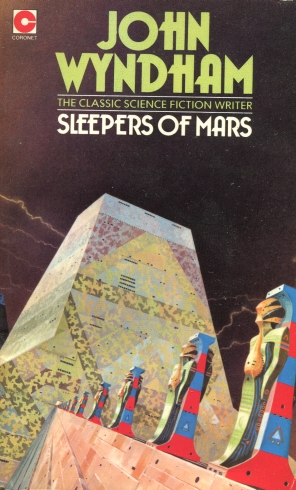
Sleepers Of Mars
- Автор: Уиндем Джон Паркс Лукас Бейнон Харрис
- Год: 1977
- Язык: английский
- Год: Coronet Books/Hodder & Stoughton Ltd
- ISBN: 0340173262
- Жанр: Научная фантастика

Электронная книга - «Sleepers Of Mars». Краткое содержание книги:
Of course, we are now well used to the idea of Man On The Moon, we have become blasé as to the possibilities of inter-planetary travel. But imagine two expeditions to Mars, one British, the other Russian, both in the process of discovering a mechanical race, invented and produced by the Martians as they believe their specie to be dying.
The other four novellas in this collection give further evidence of John Wyndham’s genius at invention, characterisation and sense of movement.
Sleepers of Mars
John Wyndham
isbn: 0-340-17326-2 / 978-0-340-17326-8
publisher: Hodder & Stoughton Ltd
published:01 Sep 1977
Copyright © 1938,1931, 1933, 1934, 1933 by the Executors of John Beynon Harris
Printed and bound in Great Britain for Hodder and Stoughton Paperbacks, a division of Hodder and Stoughton Ltd.,
Mill Road, Dunton Green, Sevenoaks,
Kent (Editorial Office: 47 Bedford Square, London, WC1 3DP) by Richard Clay (The Chaucer Press), Ltd, Bungay, Suffolk
Introduction: THE FATE OF THE MARTIANS
The fiction writers have toyed with the notion of travelling to the planets for two centuries or more. But to foresee in the thirties the day when both America and Russia would engage in systematic efforts to explore the surface of Mars, through ingenious rocket machines, with the final object of setting human foot upon that planet, would appear to rely on something more than imaginative guesswork.
In the years before World War II interrupted his writings, the late John Wyndham was a keen observer of the first tentative experiments in rocket propulsion. While others scoffed at the prophecies of those who pioneered the science of astronautics, he lent a sympathetic ear to their aspirations—and found in them inspiration for his tales.
In Stowaway to Mars, his second full-length novel (already revived by Coronet Books), he anticipated the universal excitement which might one day be aroused by the attempt to cross interplanetary space—by three competing nations, in the year 1981. The story relates the adventures of the crew of the British vessel Gloria Mundi, which alone completes a triumphant return to Earth. An American contestant in the space race makes a disastrous landing on Mars. What happened to the crew of the Russian ship Tovaritch, with whom the British astronauts had a brief, unfriendly encounter?
The first story in this new selection of the early work of John Wyndham, from the days when he wrote as John Beynon or John Beynon Harris (his real name), was intended to resolve this intriguing question. Though originally published as a sequel to the earlier novel, it is actually a separate story, in which Commander Karaminoff and his comrades discover the secrets of the mysterious red world and its perambulating machines.
Did Mars once harbour a dwindling race of beings who were compelled to take drastic measures in the face of the gradual dissolution of their planet—measures that might ensure a new lease of life for their kind? As you read the fabled history of this ancient globe and its doomed civilisation, you may be tempted to see in the efforts of the Martians to put off their inevitable fate some hint of the methods which man may have to adopt if he is to survive on his own overcrowded, polluted planet.
Unlike ‘Sleepers of Mars,’ the other stories in this volume saw publication in the U.S.A. before they were presented in Tales of Wonder, the first British magazine to specialise in science fiction, which I was able to initiate in 1937 and which became a war casualty in 1942. The notions they offer still seem fantastic, but are none the less plausible in the hands of a writer who was always noted for his ability to tell a convincing story rather than merely to project a novel idea.
Walter Gillings
SLEEPERS OF MARS
A Sequel to Stowaway to Mars
CHAPTER ONE
THE MARTIAN MACHINES
The Sun, which has seen many strange things upon his planets, and has stranger yet to see, had risen a few hours into the Martian day at a point where, close to the equator, there was unfamiliar activity. His beams still slanted so that the wastes of reddish sandhills and protruding rocks, which cover the great part of the fourth planet, cast shadows and gave a rugged character to the scene. Before long, when he had risen a little farther, that aspect would have disappeared; the dreary miles of sand would shimmer unshaded, unchanging, barren as they had been for centuries.
All the planets are dying. Some, like Pluto swinging in his remote icy circuit, are dying without having lived. They have passed straight from glowing birth to frozen death, too far from the Sun ever to have nourished life. Not so the inner planets; certainly not so Mars. But there is nothing eternal about a star system. Those members of it which manage to produce life can sustain it only for a short time, while all the conditions are suitable. And the time left to life on Mars was growing short.
It would have been finished there long ago, but for the tenacity with which it always defends itself. Without the supreme effort which had laced the surface of the planet with canals to hold back the creeping deserts, life would have vanished thousands of years before, or would have remained only in lowly forms, close to the poles, waiting until it should be crushed at last between ice-cap and desert.
But the canals, desperate and stupendous effort though they were, could not change the inevitable. They could delay it for centuries, even millennia, as indeed they had; but they could do no more than delay. True, there was some vegetation still along their banks—dry, rusty-looking bushes, whose papery leaves rustled dismally when there was a rare breath of moving air to stir them; but even their years were numbered now. There was still water in the canals to feed their roots, and would be for a long time, but gradually they grew less.
The sky which had once been blue was now purple, growing deeper as the centuries sucked the air into space; and the ebb of the air was the ebb of life. Slowly and relentlessly, the deserts crept ever closer to the edges of the canals….
But, after all, just what is meant by life? It is a pretty piece of vanity for us to assume that it is only something on a carbon basis needing oxygen for its existence. For there were things on the deserts, things in the cities and things moving in the papery bushes which suffered no inconvenience from the thining of the air. And in a part of the equatorial belt—a region where man might have been able to live even yet, had he enough atmosphere to keep his lungs working—was a manifestation that the process of decay was as yet by no means complete.
Two tall metal cylinders stood upright, separated by a space of a mile or so, their symmetry oddly alien in the featureless landscape. Both tapered at their tops to blunted noses, suggesting from a distance two colossal fingers pointing into the heavens. There was little difference in their main outlines, save that the one labelled in Russian characters close to its prow, Tovaritch, was supported upon four huge flanges which sprang from its base, while the slightly smaller, though more grandiosely named Gloria Mundi perched upon three.
About the great fins of both cylinders was a flurry of metal parts flashing in the sunlight. It gave at first a suggestion of ants at work, until a closer view showed that although the workers had, superficially, something of the form of insects, yet they belonged neither to the insect nor animal kingdoms. The likeness at a distance was an accident of design, for their coffinshaped body-cases were supported upon three pairs of legs, while two flexible tentacles at one end gave the impression of antennae.
But the impression went little farther, for a closer view showed that the body was a metal box, no less than coffin-sized, and that the supporting legs and active tentacles were also of white metal. At the broader end, where it was natural to expect a head, was something which looked more like the front of a complicated film camera equipped with a lens which swivelled continually as it peered this way and that.
Nevertheless, there remained something insect-like in the way they fussed about the bases of the towering cylinders.
These two great rockets from Earth were not wanted on Mars, and their departure was being arranged for them. It was not, however, the callous Martian intention to drive them at random into space. The decision that they must leave held no animosity, and the activity about the flanges showed that care was being taken that both vessels should have the best possible chance of making the return to Earth safely.