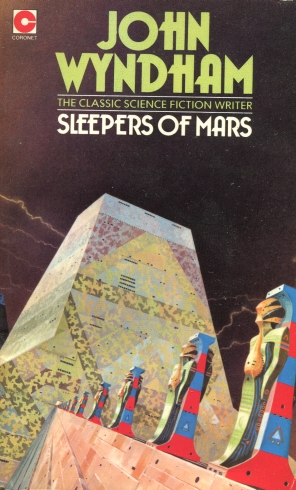
Sleepers Of Mars
- Автор: Уиндем Джон Паркс Лукас Бейнон Харрис
- Год: 1977
- Язык: английский
- Год: Coronet Books/Hodder & Stoughton Ltd
- ISBN: 0340173262
- Жанр: Научная фантастика

Электронная книга - «Sleepers Of Mars». Краткое содержание книги:
Of course, we are now well used to the idea of Man On The Moon, we have become blasé as to the possibilities of inter-planetary travel. But imagine two expeditions to Mars, one British, the other Russian, both in the process of discovering a mechanical race, invented and produced by the Martians as they believe their specie to be dying.
The other four novellas in this collection give further evidence of John Wyndham’s genius at invention, characterisation and sense of movement.
‘Did he mean that they share power with the machines, or that the machines are just machines and nothing more?’ Zhatkin persisted.
Platavinov looked at him wearily. ‘Do you think I learnt the whole state and history of the planet in a few minutes’ talk? I’ve told you what he told me. Now, for Lenin’s sake, let me get some sleep.’
CHAPTER FOUR
THE ABANDONED CITY
The white walls of Ailiko rose sheer from the desert sand. There was no degeneration or spread of minor buildings. Like a cliff, but with a face perforated by thousands of windows, the city reared unashamed, a frank product of civilisation defying the wastes about it.
The machines which had dragged the Tovaritch across the desert stopped half a mile short of the buildings and let her lie at the end of the great furrow she had ploughed across leagues of sand. A single machine approached one of the windows and beckoned with a tentacle.
The men inside climbed from their hammocks, thankful that the jolting journey was over. Each collected his breathing-mask and a small bundle of personal belongings; each also, in view of their earlier experiences, took care to arm himself with a rifle and a good supply of ammunition. Vinski and Platavinov were further encumbered, the former by cameras and cases of films, the latter by the television-box which kept him in touch with Soantin at Hanno.
Once the four were out of the airlock the waiting machine wasted no time; it led the way with its odd scuttering motion, towards the break between the buildings. The men followed with a clumsy, high-stepping walk, the result of the low Martian gravity.
‘I wish,’ said Gordonov, half to himself, as he watched the machine ahead, ‘I wish I knew what that thing is. It’s made of metal, and therefore it should be a machine. But is it? Isn’t it possible that there is a creature of some kind inside the box, working it—like one of those deep-sea diving-suits, only made for use on land?’
‘It doesn’t look that way to me,’ said Vinski. ‘I’ve been wondering whether it might possibly be something quite strange to us, say part animal and part machine.’
The engineer considered. ‘I don’t see how that could be.’ ‘Nor I. But is that any good reason why it should not be?’ They walked on in silence. The entry to the city lay like a canyon between two masses of artificial stone. The road was gritty for a few yards from the entrance, but then gave way to smooth, hard concrete. The thin winds of Mars had been unable to drift the sand far.
It soon became clear that the block of buildings on the right was their destination. They were led round a corner, and the machine signed them to enter a large doorway which faced inward to the city across an open, paved square. When the last member of the party had crossed the threshold, the machine followed. It touched a lever on the wall, and the great door closed silently behind them.
After a minute or less, a similar door at the other end of the room swung open. The machine chattered abruptly. Platavinov put his free hand to the buckles of his mask and slipped it off.
‘It’s all right. Plenty of air here,’ he told the rest.
They emerged from the big airlock into what, for a first astonished moment, they took to be the open. The size of the place and the buildings which surrounded it gave that impression, until one looked up to see the glass or glasslike roof three hundred feet above.
They stood for some minutes staring up at the huge buildings and at the balconies, inter-connected by stairs and lifts, which ran along the facades. The ground space was covered with dry earth, unpaved. It appeared less like the well of a single building than like a section of the city roofed in. Platavinov turned to the machine with a question; he translated its answer for the rest.
‘It says that when the city was in use this was a garden. All the buildings had gardens in the middle.’
‘But for that,’ said Vinski, ‘they might have left it only yesterday. Abandoned a thousand years ago, and shows no sign of it! They must have been wonderful builders. It looks as if time meant very little here.’
‘I should say that that is literally true,’ the doctor agreed. Time without change means nothing, and there can have been little change here; there are no growing things any more, and there can be little weather as we know it. Just a light wind sometimes—very rarely. When you come to think of it, it is probably a good many thousand years since it even rained on Mars.’
‘Yes, I suppose it is. I hadn’t thought of that.’
Zhatkin took in the scene with his sad, dreamy eyes.
‘I don’t like this place. It’s too full of ghosts. They used to live here. They used to throng those long balconies and lean over to watch their children playing in the garden down here. And they would know what the end must be; what lay in store for their children, if not for themselves. They must, I think, have been a very unhappy people. A thousand years is nothing; something of them is still here.’
Vinski grunted. ‘Well, if that’s how it takes you, it’d be better if you kept it to yourself. We’ve got to live here.’
Nevertheless, it was not only Zhatkin who felt that sad, discouraged past which clung about the buildings.
The machine led them to the top balcony by way of a lift, and down a long corridor. By the time it reached a large, sparsely furnished room, they had lost their sense of direction.
Vinski went at once to the window which filled most of one side. He found himself looking to a straight horizon across a monotony of barren sandhills.
To the left one could just manage an oblique view of some of the rusty-looking bushes which were, as far as he knew, Mars’ only form of vegetation. Beyond them was a faint gleam of water; a part, he guessed, of the canal which must have been Ailiko’s life-line in its latter days. To the right he could see a part of the furrow the Tovaritch had ploughed, but the ship herself was out of sight.
He turned back and surveyed the room, while the machine’s metallic voice chattered at a closely attentive Platavinov. The furnishing was extremely simple. A few box-like stools with padded tops, a low divan against one wall and a solid cube doing duty as a table comprised most of the portable pieces. But in the walls were a great number of panels set flush, which he assumed to cover cupboards, and also a number of separate instrument boards of some kind.
The colour of both walls and furniture was a near-white, relieved by an occasional and skilfully placed coloured line or motif. The most noticeable feature of the room was a panel of pearl-grey glass, some six feet square, set on the inner wall.
At last the machine’s chatter stopped, and it took itself off the way they had come. Platavinov turned to them.
‘Well, it may be a Martian custom to keep visitors at considerably more than arm’s length, but I don’t think we shall be able to accuse them of inhospitality. According to the machine, there’s not much we shall lack—if I can remember the right levers to push.’
They had, it seemed, been given the complete freedom of Ailiko. The room they were in and those close by had been put into full working order, as far as heating and services were concerned. The whole enclosed block had been given an atmosphere of close upon fifteen pounds to the square inch, and though other parts of the city had only the attenuated natural air of the planet, they were at liberty to go where they would and see what they liked.
‘As long as our oxygen-tanks last,’ put in Vinski.
But Platavinov was able to assure them that there was not this limitation. In each building there were stores of space-suits which had been held partly for regular use, but more against any chance failure of the atmosphere system. They could take their pick of thousands of these ready for use, and requiring only the simple charging of the air-tanks.