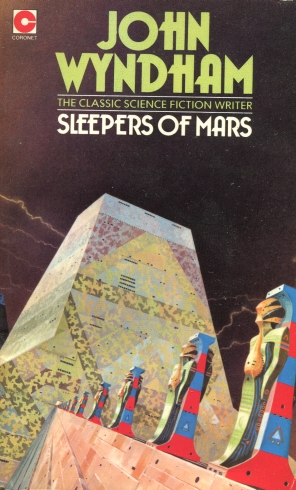
Sleepers Of Mars
- Автор: Уиндем Джон Паркс Лукас Бейнон Харрис
- Год: 1977
- Язык: английский
- Год: Coronet Books/Hodder & Stoughton Ltd
- ISBN: 0340173262
- Жанр: Научная фантастика

Электронная книга - «Sleepers Of Mars». Краткое содержание книги:
Of course, we are now well used to the idea of Man On The Moon, we have become blasé as to the possibilities of inter-planetary travel. But imagine two expeditions to Mars, one British, the other Russian, both in the process of discovering a mechanical race, invented and produced by the Martians as they believe their specie to be dying.
The other four novellas in this collection give further evidence of John Wyndham’s genius at invention, characterisation and sense of movement.
‘That’s easy; and it certainly knows where we came from,’ Vinski said, as they watched it draw a fourth circle to represent the orbit of Mars.
Near a point which it had made to represent the actual position of Mars, the silvery arms made a rapid sketch of their rocket-ship, pointed towards the centre of the diagram. It swivelled its lens up once more, to be sure of attention, before it very deliberately drew a line which began at Mars and ended on the Earth’s orbit.
‘Which seems to indicate that you were right,’ Vinski said. ‘They don’t seem to want us here. And if this planet can show no better forms of animation than we’ve seen already I can’t say I’m sorry.’
Platavinov nodded. There was little chance that the machine could be intending to convey anything else. He watched it as it repeated its action in a manner which dispelled all doubt. Then Vinski, assuming an expression of intense inquiry, lifted his arm and pointed towards the other rocket. The machine drew another sketch of a rocket beside the first, and from it another line to Earth’s orbit.
Vinski nodded. ‘So they’re to be shoved off, too,’ he observed.
The machine, assured that its point was taken, became active in another way. It picked up a metal rod, retired with it for some distance and then stopped to thrust it aslant into the ground. It pointed a tentacle first to the Sun, then drew it along the shadow which the rod cast; and at the end it repeated its rocket-sketching trick in the sand.
‘So far, so bad,’ observed Vinski. ‘About as clear as dregs. What’s it doing now—communing with itself? Or don’t machines commune?’
With a switch of its legs, to be sure that they still watched, the machine moved again. It drew another line from the base of the rod at an acute angle to the former. At the end of it, it started sketching once more.
‘Getting damned good at drawing rockets, isn’t it?’ Vinski went on. ‘What’s the point of all this?’
Platavinov frowned, then, sure that the machine had its lens on him, he carried his finger to the right, and then raised both arms suddenly. The machine below imitated exactly with its tentacles, then pointed emphatically once more to the second line.
‘What-?’ began Vinski, but Platavinov cut him short.
‘I gather that the idea is for us to take off exactly when the shadow coincides with the second line. That should be in about three hours, at a guess. We’d better get back and see what Zhatkin has to say about it.’
They closed the outer door of the lock and shortly re-emerged into the living-room. Vinski reported briefly to the others on what had taken place.
‘The first thing seems to be for Comrade Zhatkin to determine whether some three hours from now would be a possible time for taking off,’ he added. ‘Will you get on with that?’
Zhatkin nodded. His eyes lost their dreamy look as he glanced at the chronometer and went to fetch his slide-rule, charts and tables.
Platavinov demurred:
‘Isn’t the first thing to decide whether we are going to take any notice of this—this order to leave?’ He looked thoughtfully at Vinski and Gordonov. ‘So far we have learned almost nothing of Mars save that an intelligence of some kind certainly exists here. Are we justified in wasting the labour and expense which our comrades put into the ship by going back practically empty-handed?
‘We were to establish relations with any inhabitants of the planet. Are we to go back now and admit that we don’t even know whether there are any, save these absurd machines? We know nothing of the flora, fauna or minerals; we have seen nothing but a very small corner of a desert. Oughtn’t we to stay on and try to come to some understanding with the machines themselves, even if we cannot make contact with their masters? We could start by convincing them that we come with only peaceful intentions.’
‘I doubt whether that would interest them—particularly as we have already destroyed a number of machines,’ Vinski replied. ‘In any case, why should they bother to negotiate with us, and what sort of an agreement can one make with a machine?’
‘There’s another point,’ Gordonov put in. ‘I’ll tell you straight, I’m not for taking off in a few hours’ time. And it’s not for Platavinov’s reason, either. It’s because I’ve had no chance to look over the ship and test her. How am I to know that after all she’s done she is in a fit condition to turn straight round and spend another three months in space?’
‘Is anything likely to be wrong?’
‘Not that I know of, but there might be.’
Vinski glanced towards one of the windows. From where he sat he could see the British rocket. He considered it thoughtfully for a while.
‘The English,’ he remarked at length, ‘have a saying that possession is nine points of the law. It is just the kind of sentiment one would expect to find in a capitalist country. Now, neither we nor they can truthfully say that Mars has been possessed—far from it; nevertheless, the first thing those men in the Gloria Mundi did was to set up their flag and formally annex the planet to the British Empire.
‘Yes, in one way it is a matter for smiling, but in another it is not. For when they get back they will announce their claim to it at once. In a case like this, it is the first claim to be published that will carry the weight; that is where their proverb comes in. And if they are wise enough to give other capitalist countries a title to parts of this planet, the rest of the world will support their claim. If we make a later claim it will appear merely that we are trying to dispossess them.
‘But if we make a public announcement first that Mars is the eighth and latest republic to be attached to the Soviet Union, the position is reversed. There will be trouble and disputes, of course, but it will be registered in the minds of the world that ours was the first claim. They will say, of course, that they landed here first, and therefore have the right but at least there will be a confusion of claims.
‘You may not think this matters a great deal, but one day it will. Some time there will be a better method of space travel than these cumbersome rocket-ships, and the ownership of Mars will become a practical question. When that day comes, we do not wish to see it already labelled in the public mind as just another British colony—assuming that the British Empire is still in existence, of course.’
‘Certainly not,’ Platavinov agreed. ‘And therefore you suggest-?’
‘That we shall do a great deal more for Russia by arriving first on Earth to announce our claim than by staying here on the thin chance that we may be allowed to do a little exploring.’
‘But can we arrive before they do?’
‘There’s no doubt of that. The Gloria Mundi is a smaller ship. She carries less reserve of fuel. There is also the fact that she was intended to carry five, and actually left with six on board.’
‘Was that true, then, about the girl stowaway?’ Zhatkin asked, looking up from his calculations.
‘I believe so.’
‘There wasn’t any sign of her when we went there,’ the doctor put in.
‘They may have thrown her out,’ Gordonov suggested.
Vinski thought not. ‘But whether they did or not,’ he went on, ‘the harm was done. The rocket had to expend the extra power required to lift her weight, which means that they have even less fuel margin than they intended.
‘Now, we have a much higher proportionate reserve, as Gordonov can tell you. Even if Karaminoff and the others were still with us, we could probably accelerate to a velocity of 0.5 of a mile per second more than they would dare. Whereas, with four less to lift…’ He left the obvious conclusion of the sentence to them.