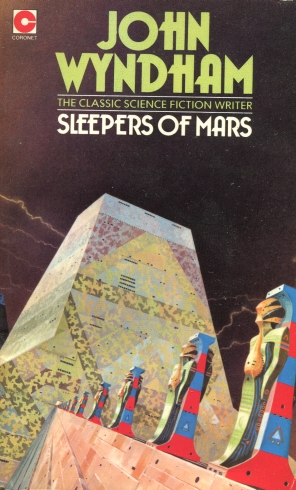
Sleepers Of Mars
- Автор: Уиндем Джон Паркс Лукас Бейнон Харрис
- Год: 1977
- Язык: английский
- Год: Coronet Books/Hodder & Stoughton Ltd
- ISBN: 0340173262
- Жанр: Научная фантастика

Электронная книга - «Sleepers Of Mars». Краткое содержание книги:
Of course, we are now well used to the idea of Man On The Moon, we have become blasé as to the possibilities of inter-planetary travel. But imagine two expeditions to Mars, one British, the other Russian, both in the process of discovering a mechanical race, invented and produced by the Martians as they believe their specie to be dying.
The other four novellas in this collection give further evidence of John Wyndham’s genius at invention, characterisation and sense of movement.
The face was old, but its age was indeterminate. The head bore sparse remnants of dark hair. The features were finely shaped and regular; only the ears were disproportionate, for though they were well modelled and lay close, they were abnormally large. But it was the eyes which dominated. At first sight one saw only the eyes—wide apart and dark, perhaps a little tired, more than a little sad, but for all that, alive and strong.
Vinski felt a light touch on his arm. The machine urged him in front of the box with outstretched feeler. He obeyed, and for some seconds he and the man on the glass screen stared into each other’s eyes. He had a feeling that he was being searched through.
One by one the men stood before the box and endured the scrutiny. When all had taken their turns there was a pause. Each was subdued by the sense that he had been examined and considered by a mind more powerful than his own. Only Gordonov spoke; a line of English in a quiet, ruminative tone:
‘ “An eye like Mars to threaten and command.” ’
A voice came from the box on the table. At once the machine uncurled its tentacle and tapped Platavinov. He stepped forward with his eyes fixed on those of the man in the screen. Slowly, almost as if he was unaware of it he sank on to the stool and set his arms on the table before him.
He sat there staring, unmoving and unblinking, into the other’s eyes; so still that he appeared scarcely to breathe. The rest watched uneasily, aware that something novel was afoot, but puzzled as to what it might mean. It was Zhatkin who broke the spell.
‘Platavinov’ he said sharply.
No statue could have remained more unmoved than the doctor.
‘I don’t like this,’ Vinski said, taking a step forward.
A tentacle whisked through the air to bar his way. Slowly, and quite gently, it pressed him back. Gordonov leaned forward to get a better view of the doctor.
‘He’s a good subject. Went under at once. Don’t do anything. It’s usually dangerous to disturb a hypnotic trance.’
‘But what’s he being hypnotised for?’ Vinski asked.
‘We shall have to wait, but we shall undoubtedly see,’ Gordonov said resignedly.
It was a full four hours before the doctor moved, and it was a simple action when it occurred. His eyes closed and his head drooped forward on his arms. The face of the stranger vanished, but the screen still remained luminous.
‘He’s asleep,’ said Gordonov. ‘Better give him half an hour at least before we wake him.’
At the end of that tantalising wait he stepped past the machine, which made no effort to stop him, and laid his hand on the sleeper’s shoulder. Platavinov stirred, rubbed his eyes and yawned.
‘What happened?’ inquired Zhatkin.
The doctor turned to meet their intent common gaze.
‘What’s wrong? Why are you all looking at me like that?’
Gordonov interrupted to give him a drink. He took it gratefully.
‘How do you feel?’ the engineer asked, as the cup was set down.
‘Pretty tired, but-’
A sudden chatter from the diaphragm in the front of the watching machine cut him short. Platavinov replied to it without a moment’s hesitation. An astounded silence fell on the living-room.
‘You—you answered it! ’ Vinski managed at last.
‘I—why, so I did.’ The doctor turned his bewildered face from the men to the machine, and back. ‘What’s happened?’
‘That’s what we want to know,’ three voices told him together.
The machine touched a switch at the back of the box. Again the face of the stranger appeared on the screen. This time he spoke at once. Platavinov replied as though he were talking his mother tongue.
The conversation which followed, conducted in a language which abounded in odd diphthongs and unfamiliar linguals, seemed to the listeners to be of intolerable length, though in reality little more than forty minutes passed before the face again faded from the screen.
‘Well?’ said Vinski. ‘Now let’s have it.’
Platavinov gave them a brief resume.
The man whose head they had seen was called Soantin. He had introduced himself as the governor of Hanno, the chief of the seven inhabited cities of Mars, which the doctor understood to mean in effect the ruler of Mars, in so far as ruling was necessary. He had made an explanation and part apology for hypnotising Platavinov without his consent, on the ground that it was desirable that a means of communication should be found as soon and as easily as possible.
He appreciated that the crew of the rocket could not stay where they were indefinitely, and he had learned from the machines that the Tovaritch was in no condition to leave without extensive repairs. Some of the blast-tubes were badly scored and would need replacement, and it would appear that the firing element in two or more of the mixing-chambers had burned away. There were also several minor defects; in fact, in his opinion, the ship had had a very lucky escape from complete destruction.
‘Kind of him,’ muttered Gordonov, ‘considering that it was his idea, or the machines’, not to give us the chance of looking over her.’
This Soantin, Platavinov went on, wished them no harm; but he refused, both for himself and for his people, to have any contact with them. Already, he said, there had been contact between one of his men and a member of the Gloria Mundi’s crew, and as a result this man had picked up Earthly bacteria against which he had little resistance. It was hoped to prevent the resultant complaint from spreading, but it was extremely doubtful whether the man himself would survive the experience.
It was thus impossible that the crew of the Tovaritch should be offered the hospitality of Hanno or of any of the other six living cities. He had, therefore, after consultation with the machines, decided to offer them accommodation in Ailiko. This city lay at no great distance to the north of them. It was in good condition, having been in occupation until quite recent times; it had, in fact, only been abandoned some 500 Martian years—a little under 1,000 Earth years—ago.
Orders had already been given to make the most recent of the community buildings there habitable once more, and the work of aeration, water and food supply was already going forward. This accommodation he offered them freely while their ship underwent repairs.
He could not say how long these repairs would take; not only was the full extent of the necessary work unknown yet, but it might entail some research into heat-resisting alloys, for Mars had been exploited until certain metals were almost unobtainable. This, unfortunately but unavoidably, would detain them for some time, and he appreciated that each day’s delay would mean for them a longer journey home; but this, he assured them, need cause them misgiving only at the prospect of a longer and therefore more tedious voyage.
The ship would be restocked for them with both food and fuel. Their new quarters would be ready by the next day, and the removal of the Tovaritch to Ailiko would begin in the morning.
It was an offer without alternative, but at least it was generous. There was no reason save common humanity to prevent the Martians leaving them out there on the desert to starve. ‘I thanked him on behalf of all of us, and told him that we would be ready,’ Platavinov ended.
Vinski nodded. ‘We’re in his hands,’ he agreed. ‘And there’s one good thing; we look like learning a lot more about the place than the English did.’
‘What did he mean by “after consultation with the machines”?’ Zhatkin wanted to know. ‘How can one “consult” with a machine?’
‘I don’t know, but that’s how he put it,’ the doctor said.