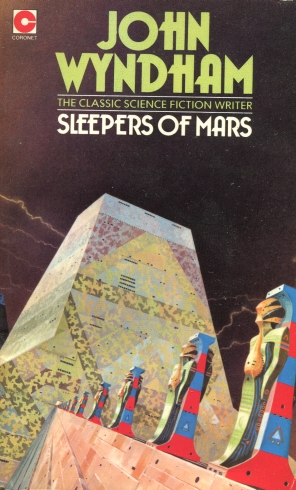
Sleepers Of Mars
- Автор: Уиндем Джон Паркс Лукас Бейнон Харрис
- Год: 1977
- Язык: английский
- Год: Coronet Books/Hodder & Stoughton Ltd
- ISBN: 0340173262
- Жанр: Научная фантастика

Электронная книга - «Sleepers Of Mars». Краткое содержание книги:
Of course, we are now well used to the idea of Man On The Moon, we have become blasé as to the possibilities of inter-planetary travel. But imagine two expeditions to Mars, one British, the other Russian, both in the process of discovering a mechanical race, invented and produced by the Martians as they believe their specie to be dying.
The other four novellas in this collection give further evidence of John Wyndham’s genius at invention, characterisation and sense of movement.
But they could not let go of life even now. There was an aspect of their state which reduced them to little more than ingenious mechanical creatures, driven on by some external power. It was, they thought, their own will that they should survive. But was it? Here they were, still struggling on in the face of the fact that they knew they could not survive.
It suggested uncomfortably that man was the driven and not the driver. And the comparison between the end of Mars and the end of Earth was inescapable. It was in that that the real pang of depression lay for the Tovaritch’s crew. After the first few days they had found themselves subconsciously asking: What’s the use?
Indeed, what was the use? Why civilise? Why build? Why try to live by a code? Why try to cross space? Why do anything if I this was to be the end of it all? They were faced with the realisation of what must come to Earth one day, as it had already come to Mars. If that were all, the logical thing would be to end it here and now. But they did not. Even more urgently than the Martians, they were driven to working out their existences. Why? And the realisation, for the first time driven home, that they had not the slightest idea why, was knocking a lot of the conceit out of four specimens of the lords of creation.
The longer they were forced to stay on this desiccated, shrivelling planet, the more powerful became the sense of their own impotence and futility. The Martians, who knew so much more than they, had been able to do nothing but stave off extinction for a few millennia—what more could Earth hope to achieve?
And that was supposing there would still be men on Earth when she should reach this stage. Soantin thought that even that would be unlikely.
‘Yours is a larger planet, with a longer life,’ he had said once. ‘Evolution will have more time to work.’ And he went on to suggest that there would probably be several successors to man, as different from him, perhaps, as he had been from the dinosaurs. It was a theory which was scarcely kinder to the vanity of his listeners than was the prospect of their race dying with their planet.
Nothing seemed worth while any longer. The Martians had attempted a way out by constructing the machines. These, they said, would be their successors, the heirs to their knowledge. Life, of a sort, created by their intelligence, would go on on Mars long after man was gone—for the machines, Soantin assured them, were alive. They were rational beings, though simple as yet. They were built of metal, because that had been the easiest and most durable material in which to work; nevertheless, they were alive, and would develop in time.
They had been made independent of their surroundings to a greater extent than any naturally evolved organism. There was something animal, but more vegetable, in the basis of their existence. Temperature and lack of air did not affect them. As long as they had water and sunlight they could, by processes of photo synthesis, go on.
But how much did that mean? Gordonov had asked himself. The humanity of man was lost, even though his productions should survive him—and even that was just another procrastination. When the water gave out, when the sun should grow cold, the end would come just the same…. Why bother about them? That summed up the feeling that the place had engendered in him : why bother? But the devil of it was that one did bother, and went on bothering.
Vinski had spoken for them all when he said the sooner they got away the better. It would not solve anything, but once they were out of the place the inevitable end would seem less near and less real.
Where have the others gone?’ Vinski asked.
‘I don’t know,’ Gordonov told him, without moving his eyes from the screen. ‘The hospital, I expect. The place seems to have an unholy fascination for Platavinov.’
Scarcely surprising, considering he’s a doctor. You spent several days in the engineering shops yourself.’
‘I certainly did. And nearly went mad as a result. If these people had been content to use only simple things like steam, oil and electricity, I might have picked up some useful hints, but this weird form of power they used for all the big jobs just leaves me guessing.’
‘It must be quite easily comprehensible really,’ Vinski said. ‘After all, our present use of electricity would be pretty bewildering to an engineer of two centuries ago.’
‘A lot of help that is. Of course, it’s comprehensible if you’ve got somebody to explain the basic principles; but I haven’t, and I can’t find anywhere to begin. If I’d kept on it any longer, I’d have had a brain-storm. Since then I’ve kept away from the damned stuff as much as possible. Unless that hospital’s a lot simpler than the workshops we shall be having to tie Platavinov down before long.’
‘You needn’t worry about him. The place has less effect on him than on any of us. Zhatkin go with him?’
‘Sure; he gets bored in here, but he can’t stand wandering round on his own. Says every corner of Ailiko’s crammed full of ghosts, so he trailed along with the doctor for company.’
The two made a meal of synthetic foods. After it, Gordonov went back to his occupation of watching the repair work through the visi-screen. Vinski, too, watched for a time, but soon became tired of it. He picked up the silvery suit from the floor and pulled it on again.
‘I think I’ll just go along and see what they’re up to,’ he said. ‘It’s better than hanging about here.’
He took up his helmet and went out. Gordonov nodded, but did not trouble to reply.
There were two ways of getting about Ailiko. Either one passed through the building’s main airlock into the open street, or one went down to the underground passages which connected the various buildings. In the days of occupation the passages had, it was obvious, been filled with air, making it possible for the inhabitants to go about all over the city without using space-suits; now there was little to choose, for the passages had no more air than the outer surface.
Nevertheless, Vinski elected to go below ground, for it offered a more direct route to the hospital. He left the lift at its lowest level, fastened the transparent, domed helmet over his head and adjusted the air supply. Then he stepped into the lock which prevented the air from the building from leaking out into the empty passages.
It was a lonely walk under the dim roof lights. He scarcely blamed Zhatkin for his nervousness and talk of ghosts. Many a time in these passages, and in the deserted rooms, halls and galleries of Ailiko, he had himself had to fight down a sudden attack of panic. Even out in the streets, under the purple sky, one was not free from these rushes of alarm.
It came, he supposed, partly from the readiness of the city to spring to life again. With nothing dismantled, nothing destroyed and everything capable of being put into use again, it was hard to realise that it had indeed been abandoned for ever.
There was no difficulty about finding his way. He had been to look at the empty hospital before, and he carried a card upon which Platavinov had written out translations of the notices occurring in the passages. One had only to identify the lettering over the various locks and refer to the card to see which building had been reached.
But it did not prove necessary for him to go all the way to the hospital to find the others. Half a mile before he reached it he saw them coming towards him down the long corridor. The light was playing in subdued reflections upon their helmets and silver suits, and upon something which they carried between them.
He met and greeted them. It was necessary to speak loudly when wearing the helmets, for though the transmitting diaphragms set in them were sensitive, the air was thin to carry the sound.