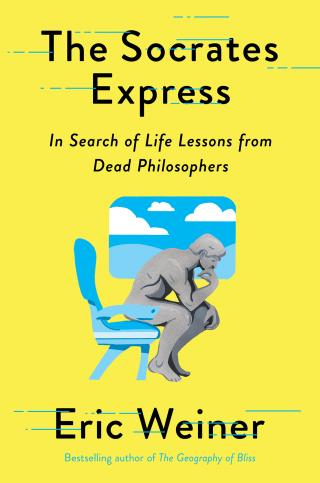
The Socrates Express
- Автор: Вейнер Эрик
- Год: 2020
- Язык: английский
- Год: Avid Reader Press / Simon & Schuster
- Жанр: География, путевые заметки

Электронная книга - «The Socrates Express». Краткое содержание книги:
We contemplate for the same reasons we travel: to see the world from a different perspective, to unearth hidden beauty and find new ways of being. We want to learn how to embrace wonder. Face regrets. Sustain hope.
Eric Weiner, *New York Times* bestselling author of *The Geography of Bliss* , combines his twin passions for philosophy and global travel in a pilgrimage that uncovers surprising life lessons from philosophers around the world, from Marcus Aurelius to Arthur Schopenhauer, Confucius to Montaigne. Traveling by train (the most thoughtful mode of transport) he traversed thousands of miles, making stops in Athens, Delhi,...
Most philosophers were unlucky in love. I could not be luckier. My wife, Sharon, stood by me during thick and thicker. She read rough first pages and, with her love and encouragement, gave me my second, third, and fourth winds. I could not have written this book without her.
More from the Author
The Geography of Genius
About the Author
ERIC WEINER is an award-winning journalist, bestselling author, and speaker. A philosophical traveler, he writes about the intersection of place and idea. His books include the bestselling The Geography of Bliss and The Geography of Genius, as well as the spiritual memoir Man Seeks God. They’ve been translated into more than twenty languages. A former foreign correspondent for NPR, he is a regular contributor to the Washington Post and AFAR, among other publications. He lives in the Washington, D.C., area, with his wife, daughter, and a menagerie of rambunctious cats and dogs.
AvidReaderPress.com
SimonandSchuster.com
www.SimonandSchuster.com/Authors/Eric-Weiner
@avidreaderpress @avidreaderpress @avidreaderpress
ALSO BY ERIC WEINER
The Geography of Bliss
Man Seeks God
The Geography of Genius
We hope you enjoyed reading this Simon & Schuster ebook.
Get a FREE ebook when you join our mailing list. Plus, get updates on new releases, deals, recommended reads, and more from Simon & Schuster. Click below to sign up and see terms and conditions.
CLICK HERE TO SIGN UP
Already a subscriber? Provide your email again so we can register this ebook and send you more of what you like to read. You will continue to receive exclusive offers in your inbox.
Notes
In the interest of keeping the endnotes relatively brief, I’ve cited only secondary sources here, as well as clarified points of controversy. Primary sources—the words of the philosophers themselves—can be found in the bibliography.
INTRODUCTION: DEPARTURE
“Knowledge is knowing that a tomato”: Cited in Gyles Brandreth, ed., Oxford Dictionary of Humorous Quotations (Oxford, UK: Oxford University Press, 2013), 84.
“misliving”: William Irvine, A Guide to the Good Life: The Ancient Art of Stoic Joy (New York: Oxford University Press, 2009), 13.
“radical reflection”: Maurice Merleau-Ponty, The Phenomenology of Perception, trans. Donald Landes (New York: Routledge, 2012), xxxv.
“life-enhancing poetry”: Daniel Klein, Foreword to Epicurus: The Art of Happiness (New York: Penguin, 2012), viii–ix.
“Sooner or later”: Quoted in Robert Solomon, The Joy of Philosophy: Thinking Thin versus the Passionate Life (New York: Oxford University Press, 1999), 10.
1: HOW TO GET OUT OF BED LIKE MARCUS AURELIUS
We have a common enemy: Marcus and I both follow the path of Portuguese poet Fernando Pessoa. “The essence of my desire is simply this: to sleep away life,” he said. The Book of Disquiet, trans. Richard Zenith (New York: Penguin, 2002), 428.
Suicide, said the French: Albert Camus, The Myth of Sisyphus and Other Essays, trans. Justin O’Brien (New York: Vintage, 1983), 3.
The Scottish philosopher: David Hume, A Treatise of Human Nature (New York: Penguin, 1985), Book III, Part I.
Later, enamored of the Greek: Frank McLynn, Marcus Aurelius: A Life (Cambridge, MA: Da Capo Press, 2009), 21.
“his constant strivings”: Ibid. 251.
possibly laced with opium: A good deal of controversy surrounds the question of whether Marcus was ingesting, and possibly addicted to, opium. See Thomas Africa, “The Opium Addiction of Marcus Aurelius,” Journal of the History of Ideas 22, no. 1 (1961): 97–102.
Marcus had no intention: “To Myself” is a more faithful translation of the title than Meditations.
“a self-help book”: Gregory Hays, Introduction to Marcus Aurelius, Meditations (New York: Penguin, 2002), xxxvii.
“someone in the process”: Pierre Hadot, Philosophy as a Way of Life (Oxford, UK: Blackwell), 251.
2: HOW TO WONDER LIKE SOCRATES
Train of thought: I had assumed that, like “off the rails,” the expression “train of thought(s)” was born of the railroad age. It was not. The phrase was coined by the English philosopher Thomas Hobbes in 1651—more than a century before the first railroad.
“Our culture has generally tended to solve”: Jacob Needleman, The Heart of Philosophy (San Francisco: Harper & Row, 1982), 7.
“He seems to have entered”: Peter Kreeft, Philosophy 101 by Socrates (San Francisco: Ignatius Press, 2002), 25.
Socrates was a practitioner of: Drukpa Kunley, a fifteenth-century Buddhist monk, was perhaps the most famous practitioner of Crazy Wisdom. He called his penis “The Thunderbolt of Flaming Wisdom” and is credited with initiating the practice in Bhutan (still in vogue today) of painting phalluses on buildings to ward off evil spirits.
“with a big, round”: Needleman, The Heart of Philosophy, 153.
“great, smooth forehead”: Ibid, 153.
“marvelous new naiveté”: Karl Jaspers, The Great Philosophers (New York: Harcourt, Brace, 1957), 31.
“Every question is a cry”: Carl Sagan, The Demon-Haunted World: Science as a Cradle in the Dark (New York: Ballantine, 1996), 323.
“Socrates was the first”: Quoted in Paul Johnson, Socrates: A Man for Our Times (New York: Penguin, 2002), 81–82.
“Enlightened kibitzing”: Solomon, The Joy of Philosophy, 14.
“All philosophy begins with”: Centuries later, Ralph Waldo Emerson added, correctly, that “[w]onder is the seed of science.”
“One time at dawn he”: Quoted in James Miller, Examined Lives: From Socrates to Nietzsche (New York: Farrar, Straus & Giroux, 2011), 42.