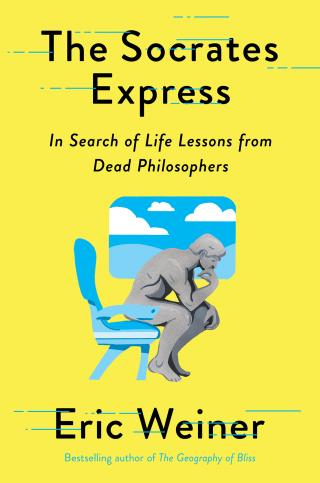
The Socrates Express
- Автор: Вейнер Эрик
- Год: 2020
- Язык: английский
- Год: Avid Reader Press / Simon & Schuster
- Жанр: География, путевые заметки

Электронная книга - «The Socrates Express». Краткое содержание книги:
We contemplate for the same reasons we travel: to see the world from a different perspective, to unearth hidden beauty and find new ways of being. We want to learn how to embrace wonder. Face regrets. Sustain hope.
Eric Weiner, *New York Times* bestselling author of *The Geography of Bliss* , combines his twin passions for philosophy and global travel in a pilgrimage that uncovers surprising life lessons from philosophers around the world, from Marcus Aurelius to Arthur Schopenhauer, Confucius to Montaigne. Traveling by train (the most thoughtful mode of transport) he traversed thousands of miles, making stops in Athens, Delhi,...
I exit the train and walk a few blocks. I do not stroll like Rousseau or saunter like Thoreau. Mine is the hurried gait of the commuter.
I’m standing on a street corner, waiting for the Walk sign. I can’t endure twenty seconds without external stimuli, so I reach for my smartphone. I fumble (I wasn’t paying attention) and it slips from my hands, landing on the pavement hard, screen first. This can’t be good.
Sure enough, the screen has shattered. A spiderweb of fissures radiates from ground zero in the upper left corner. Shards of glass protrude. I attempt to text my wife but quit after a few letters, bleeding profusely.
There are people who handle life’s minor setbacks with aplomb. As you’ve probably surmised by now, I am not one of these people. The shattered screen is a sign, I conclude, and not a propitious one. There was, I calculate, only a one-in-two chance of my phone landing screen-down, and yet it did. Case closed. The universe is out to get me. Like a locomotive, the shattered phone pulls along boxcars of melancholia and angst. The broken phone signifies a broken life. It is Schopenhauer’s Will at work, devouring everything in its path, including me. Where is my “portion of the infinite,” as Thoreau called it?
I spend the next several minutes pouting and cursing and googling “shattered screen” on my shattered phone. I must have lost a pint of blood.
Then I surprise myself. I pause. Not a Socratic Mighty Pause—more of a mini-pause—but a start. The pause invites questions, and wonder. I wonder why, having spent the past few years imbibing the life-enhancing poetry of fourteen of history’s greatest thinkers, it hasn’t occurred to me to consult them. If philosophy can’t help me navigate this mini-crisis, what good is it?
I hear voices. Comforting voices. Chiding voices. Wise voices. Socrates urges me to stop and question my assumptions. I assume my smartphone is necessary for my happiness, my eudaimonia, but is it? Like so many, I strive to achieve ever-greater connectivity at ever greater speeds, but rarely stop to question the assumption that connectivity and speed are inherently good. I don’t know this to be true, Socrates reminds me. Is the demise of my smartphone catastrophic? Maybe, maybe not.
Epicurus spits at my so-called crisis. My phone was neither a natural nor necessary pleasure. Good riddance. Sei Shōnagon reminds me that the phone, like the cherry blossom, is impermanent. Accept that fact. Celebrate it. The Stoics, naturally, dispense no pity. Had I practiced premeditated adversity, I would have seen this coming. I can’t control the events that led to my broken phone, but I can control my reaction. I can assent to my “pre-emotion” or not. I can sulk or not. It is my choice. Man up!
So many voices. They threaten to overwhelm my own. I retreat to a coffee shop: nothing special, but good enough. Squirrelling a few of Thoreau’s “fugitive moments,” as he called these stray bits of time, I let my eyes linger on the shattered screen. I don’t look more closely, not exactly. I look differently. First from this angle, then that. I am not so much looking at my broken phone as conversing with it. Seeing is a dialogue—usually a humdrum one, but occasionally the discourse takes on a poetic quality. For someone like Thoreau, fluent in the language of the eye, life was one continuous poem.
After a few minutes, I see—and I know this sounds weird—art. Not MOMA art, but art nonetheless. The way the shards form shapes and patterns: triangles and rectangles and rhomboids, too. The way, seen as a whole, the screen resembles a stained-glass window I once saw in a Florentine church. Collateral beauty, right before my eyes.
I tuck my phone—my beautiful, broken phone—into my pocket and walk home, grateful for the visual verse I had just experienced. Mine is not a full poem. A stanza, perhaps, but I’ll take it. My portion of the infinite, at last.
What had changed? Not my phone. It is still shattered. Not the laws of nature. They are immutable. My conversation with myself had changed. I thought otherwise, so I saw otherwise. It was the slightest shift in perspective; tiny, really, but as Sei Shōnagon reminds me, there is great power, and beauty, in the small.
As I walk, one last voice rises above the rest. It is not speaking to me. It is shouting! Nietzsche. He reminds me I will walk this selfsame street again and again. I will fumble my phone and it will fall—facedown every time. Forever. I will bleed and I will fret, again, and for all eternity. Can you live with that? he asks. Can you love that?
As I walk, my answer materializes. Two short words: foreign yet familiar, absurd yet plausible, more real than real. Da capo.
Again, again.
Acknowledgments
Socrates believed philosophy is a group activity. So, too, is writing a book about philosophy, as I discovered. Throughout my journeys, from New Delhi to New York, friends and strangers alike provided insight and inspiration, support and succor. I am deeply grateful to each of them.
In the early stages of my research, Stanford University professors Ken Taylor and Rob Reich graciously offered their time and wisdom. Later, Tim LeBon channeled the ancient Stoics over lunch in New York, and Rob Colter kindly agreed to enroll me in Stoic Camp in the wilds of Wyoming. In Concord, Massachusetts, Richard Smith, Michael Frederick, and Tom Blanding generously shared their insights into all things Thoreau. New York University professor Moss Roberts enlightened me about Confucius.
Farther afield, in Paris, Gunter Gorhan and Catherine Monnet shared their philosophical insights with me over café au lait and croissants. In Athens, I was fortunate enough to break bread with the savant Brady Kiesling, as well as a pair of top-notch Epicureans: Christos Yapijakis and Elli Pensa. In Switzerland, Roland Kaehr helped me follow in Rousseau’s footsteps, and Peter Villwock in Nietzsche’s. In Tokyo, the great Junko Takahashi provided guidance, translations, and good company.
Authors, like philosophers, need a place to think, and write. I am grateful to the Virginia Center for the Creative Arts for providing just such a place. In New York, David and Abby Snoddy graciously supplied me with a room of my own, as well as sake and camaraderie.
My research assistants, Alyson Wright and Alec Siegel, dug tirelessly, finding the right person in the right place, and unearthing hidden philosophical gems, too. John Lister and Josh Horwitz read early drafts of this book and offered valuable suggestions.
No less important was the moral support proffered by friends and strangers. My informal clutch of writer-friends, the Writers Who Lunch, supplied a steady diet of encouragement and curry. Friends Stefan Gunther, Lisa Goldberg, Laura Blumenfeld, and Jacki Lyden steadied me whenever the winds of self-doubt reached gale force. A special shout-out to my Bulgarian publisher, and friend, Neyko Genchev, for painstakingly translating my words and attracting so many readers in his corner of the globe.
My agent, Sloan Harris, believed in the project from the outset, and never wavered in his support. I am grateful for that, as well as his wise counsel. I owe a particular debt to Ben Loehnen, my editor at Simon & Schuster’s Avid Reader Press, for his faith in me and my book, and for wielding his razor-sharp editorial knife with skill and kindness. Avid Reader’s Carolyn Kelly expertly shepherded my manuscript through the editorial gauntlet. Thank you to Simon & Schuster’s president and publisher, Jonathan Karp, for being Jonathan Karp.
A big thank-you to my daughter, Sonya. She tolerated my absences from home, as well as my many annoying philosophical questions. On the road, she was a good sport, even when the sport was not of her choosing. She is my foil and my muse. This book is for her, too.