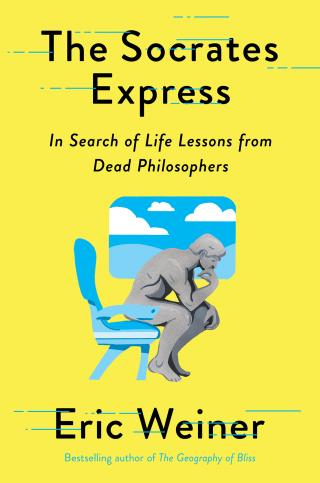
The Socrates Express
- Автор: Вейнер Эрик
- Год: 2020
- Язык: английский
- Год: Avid Reader Press / Simon & Schuster
- Жанр: География, путевые заметки

Электронная книга - «The Socrates Express». Краткое содержание книги:
We contemplate for the same reasons we travel: to see the world from a different perspective, to unearth hidden beauty and find new ways of being. We want to learn how to embrace wonder. Face regrets. Sustain hope.
Eric Weiner, *New York Times* bestselling author of *The Geography of Bliss* , combines his twin passions for philosophy and global travel in a pilgrimage that uncovers surprising life lessons from philosophers around the world, from Marcus Aurelius to Arthur Schopenhauer, Confucius to Montaigne. Traveling by train (the most thoughtful mode of transport) he traversed thousands of miles, making stops in Athens, Delhi,...
“the cult of beauty”: Ivan Morris, The World of the Shining Prince: Court Life in Ancient Japan (New York: Vintage, 1964), 170.
“proper thickness, size, design”: Ibid., 187.
“smart, good-looking”: Ibid., 188.
“to demonstrate that things can be”: Ullrich Haase, Starting with Nietzsche (New York: Continuum, 2008), 25.
“The man who for the first time”: Hermann Hesse, My Belief: Essays on Life and Art (New York: Farrar, Straus & Giroux, 1974).
11: HOW TO HAVE NO REGRETS LIKE NIETZSCHE
“had none of the searching”: Quoted in Curtis Cate, Friedrich Nietzsche (New York: Overlook Press, 2005), 328.
“a piece of pseudo-aesthetic”: Friedrich Ritschl, quoted in Miller, Examined Lives, 326.
“Perhaps no one”: Stefan Zweig, Nietzsche, trans. William Stone (London: Hesperus), 54.
“where doubts and rebellion grow”: Robert Solomon and Kathleen Higgins, eds., Reading Nietzsche (New York: Oxford University Press, 1988), 4.
there are many more combinations: Sometimes a higher number, 255,168, is cited, but that refers to the number of possible sequences, not games per se. See Steve Schaefer, “MathRec Solution (Tic-Tac-Toe): Mathematical Recreations (2002),” http://www.mathrec.org/old/2002jan/solutions.html.
In chess, considerably more games: For an explanation of how this number is arrived at, see David Shenk’s The Immortal Game: A History of Chess (New York: Anchor, 2007), 69–70.
what one scholar calls: Maudemarie Clark, Nietzsche on Truth and Philosophy (New York: Cambridge University Press, 1990), 270.
a hearty Da capo!: An Italian musical term, Da capo means “from the beginning” (literally, “from the head”).
like Sisyphus happy: “We must imagine Sisyphus happy,” Albert Camus said in his essay “The Myth of Sisyphus.”
most likely due to syphilis: Possibly contracted during a trip to a brothel when he was a young man.
“an experiment in reorienting”: R. J. Hollingdale, ed., A Nietzsche Reader (New York: Penguin, 1977), 11–12.
12: HOW TO COPE LIKE EPICTETUS
including George Washington and John Adams: Carl Richard, “The Classical Founding of American Roots,” in Daniel Robinson and Richard Williams, eds., The American Founding: Its Intellectual and Moral Framework (New York: Continuum, 2012), 47.
“I had a good voyage”: Laertius, Lives of the Eminent Philosophers, 314.
“No tree becomes rooted and sturdy”: Quoted in Donald Robertson, Stoicism and the Art of Happiness: Practical Wisdom for Everyday Life (New York: McGraw-Hill, 2013), vii.
James Stockdale, an American pilot: See James Stockdale, Thoughts of a Philosophical Fighter Pilot (Stanford, CA: Hoover Institution Press, 1995).
“We don’t typically get angry”: A. A. Long, From Epicurus to Epictetus (New York: Oxford University Press, 2006), 379.
Forgoing pleasure is one of life’s: As William Irvine says, “Leave it to the Stoics to realize the act of forgoing pleasure can itself be pleasant.” Irvine, A Guide to the Good Life, 117.
“rehearse them in your mind”: Seneca, quoted in Antonia Macaro, “What Can the Stoic Do for Us,” in Patrick Ussher, ed., Stoicism Today: Selected Writing I (Stoicism Today, 2014), 54.
“Let your tears flow, but let them also cease”: Quoted in Irvine, A Guide to the Good Life, 154.
“Do you suppose that wisdom”: Quoted in William Stephens, “A Stoic Approach to Travel and Tourism,” Modern Stoicism, November 24, 2018, https://modernstoicism.com/a-stoic-approach-to-travel-and-tourism-by-william-o-stephens/.
I turn to Epictetus: Epictetus died in AD 135. Mourners heralded him as a “friend of the immortals.” He had inspired a Roman emperor. He would inspire Shakespeare and birth a form of psychotherapy, cognitive behavioral therapy, that is still practiced today. Not bad for a former slave.
13: HOW TO GROW OLD LIKE BEAUVOIR
“Chronological age is not”: Jan Baars, Aging and the Art of Living (Baltimore: Johns Hopkins University Press, 2012), 52.
“The utter daring!”: Quoted in Claude Francis and Fernande Gontier, Simone de Beauvoir: A Life, a Love Story (Paris: Librairie Académique Perrin, 1985), 359.
The word “work”: Francis and Gontier, Simone de Beauvoir, 198.
“Everyone hopes to reach”: Marcus Cicero, How to Grow Old: Ancient Wisdom for the Second Half of Life, trans. Philip Freeman (Princeton, NJ: Princeton University Press, 2016), 11.
“I don’t recognize”: Martha Nussbaum and Saul Levmore, Aging Thoughtfully: Conversations About Retirement, Romance, Wrinkles & Regret (New York: Oxford University Press), 19.
“His movement is quick”: Jean-Paul Sartre, Being and Nothingness, trans. Hazel Barnes (New York: Washington Square Press, 1992), 101.
And it was Sylvie who rescued: Friends, worried Beauvoir might commit suicide, wouldn’t leave her alone. She fell physically ill, too. She spent a month in the hospital, suffering from pneumonia and cirrhosis of the liver, the result of a lifetime of heavy drinking. When Beauvoir was discharged, she agreed to a strict health regime, and eliminated all her vices, save Scotch and vodka. “I need those,” she said. Sylvie secretly watered down her Scotch, just as Beauvoir had done for Sartre.
“It was as if she had put it all behind her”: Quoted in Deirdre Bair, Simone de Beauvoir: A Biography (New York: Touchstone, 1990), 588.
“At my age”: Quoted in Wayne Booth, ed., The Art of Growing Older: Writers on Living and Aging (Chicago: University of Chicago Press, 1992), 159.
“the certainty of a crushing”: Camus, The Myth of Sisyphus and Other Essays, 54.
“wider and more impersonal”: Bertrand Russell, “How to Grow Old,” in Portraits from Memory and Other Essays (Nottingham: Spokesman Books, 1995), 52.
The person who departs this world: Many of the philosophers I’ve encountered are good role models in this regard, especially Thoreau. Says author William Cain: “He persisted with his journal until serious illness intervened, and on his deathbed he was still writing: adding to his calendar of flowers and shrubs, compiling lists of birds, making selections from his journals, and preparing articles from his journals.” William Cain, ed., A Historical Guide to Henry David Thoreau (New York: Oxford University Press, 2000), 4.
14: HOW TO DIE LIKE MONTAIGNE
at an alarming rate: It was one such slaughter, in which ten thousand Protestants were killed, that gave the world a new word, massacre, from the Old French for butchery.