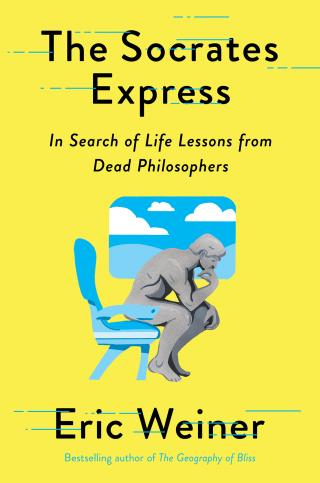
The Socrates Express
- Автор: Вейнер Эрик
- Год: 2020
- Язык: английский
- Год: Avid Reader Press / Simon & Schuster
- Жанр: География, путевые заметки

Электронная книга - «The Socrates Express». Краткое содержание книги:
We contemplate for the same reasons we travel: to see the world from a different perspective, to unearth hidden beauty and find new ways of being. We want to learn how to embrace wonder. Face regrets. Sustain hope.
Eric Weiner, *New York Times* bestselling author of *The Geography of Bliss* , combines his twin passions for philosophy and global travel in a pilgrimage that uncovers surprising life lessons from philosophers around the world, from Marcus Aurelius to Arthur Schopenhauer, Confucius to Montaigne. Traveling by train (the most thoughtful mode of transport) he traversed thousands of miles, making stops in Athens, Delhi,...
“If you do not annoy”: Kreeft, Philosophy 101 by Socrates, 63.
“planting a puzzle”: Ibid., 37.
“Men pummeled [Socrates]”: Diogenes Laertius, Lives of the Eminent Philosophers, trans. Pamela Mensch (New York: Oxford University Press, 2018), 71.
“The moment of insight”: Karen Armstrong, The Great Transformation: The Beginning of Our Religious Traditions (New York: Random House, 2006), 307.
“like the sensation”: Leo Tolstoy, The Death of Ivan Ilyich, trans. Louise and Aylmer Maude (Bulgaria: Demetra, 1886), 88.
I am embarking on a: Michel de Certeau, The Practice of Everyday Life (Berkeley: University of California Press, 1984), 115.
“Generosity just flows”: Solomon, The Joy of Philosophy, 76.
“Ask yourself if you are happy”: John Stuart Mill, Autobiography (CreateSpace, 2018), 49.
3: HOW TO WALK LIKE ROUSSEAU
“The flowers by the side”: Quoted in Wolfgang Schivelbusch, The Railway Journey: The Industrialization of Time and Space in the 19th Century (Oakland: University of California Press, 2014), 55.
“All traveling becomes dull”: Quoted in Schivelbusch, The Railway Journey, 58.
“follow this way or that”: Robert Louis Stevenson, Robert Louis Stevenson’s Thoughts on Walking (London: Read Books, 2013), 5.
“A difficult friend”: Leo Damrosch, Jean-Jacques Rousseau: Restless Genius (New York: Houghton Mifflin, 2005), 4.
The Pentagon recently developed: Joseph Amato, On Foot: A History of Walking (New York: New York University Press, 2004), 257.
“I could not imagine the malice”: Maurice Merleau-Ponty, The World of Perception, trans. Oliver Davis (New York: Routledge, 2004), 63.
“a book that is and is not”: Rebecca Solnit, Wanderlust: A History of Walking (New York: Penguin, 2000), 20.
“to roll about, toss”: John Ayto, Word Origins: The Secret History of English Words from A to Z (London: A. & C. Black, 1990), 539.
About six million years ago: This is an estimate. Anthropologists are uncertain exactly when, or why, primates first took to two feet. For an overview of the research, see Erin Wayman, “On Becoming Human: The Evolution of Walking Upright,” Smithsonian, August 6, 2012. https://www.smithsonianmag.com/science-nature/becoming-human-the-evolution-of-walking-upright-13837658/.
“It requires spending three-fourths”: Amato, On Foot, 3.
“essentially unimproved”: Solnit, Wanderlust, 18.
“a nobleman’s carriage”: Damrosch, Jean-Jacques Rousseau, 485.
“imagination is more important”: Albert Einstein, in an interview with the Saturday Evening Post, October 26, 1929.
“sanctuary in time”: Abraham Heschel, The Sabbath (New York: Farrar, Straus & Giroux, 1951), 17.
4: HOW TO SEE LIKE THOREAU
stumbled upon: Kathryn Schulz, “Pond Scum,” New Yorker, October 12, 2015.
as the commuter train: I am riding the Fitchburg Line. It reached Concord in June 1844, just thirteen months before Thoreau moved to his cabin on Walden Pond.
“The biggest little place”: Henry James, Collected Travel Writings: Great Britain and America (New York: Library of America, 1993), 565.
the shot heard round the world: Most historians agree the phrase refers to the skirmish at Concord’s North Bridge on April 19, 1775. That’s where the first British soldiers fell in the battles of Lexington and Concord. However, shots were fired earlier that day in Lexington, and the two towns continue to dispute exactly where the Revolutionary War began.
“a certain iron-pokerishness”: Quoted in Sandra Petrulionis, ed., Thoreau in His Own Time: A Biographical Chronicle of His Life, Drawn from Recollections, Interviews, and Memoirs by Family, Friends, and Associates (Iowa City: University of Iowa Press, 2012), xxiv.
The scientist’s detached: The phrase “the view from nowhere” was coined by the contemporary philosopher Thomas Nagel and is the title of his 1986 book. Thoreau, though, was certainly aware of the concept of detached scientific observation, as well as the critiques of it.
“A world that makes room”: Roger Scruton, Beauty: A Very Short Introduction (New York: Oxford University Press, 2011), 55.
“fearless self-inspection”: H. H. Salt, animal rights advocate and an early biographer of Thoreau, quoted in Arthur Versluis, American Transcendentalism and Asian Religions (New York: Oxford University Press, 1993), 135.
“sit motionless”: Concord native Joseph Hammer, quoted in Versluis, American Transcendentalism and Asian Religions, 102.
“He walked as if a great deal”: Quoted in Petrulionis, Thoreau in His Own Time, 57.
“innocence of the eye”: The phrase is John Ruskin’s. Thoreau read Ruskin and was greatly affected by his thoughts on seeing. See John Ruskin, The Elements of Drawing (Mineola, NY: Dover, 1971), 27.
thoroughly conscious ignorance: The phrase comes from the nineteenth-century Scottish physicist James Maxwell. “Thoroughly conscious ignorance is a prelude to every real advance in knowledge.” Quoted in Stuart Friedman, “What Science Wants to Know,” Scientific American, April 1, 2012.
“I stopped and looked”: Quoted in Walter Harding, “The Adventures of a Literary Detective in Search of Thoreau,” Virginia Quarterly Review, Spring, 1992.
There’s a physiological basis: This is due to the fact that the light hits the more sensitive periphery of the rods.
a fun-pack of optical tricks: Thoreau, the great seer, didn’t care to see everything. When a farmer invited him to see a two-headed calf, Thoreau demurred. “We do not live for amusement,” he said.
thin, but very wide: As Wittgenstein said: “The depths are on the surface.”
The glance is helpful: Not all philosophers were fond of the glance. Kant dismissed it as herumtappen, “random groping.”
spiritual seeker named: Not to be confused with the English poet William Blake.
5: HOW TO LISTEN LIKE SCHOPENHAUER
“We cannot leave”: Nigel Warburton, Philosophy: The Basics (London: Routledge, 1992), 100.
“It is as if time had stopped”: Bryan Magee, The Philosophy of Schopenhauer (New York: Oxford University Press, 1983), 164.
Only in the last few years: Toward the end of Schopenhauer’s life, a British newspaper ran a favorable review of his collection of essays, and soon it became an ornamental must-have for every middle-class coffee table in Europe. His fame, though, came too late, and like a meal that’s taken too long to arrive, he couldn’t fully enjoy it.