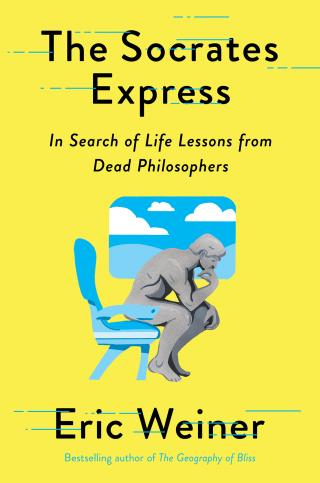
The Socrates Express
- Автор: Вейнер Эрик
- Год: 2020
- Язык: английский
- Год: Avid Reader Press / Simon & Schuster
- Жанр: География, путевые заметки

Электронная книга - «The Socrates Express». Краткое содержание книги:
We contemplate for the same reasons we travel: to see the world from a different perspective, to unearth hidden beauty and find new ways of being. We want to learn how to embrace wonder. Face regrets. Sustain hope.
Eric Weiner, *New York Times* bestselling author of *The Geography of Bliss* , combines his twin passions for philosophy and global travel in a pilgrimage that uncovers surprising life lessons from philosophers around the world, from Marcus Aurelius to Arthur Schopenhauer, Confucius to Montaigne. Traveling by train (the most thoughtful mode of transport) he traversed thousands of miles, making stops in Athens, Delhi,...
Sonya and I climb a circular staircase, the same one Montaigne climbed some 450 years ago. This is where he savored his solitude. I suspect Montaigne was, like me, an introvert capable of doing a decent extrovert imitation when circumstances demanded. We can fool the world, we outgoing introverts, but at a personal cost. All this feigned extroverting drains us. Exhausts us.
The tower is largely unchanged from Montaigne’s day. The three narrow windows overlooking the Aquitaine countryside are still here. So is Montaigne’s writing desk and his saddles. He loved everything about his tower. He loved the way it overlooked the family vineyard. He loved the quiet. He loved how, wherever he looked, his eyes alighted on a book.
His treasured library began with a gift from La Boétie, who insisted Montaigne accept the books as “a remembrance of your friend.” Montaigne did, reluctantly at first, hauling the books up the spiral stairs and carefully arranging them on shelves. He grew to love his library, and it grew, too. By the time of his death, Montaigne had amassed one thousand volumes.
He’d spend hours, days, in his tower, alone with his books and his thoughts. Distance mattered for Montaigne. Alone in his tower, he cleaved himself from the world out there, and, in a way, from himself, too. He took a step back in order to see himself more clearly, the way one half-steps away from a mirror. We are too close to ourselves to see ourselves. “We are all huddled and concentrated in ourselves, and our vision is reduced to the length of our nose,” he writes. So, move your nose. Stick it here, then there. Exterior distance makes interior closeness possible.
It was here, in his beloved tower, that Montaigne ended his conversation with the world and began one with himself. “It is time to turn my back on company,” he said, “and retire into my shell like a tortoise.”
I look up and see wisdom staring back at me: some fifty quotations carved into the rafters. Among the ancient sayings is one of Montaigne’s own: Que sais-je: “What do I know?” These four words neatly sum up his philosophy, and his way of life.
Montaigne was a Skeptic, in the word’s original meaning: not a naysayer who punctures the ideas of others for sport but a doubter in search of truth. Montaigne doubted so he could be certain. He built his tower of certainty one doubt at a time.
Humans, he thought, can never know absolute truth. The best we can do is snare provisional, contingent truths. Truth nuggets. These truth nuggets are not fixed but fluid. “Flutterings,” Montaigne calls them. You can flutter a long way though, and Montaigne did.
Montaigne, like Thoreau, had angular vision. He held up an idea and looked at it from various perspectives. He did this with everything, even his cat. Was he playing with his cat or was his cat playing with him? he wondered. That notion is pure Montaigne. Take something everyone knows—everyone thinks they know—and test it. Play with it. You think you know what death is, says Montaigne, but do you? Play with it.
Socrates did. Maybe death isn’t so bad, he wondered aloud after his death sentence was handed down. Maybe it is a pleasant “dreamless sleep,” or maybe there really is an afterlife. Wouldn’t that be great, said the gadfly of Athens, imagining himself happily spending eternity philosophizing and annoying people with his pesky questions.
Like Socrates, Montaigne was, by his own account, “an accidental philosopher.” A personal one, too. He amuses himself, irritates himself, and surprises himself. What I admire about Montaigne is how, rather than dismissing these thoughts as mindless fancies, he examines them. He took himself but not his philosophy seriously. “Know thyself,” the Greeks implore but don’t tell us how. Montaigne does. You know yourself by taking chances, making mistakes, then starting over, Sisyphus-like.
Montaigne needed a literary form for his accidental philosophy. None existed, so he invented one: the essay. From the French assay, it means “try.” An assay is a trial, an attempt. His essays are one giant attempt. At what? At getting to know himself. He couldn’t die well until he lived well and he couldn’t live until he knew himself.
Montaigne is no more linear on the page than in life. Like Sei Shōnagon, he is practicing zuihitsu: following his brush. He writes about cannibals and chastity, idleness and drunkenness, flatulence and thumbs. Salted meats, too. He writes about his itchy ears and his painful kidney stones. He writes about his penis. He writes about sleep and sadness, smells, friendship, children. He writes about sex and he writes about death. But the true subject of Montaigne’s book is Montaigne. “I presented myself to myself,” he says, calling it “a wild and monstrous plan.”
Humans excel at denying inconvenient truths, and no truth is more inconvenient than death. I look at death the way I look at my aging visage in the mirror. Sideways, if at all. A desperate, and futile, attempt to inoculate myself against its bite.
Montaigne thought avoidance comes at too high a price. When we avoid death, “every other pleasure is snuffed out.” We can’t live fully, he says, without facing death, our death, fully. “Let us rid it of its strangeness, come to know it, get used to it. Let us have nothing on our minds as often as death. At every moment, let us picture it in our imagination in all its aspects. At the stumbling of a horse, the fall of a tile, the slightest pinprick. Let us promptly chew on this: well, what if it was death itself?”
Death can come at any time, Montaigne reminds us, noting that the Greek playwright Aeschylus was supposedly killed by a falling tortoise shell dropped by an eagle. “We must always be booted and ready to go.”
I toggle between Montaigne’s tower and Saint-Émilion, one of those perfect little French towns that make you wonder why everyone isn’t French. It is just me and Montaigne. Sonya has retreated into Adolescent World, rarely emerging from the hotel. Each morning, I lug my copy of The Complete Essays of Montaigne, stretching to some 850 pages, and order a double espresso at a local café. It is a low-rent place, populated by chain-smokers steadying their morning beers on shaky tables. The café also does a brisk business in cheap wine and lottery tickets. I am drawn to these sorts of slovenly places. They make fewer demands of me. I can think more clearly.
Montaigne, I learn, is a fully embodied philosopher. He walks. He rides his horse. He eats. He fucks. What Henry Miller said of the philosopher Hermann von Keyserling holds true for Montaigne as well. “He is a thinker who attacks with the whole body, who emerges at the end of a book bleeding from every pore.”
Montaigne tells me he has a quick, firm walk, and that he is short and stocky. He has chestnut-brown hair, and a face “not fat but full.” He is proud of his teeth, straight and white. He loves poetry, hates the summer heat. He can’t bear the scent of his own sweat. He never has his hair cut after dinner. He likes to sleep in. He takes his time while defecating and hates to be interrupted. He is a poor athlete, save for horseback riding, in which he excels. He dislikes small talk. He loves chess and checkers but is inept at both. He dreams that he dreams. He has a poor memory. He eats quickly, greedily, occasionally biting his tongue or even a finger. He dilutes his wine with water, like the ancient Greeks.
Montaigne’s is a patchwork philosophy, a quilt of borrowed ideas. He puts his stamp on them, makes them his own. Montaigne trusts his own experience in a way we—I—do not.
It took him a while. The earlier essays “smelt a little of the property of others,” he says, but with each page he grows more confident, bolder. I find myself rooting for him. I do so even when he dings me for snoozing during one of his long digressions. (“It’s the inattentive reader who loses my subject, not I.”) I applaud as he finds his voice. Though trained to borrow and beg, he says, we are each “richer than we think.”