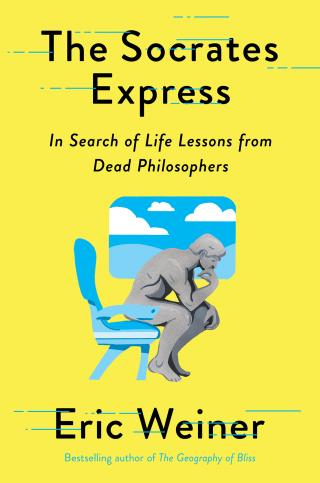
The Socrates Express
- Автор: Вейнер Эрик
- Год: 2020
- Язык: английский
- Год: Avid Reader Press / Simon & Schuster
- Жанр: География, путевые заметки

Электронная книга - «The Socrates Express». Краткое содержание книги:
We contemplate for the same reasons we travel: to see the world from a different perspective, to unearth hidden beauty and find new ways of being. We want to learn how to embrace wonder. Face regrets. Sustain hope.
Eric Weiner, *New York Times* bestselling author of *The Geography of Bliss* , combines his twin passions for philosophy and global travel in a pilgrimage that uncovers surprising life lessons from philosophers around the world, from Marcus Aurelius to Arthur Schopenhauer, Confucius to Montaigne. Traveling by train (the most thoughtful mode of transport) he traversed thousands of miles, making stops in Athens, Delhi,...
Patient people are happier: Sarah Schnitker, “An Examination of Patience and Well-Being,” Journal of Positive Psychology 7, no. 4 (2012): 263–80.
“In a moment everything is altered”: Iris Murdoch, The Sovereignty of Good (New York: Routledge & Kegan Paul, 1970), 82.
“philosopher of margins”: A. Rebecca Rozelle-Stone and Benjamin David, “Simone Weil,” Stanford Encyclopedia of Philosophy, March 10, 2018.
“She was boiling with ideas”: Pétrement, Simone Weil, 492.
“But she is mad!”: Quoted in ibid., 514.
“The steadiness of her writing”: Ibid., 521.
“freewheeling, tequila-soaked”: Mary Karr, Twitter: @marykarrlit, July 8, 2019.
fell into a funk: Despondent, Hemingway wrote to his friend Ezra Pound: “All that remains of my complete works are three pencil drafts of a bum poem… some correspondence… and some journalistic carbons.”
8: HOW TO FIGHT LIKE GANDHI
invented the concept of zero: Some scholars believe other cultures, including the Sumerians and Babylonians, may have invented the concept of zero earlier. For a summation of the various arguments, see: Jessica Szalay, “Who Invented Zero,” Live Science, September 28, 2017, https://www.livescience.com/27853-who-invented-zero.html.
surprised to find a fit: Louis Fischer, Gandhi: His Life and Message for the World (New York: New American Library, 1954), 149.
Gandhi considered it “unmanly”: Even Gandhi’s adversaries admired his courage. “A Lesson in True Manliness,” read the headline of one South African newspaper, after Gandhi forced the Transvaal government to back off from one of its demands.
“Have you no shame?”: Quoted in Fischer, Gandhi, 28.
“You have the right to work”: The Bhagavad Gita, trans. Eknath Easwaran (Tomales, CA: Nilgiri Press, 1985), 53.
“emerged from Gandhi’s hands”: Rajmohan Gandhi, Why Gandhi Still Matters: An Appraisal of the Mahatma’s Legacy (New Delhi: Aleph, 2017), 133.
Gandhi eventually settled: Gandhi had some help devising a new name for his form of nonviolent resistance. While in South Africa, he held a contest in the newspaper Indian Opinion. Gandhi tweaked the winning entry to come up with satyagraha.
“The officers ordered them”: Quoted in Homer Jack, ed., The Gandhi Reader: A Sourcebook of His Life and Writings (New York: Grove Press, 1956), 250–51.
In a comprehensive study: Erica Chenoweth and Maria Stephan, Why Civil Resistance Works: The Strategic Logic of Nonviolent Resistance (New York: Columbia University Press, 2011), 9.
movement to Euclid’s Line: This is what Gandhi had to say about the connection between his ideas and Euclid’s geometry: “Euclid’s line is one without breadth, but no one has so far been able to draw it and never will… if Euclid’s point, thought incapable of being drawn by human agency, has an imperishable value, my picture has its own for mankind to live.”
“What appears to be the end”: Mark Juergensmeyer, Gandhi’s Way: A Handbook of Conflict Resolution (Los Angeles: University of California Press, 1984), 4.
uttering the words Hey Ram: Lately, some have cast doubt on whether these were, in fact, Gandhi’s last words. His personal assistant, Venkita Kalyanam, claimed a decade ago Gandhi never uttered the words. More recently, he told the Press Trust of India: “I never said Gandhiji did not say ‘Hey Ram’ at all. What I had said was I did not hear him saying ‘Hey Ram.’ ” “Never said ‘Hey Ram’ Weren’t Bapu’s Last Words: Gandhi’s PA,” Times of India, January 30, 2018.
“To live with Gandhi”: A man identified as Chandwani, quoted in Manuben Gandhi, Last Glimpses of Bapu, trans. Moli Jain (Agra: Shiva Lal Agarwala, 1962), 253.
9: HOW TO BE KIND LIKE CONFUCIUS
He didn’t write it: Some uncertainty surrounds the question of what Confucius did and did not write. Most scholars believe The Analects was compiled by Confucius’s disciples well after his death.
“Swords and shields”: Michael Schuman, Confucius: And the World He Created (New York: Basic Books, 2015), 27.
“an uptight fuddy-duddy”: Ibid., 18.
“and you can turn the whole world”: Quoted in Philip Ivanhoe and Bryan Van Norden, eds., Readings in Classical Chinese Philosophy (Indianapolis: Hackett, 2003), 121.
“Do not roll the rice”: Quoted in Daniel Gardner, Confucianism: A Very Short Introduction (New York: Oxford University Press, 2014), 27.
“an island of kindness”: Adam Phillips and Barbara Taylor, On Kindness (New York: Farrar, Straus & Giroux, 2009), 105.
“All people have a heart”: Quoted in Paul Goldin, Confucianism (New York: Routledge, 2014), 46.
“Given the right nourishment”: Quoted in Armstrong, The Great Transformation, 304.
“Every spectacular incident”: Stephen Jay Gould, “A Time of Gifts,” New York Times, September 26, 2001.
Observing acts of kindness: Lara Aknin, Elizabeth Dunn, and Michael Norton, “Happiness Runs in Circular Motion: Evidence for a Positive Feedback Loop Between Prosocial Spending and Happiness,” Journal of Happiness Studies 13, no. 2 (2012): 347–55.
10: HOW TO APPRECIATE THE SMALL THINGS LIKE SEI SHŌNAGON
he created layers: One of Aristotle’s most famous works is called “Categories,” part of a larger collection known as the Organon.
“I perceive value”: Susan Sontag, As Consciousness Is Harnessed to Flesh: Journals and Notebooks, 1964–1980, ed. David Rieff (New York: Farrar, Straus & Giroux, 2012), 217.
“The list is the origin”: Umberto Eco, in an interview with Der Spiegel, November 11, 2009, https://www.spiegel.de/international/zeitgeist/spiegel-interview-with-umberto-eco-we-like-lists-because-we-don-t-want-to-die-a-659577.html.
“a crazy quilt”: Meredith McKinney, Introduction to The Pillow Book (New York: Penguin, 1997), ix.
okashii, or delightful: Today the Japanese word means “amusing” or “strange,” but in Shōnagon’s time it meant “delightful.”
“The most precious thing in life”: Yoshida Kenkō, Essays in Idleness, trans. Donald Keene (New York: Columbia University Press, 1998), 3.
“Beauty lies in its own”: Donald Richie, A Tractate on Japanese Aesthetics (Berkeley, CA: Stone Bridge Press, 2007), 4.
“He is paying attention to things”: Russell Goodman, “Thoreau and the Body,” in Thoreau’s Importance for Philosophy, ed. Rick Furtak et al. (New York: Fordham University Press, 2012), 33.