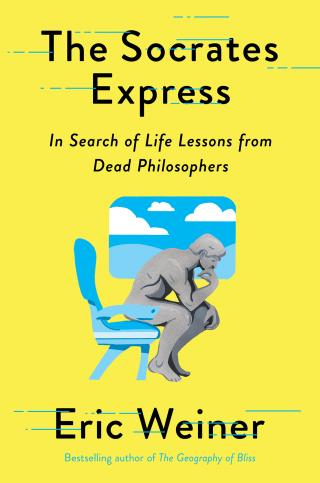
The Socrates Express
- Автор: Вейнер Эрик
- Год: 2020
- Язык: английский
- Год: Avid Reader Press / Simon & Schuster
- Жанр: География, путевые заметки

Электронная книга - «The Socrates Express». Краткое содержание книги:
We contemplate for the same reasons we travel: to see the world from a different perspective, to unearth hidden beauty and find new ways of being. We want to learn how to embrace wonder. Face regrets. Sustain hope.
Eric Weiner, *New York Times* bestselling author of *The Geography of Bliss* , combines his twin passions for philosophy and global travel in a pilgrimage that uncovers surprising life lessons from philosophers around the world, from Marcus Aurelius to Arthur Schopenhauer, Confucius to Montaigne. Traveling by train (the most thoughtful mode of transport) he traversed thousands of miles, making stops in Athens, Delhi,...
Thank you for downloading this Simon & Schuster ebook.
Get a FREE ebook when you join our mailing list. Plus, get updates on new releases, deals, recommended reads, and more from Simon & Schuster. Click below to sign up and see terms and conditions.
CLICK HERE TO SIGN UP
Already a subscriber? Provide your email again so we can register this ebook and send you more of what you like to read. You will continue to receive exclusive offers in your inbox.
For Sharon
“Sooner or later, life makes philosophers of us all.”
—MAURICE RISELING
INTRODUCTION
Departure
We are hungry. We eat and eat and eat some more, yet still we are hungry.
Sometimes we experience the hunger as a faint presence; other times, when the world is upended and fear roams unchecked, the hunger swells, and threatens to consume us.
We reach for our smartphones. With a swipe of a finger, we can access all human knowledge: from ancient Egypt to quantum physics. We gobble it up, but still we are hungry.
What is this hunger that cannot be sated? We don’t want what we think we want. We think we want information and knowledge. We do not. We want wisdom. There’s a difference. Information is a jumble of facts, knowledge a more organized jumble. Wisdom untangles the facts, makes sense of them, and, crucially, suggests how best to use them. As the British musician Miles Kington said: “Knowledge is knowing that a tomato is a fruit. Wisdom is not putting it in a fruit salad.” Knowledge knows. Wisdom sees.
The difference between knowledge and wisdom is one of kind, not degree. Greater knowledge does not necessarily translate into greater wisdom, and in fact can make us less wise. We can know too much, and we can mis-know.
Knowledge is something you possess. Wisdom is something you do. It is a skill and, like all skills, one you can learn. But it requires effort. Expecting to acquire wisdom by luck is like expecting to learn to play the violin by luck.
Yet that is essentially what we do. We stumble through life, hoping to pick up scraps of wisdom here and there. In the meantime, we’re confused. We mistake the urgent for the important, the verbose for the thoughtful, the popular for the good. We are, as one contemporary philosopher puts it, “misliving.”
I am hungry, too—more than most, I suspect, owing to a persistent melancholy that has shadowed me for as long as I can remember. Over the years, I’ve tried various means of satisfying the hunger: religion, psychotherapy, self-help books, travel, and a brief, and ill-fated, experiment with psychedelic mushrooms. Each method slaked the hunger, but never fully nor for long.
Then, one Saturday morning, I ventured to the underworld: my basement. That’s where I quarantine books deemed unfit for the living room. There, amid titles such as The Gas We Pass and Personal Finance for Dummies, I unearthed Will Durant’s 1926 book, The Story of Philosophy. It had real heft and, when I opened the cover, emitted an actual cloud of dust. I wiped it clean and began to read.
Durant’s words elicited no thunderclap of revelation, no road-to-Damascus moment. Something kept me reading, though. It was not so much the ideas embedded in the book as the passion with which they were presented. Durant was clearly a man in love, but with whom? With what?
“Philosopher,” from the Greek philosophos, means “lover of wisdom.” The definition says nothing about possessing wisdom any more than the Declaration of Independence says anything about obtaining happiness. You can love something you don’t possess, and never will. It is the pursuit that matters.
As I write these words, I am on a train. I am somewhere in North Carolina, or maybe South Carolina, I’m not sure. On a train, it’s easy to lose track of place, and of time, too.
I love trains. More precisely, I love riding trains. I am no “foamer”—a rail enthusiast who froths at the sight of, say, an SD45 diesel-electric locomotive. I could not care less about tonnage ratings or track gauges. I love the experience: that rare combination of expansiveness and coziness only travel by train provides.
There is something amniotic about the inside of a train. The toasty temperature, the warm light. Trains transport me to a happier, preconscious state. A time before 1040 forms and college tuition savings and dental plans and traffic. A time before the Kardashians.
My mother-in-law is suffering from late-stage Parkinson’s. It is a cruel disease, robbing her of abilities and memories. She has forgotten much. Yet she retains vivid recollections of childhood train rides in upstate New York. Albany to Corning to Rochester, then back to Albany. The sights and sounds and smells flood back as if they happened yesterday. There’s something about a train that stays with us.
Philosophy and trains pair well. I can think on a train. I cannot think on a bus. Not even a little. I suspect it has something to do with the different sensations, or perhaps it’s associative: buses remind me of childhood trips to school and camp, places I didn’t want to go. Trains take me where I want to go, and do so at the speed of thought.
Yet both philosophy and trains possess a certain mustiness: once-vital parts of our lives reduced to quaint anachronisms. Today few people take the train if they can help it, and no one studies philosophy if their parents can help it. Philosophy, like riding trains, is something people did before they knew better.
I subscribe to a magazine called Philosophy Now. It arrives every other month in a brown manila envelope, like pornography. One recent headline read “Is the World an Illusion?” Another asked: “Is the True the Same as the Truth?” When I read these to my wife, she rolled her eyes. For her, like many people, articles like these epitomize all that is wrong with philosophy. It asks absurd, unknowable questions. Only in a dictionary do the words “philosophy” and “practical” appear in proximity.
Technology seduces us into believing philosophy no longer matters. Who needs Aristotle when we have algorithms? Digital technology so excels at answering life’s smaller questions—Where can I find the best burrito in Boise? What is the fastest route to the office?—we assume it’s good at the big ones, too. It is not. Siri may shine at finding that burrito joint, but ask her how best to enjoy it and she will draw a blank.
Or consider a train journey. Technology, and its overlord, science, can tell you the velocity of the train, its weight and mass, and why the onboard Wi-Fi keeps cutting out. Science cannot tell you whether you should take the train to your high school reunion, or to visit Uncle Carl, who always annoyed you but is now gravely ill. Science cannot tell you whether it’s ethically acceptable to cause bodily harm to the screaming child kicking your seat. Science cannot tell you whether the view outside your window is beautiful or clichéd. Philosophy cannot either, not definitively, but it can help you see the world through a different lens, and there is great value in that.
At my local bookstore, I notice two sections: “Philosophy” and, adjacent to it, “Self Transformation.” In the Barnes & Noble of ancient Athens, these two sections would be one. Philosophy was self-transformation. Philosophy was practical. Philosophy was therapy. Medicine for the soul.