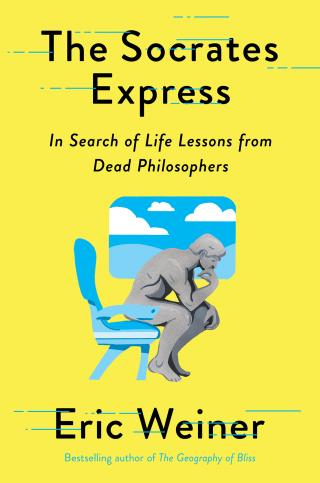
The Socrates Express
- Автор: Вейнер Эрик
- Год: 2020
- Язык: английский
- Год: Avid Reader Press / Simon & Schuster
- Жанр: География, путевые заметки

Электронная книга - «The Socrates Express». Краткое содержание книги:
We contemplate for the same reasons we travel: to see the world from a different perspective, to unearth hidden beauty and find new ways of being. We want to learn how to embrace wonder. Face regrets. Sustain hope.
Eric Weiner, *New York Times* bestselling author of *The Geography of Bliss* , combines his twin passions for philosophy and global travel in a pilgrimage that uncovers surprising life lessons from philosophers around the world, from Marcus Aurelius to Arthur Schopenhauer, Confucius to Montaigne. Traveling by train (the most thoughtful mode of transport) he traversed thousands of miles, making stops in Athens, Delhi,...
Montaigne isn’t afraid to contradict himself. He reverses his stance on matters large and small. Radishes, for instance. First they disagree with him, then agree, then disagree.
Nowhere is he more inconsistent than on the subject of death. In his earlier essays, Montaigne believes study and contemplation can free a man from the horrors of dying. “That to Philosophize Is to Learn to Die” is the title of one essay. By the end, he has fully reversed course. To philosophize, he concludes, is to learn to live. Death is the end, but not the goal, of life.
Montaigne did not have a death wish. He had a life wish. Yet he knew this wish could not be fully realized without coming to terms with death. We might think life and death are strictly sequentiaclass="underline" we live, then we die. The truth, says Montaigne, is that “death mingles and fuses with our lives throughout.” We don’t die because we are sick. We die because we are alive.
Montaigne thinks of death in ways I didn’t believe possible. Not only does he contemplate it but he plays with it and even—I realize this sounds odd—befriends it. “I want death to have a share in the ease and comfort of my life. It is a great and important part of it.”
I struggle with this idea. I’m not sure I want death to be a part of my life, great or otherwise. How, I wonder, can I come to terms with death while keeping it at a safe distance?
You can’t, says Montaigne. You must, if not befriend death, then at least defang it. You think of death as the enemy, something out there. Wrong. “Death is the condition of your creation. It is a part of you. You are fleeing from your own selves.” We must reorient ourselves toward death. It is not an “it” and you are not its victim.
Montaigne, an experimenter like Gandhi, believed in trying anything once. “We must push against a door to know it is closed to us,” he said. No door is more closed than death. Still, we must push. Don’t mock death until you’ve tried it, he says.
What are you talking about, Michel? We can rehearse for many events—weddings, bar mitzvahs, job interviews—but surely not for death. There are experts on death and dying but no expert “diers.” (My spellcheck doesn’t even recognize the word.) We can’t practice dying. Or can we? Montaigne did.
The year is 1569. Montaigne is riding, not far from his house. He has selected a gentle, compliant horse. He’s made this journey many times, and thinks he is perfectly safe, when another rider, astride a powerful workhorse, attempts to pass him at full speed. “[He] hit us like a thunderbolt with all his strength and weight, sending us both head over heels,” recalls Montaigne.
Montaigne, thrown from his horse, is lying on the ground, bruised and bleeding, with “no more motion or feeling than a log.” Passersby were convinced he was dead. But then they detected slight movement. They lifted Montaigne to his feet, and he promptly “threw up a whole bucketful of clots of pure blood.”
“It seemed to me that my life was hanging only by the tips of my lips,” he recalls. Oddly, he experienced neither pain nor fear. He closed his eyes and took pleasure in letting himself go, as if sliding gently into sleep. If this is death, Montaigne thought, it’s not so bad, not bad at all.
Friends carried him home. He saw his house but did not recognize it. People offered him various remedies. He refused them all, convinced he was mortally wounded. Yet, still, he felt no pain, no fear—only “infinite sweetness.” It would have been, he recalled, “a very happy death.” He let himself slip away gradually, effortlessly.
Then he began to recover, and with his revival came pain. “It seemed to me that a flash of lightning was striking my soul with a violent shock, and that I was coming back from the other world.”
The accident had a profound effect on Montaigne. He questioned his assumption that death is something we can’t practice. Maybe we can. Maybe we can give it a try, an assay. We can’t see death itself but we can “at least glimpse it and explore the approaches to it.”
Death is not something we master, like chess or winemaking. It is not a skill. It is an orientation, one aligned with nature. “There is nothing useless in nature, not even uselessness itself,” says Montaigne. Death is not life’s failure but its natural outcome.
Slowly, Montaigne begins to approach death “not as a catastrophe but as something beautiful and inevitable,” like an autumn leaf falling from a tree. The leaf doesn’t worry about how to fall, and nor should we. “If you do not know how to die, don’t worry; Nature will tell you what to do on the spot, fully and adequately. She will do the job perfectly for you; don’t bother your head about it.”
Will she, Michel? I hope so. She is awfully mercurial. One moment she’s blooming cherry blossoms, the next she’s unleashing a category 5 hurricane. I don’t subscribe to the if-it’s-natural-it-must-be-good theory. Cockroaches are natural. Earthquakes are natural. Nasal hair is natural.
What does a good death look like? It usually (but not always) comes at the end of a good life. The atmospherics are important, too. The less drama, the better. Too often, in Montaigne’s day, a dying person was surrounded by “a number of pale and weeping servants, a darkened room, lighted candles; our bedside besieged by doctors and preachers; in short, everything horror and fright around us.” Today, our hospital rooms are lit by fluorescent, not candlelight. But the doctors and preachers are still there, as is the horror and fright.
My most intimate experience with death was watching my father-in-law die. He died two ways: slowly, then quickly. A disease called frontotemporal dementia explained the paranoia, and the anger. A stroke sent him to the hospital, then a nursing home, then, when his kidneys shut down, back to the hospital. We knew it was the end. The doctors knew, too. Yet nobody acknowledged it. A conspiracy of silence enveloped the hospital room, and we were all unindicted co-conspirators. Such is the charade of feigned ignorance that defines dying in our age.
I watched my father-in-law’s chest heave up and down, his eyes glazed over by the morphine while a cockpit’s worth of machines beeped and pinged. I fixated on one screen, which monitored his oxygenation levels. Forty-five then 75, then down to 40. I watched the number fluctuate, as if the act of watching would somehow keep him alive. Medical technology comforts us by numbing us and numbs us by distracting us. As long as the machines beep and the screens flash, all is well.
Montaigne would not approve. It’s not the palliative care that would distress him but the denial. Technology distances us from the reality of death, which is nothing more and nothing less than nature. Since we are part of nature, we are only distancing ourselves from ourselves. Fleeing ourselves. One beep at a time. He’d look at the flashing monitors and the pinging cardiograph and the metered IV drips and see clear as day what was missing from the room: acceptance.
The remedy for death is not more life—any more than the remedy for despair is hope. Both states call for the same medicine: acceptance. That is where Montaigne, like Beauvoir, ends up. Not a half-hearted acceptance but a full and generous one. Acceptance of death, yes, but of life, too, and of himself. Acceptance of his positive traits (“To say less of yourself than is true is stupidity, not modesty”) and acceptance of his flaws as well. Like idleness. Montaigne often chastised himself for wasting time. Eventually he realized how silly that was. “We are great fools, ‘He has spent his life in idleness,’ we say; ‘I have done nothing today.’ What, have you not lived?”