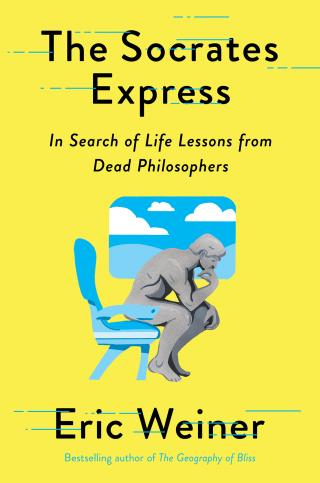
The Socrates Express
- Автор: Вейнер Эрик
- Год: 2020
- Язык: английский
- Год: Avid Reader Press / Simon & Schuster
- Жанр: География, путевые заметки

Электронная книга - «The Socrates Express». Краткое содержание книги:
We contemplate for the same reasons we travel: to see the world from a different perspective, to unearth hidden beauty and find new ways of being. We want to learn how to embrace wonder. Face regrets. Sustain hope.
Eric Weiner, *New York Times* bestselling author of *The Geography of Bliss* , combines his twin passions for philosophy and global travel in a pilgrimage that uncovers surprising life lessons from philosophers around the world, from Marcus Aurelius to Arthur Schopenhauer, Confucius to Montaigne. Traveling by train (the most thoughtful mode of transport) he traversed thousands of miles, making stops in Athens, Delhi,...
“playing with my new doll”: Quoted in Julian Young, Schopenhauer (New York: Routledge, 2005), 1.
“Your mother expects”: Quoted in David Cartwright, Schopenhauer: A Biography (New York: Cambridge University Press, 2010), 43–44.
“I wish you learned to make yourself”: Quoted in Rüdiger Safranski, Schopenhauer and the Wild Years of Philosophy (Cambridge, MA: Harvard University Press, 1989), 53.
“The sound, which like all music”: William Styron, Darkness Visible: A Memoir of Madness (New York: Random House, 1990), 66.
cognitive recovery after a stroke: Kil-Byung Lim et al., “The Therapeutic Effect of Neurologic Music Therapy and Speech Language Therapy in Post-Stroke Aphasic Patients,” Annals of Rehabilitation Medicine 74, no. 4 (2016): 556–62.
Patients in minimally conscious: Helen Thomson, “Familiar Music Could Help People with Brain Damage,” New Scientist, August 29, 2012, https://www.newscientist.com/article/dn22221-familiar-music-could-help-people-with-brain-damage/.
a joy to read: Philosophical writing, Schopenhauer said, should “resemble not a turbid, impetuous torrent, but rather a Swiss lake which by its calm combines great depth with great clearness, the depth revealing itself precisely through the clearness.”
is “more with you”: Magee, The Philosophy of Schopenhauer, 7.
“a nasty piece of work”: Paul Strathern, Schopenhauer in 90 Minutes (Lanham, MD: Ivan R. Dee, 1999), 11.
At night, he jumped: Schopenhauer, the big-eared philosopher, would lose much of his hearing late in life. First one ear, then the other. The noise he so hated disappeared, but this provided little consolation, for so, too, did the music.
According to one study: Lisa Goines and Louis Hagler, “Noise Pollution: A Modern Plague,” Southern Medical Journal 100, no. 3 (2007): 287–94.
Another study found that the roar: Stephen Stansfeld and Mark Matheson, “Noise Pollution: Non-Auditory Effects on Health,” British Journal of Medicine 8, no. 1 (2003): 244.
6: HOW TO ENJOY LIKE EPICURUS
A New York Times correspondent: Quoted in Jeri Quinzio, Food on the Rails: The Golden Era of Railroad Dining (London: Rowan & Littlefield, 2014), 30.
It is edible, yes: Amtrak recently announced it will be curtailing its dining car service. Luz Lazo, “The End of an American Tradition: The Amtrak Dining Car,” Washington Post, September 21, 2019.
“air and genius of gardens”: Quoted in David Cooper, A Philosophy of Gardens (New York: Oxford University Press, 2008), 6.
“for many years he was unable”: Quoted in Klein, The Art of Happiness, 82. Diogenes dismissed these rumors, though. “The critics are all crazy,” he wrote.
the “Four-Part Cure”: The Epicurean Philodemus summarizes the Four-Part Cure this way: “Nothing to fear from god, nothing to worry about in death. Good is easy to obtain, and evil easy to endure.” Tim O’Keefe, Epicureanism (New York: Routledge, 2010), 6.
was a “tranquillist”: O’Keefe, Epicureanism, 120.
“Happiness is definitely”: Ad Bergsma et al., “Happiness in the Garden of Epicurus,” Journal of Happiness Studies 9, no. 3 (2008): 397–423.
“pure pleasure of existing”: Hadot, What Is Ancient Philosophy, 115.
“I too am an Epicurean”: Quoted in James Warren, ed., The Cambridge Companion to Epicureanism (Cambridge, UK: Cambridge University Press, 2009), 1.
Two of Epicurus’s early influences: Klein, The Art of Happiness, ix.
7: HOW TO PAY ATTENTION LIKE SIMONE WEIL
If I had more time, I’d read: Before the advent of rail travel, hardly anyone read while traveling overland. The novelty of reading while moving quickly captured the imagination of a restless, literate public, and by the 1840s English booksellers established stalls at rail stations. One touted its “Literature for the Rail—works for sound information and innocent amusement.”
“in her presence all ‘lies’ ”: The poet Jean Tortel quoted in Francine du Plessix Gray, Simone Weil (New York: Viking Penguin, 2001), 168.
“For the moment, what we attend”: William James, The Principles of Psychology (Cambridge, MA: Harvard University Press, 1983), 428.
As many studies reveal, we do not: The most famous of these is the so-called invisible-gorilla study. Psychologists Daniel Simons and Christopher Chabris asked participants to watch a video of people passing a basketball and count the number of passes. Halfway through the video, a woman dressed in a gorilla suit enters the scene, thumps her chest, then walks away. Afterward, fully half of the participants didn’t recall anything unusual during the video. Psychologists call this phenomenon “inattentional blindness.” We only see what we expect to see. See Christopher Chabris and Daniel Simons, The Invisible Gorilla: How Our Intuitions Deceive Us (New York: Crown, 2009).
“a condition so rewarding”: Mihaly Csikszentmihalyi et al., The Art of Seeing: An Interpretation of the Aesthetic Encounter (Los Angeles: J. Paul Getty Museum, 1990), 19.
“One forgets oneself”: Quoted in Mihaly Csikszentmihalyi et al., eds., Optimal Experience: Psychological Studies of Flow in Consciousness (New York: Cambridge University Press, 1998), 220.
“There is no primary act”: Francis Bradley, “Is There a Special Activity of Attention?” Mind 11, no. 43 (1886): 305–23.
“Everyone knows what attention”: James, The Principles of Psychology, 170.
we routinely overestimate our ability: As one example, see David Sanbonmatsu et al., “Who Multi-Tasks and Why? Multi-Tasking Ability, Perceived Multi-Tasking Ability, Impulsivity, and Sensation Seeking,” PLOS One, January 23, 2013.
“No such upper bound”: Alan Allport, “Attention and Integration,” in Attention: Philosophical and Psychological Essays, ed. Christopher Mole et al. (New York: Oxford University Press, 2011), 29.
“I envied her for having a heart”: Simone de Beauvoir, Memoirs of a Dutiful Daughter (New York: HarperCollins, 1958), 239.
“Mi-usine, mi-palais”: Alfred Meyer, quoted in Schivelbusch, The Railway Journey, 189.
“the only great spirit”: Quoted in John Hellman, Simone Weiclass="underline" An Introduction to Her Thought (Eugene, OR: Wipf & Stock, 1982), 1.
“sloppy, almost careless”: Simone Pétrement, Simone Weiclass="underline" A Life (New York: Pantheon, 1976), 39.