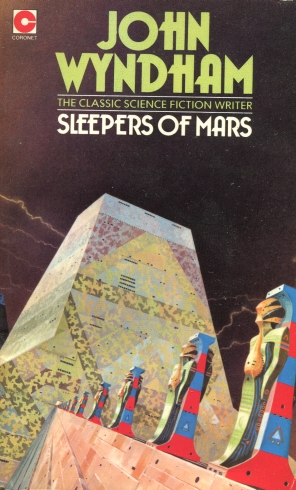
Sleepers Of Mars
- Автор: Уиндем Джон Паркс Лукас Бейнон Харрис
- Год: 1977
- Язык: английский
- Год: Coronet Books/Hodder & Stoughton Ltd
- ISBN: 0340173262
- Жанр: Научная фантастика

Электронная книга - «Sleepers Of Mars». Краткое содержание книги:
Of course, we are now well used to the idea of Man On The Moon, we have become blasé as to the possibilities of inter-planetary travel. But imagine two expeditions to Mars, one British, the other Russian, both in the process of discovering a mechanical race, invented and produced by the Martians as they believe their specie to be dying.
The other four novellas in this collection give further evidence of John Wyndham’s genius at invention, characterisation and sense of movement.
Vinski, by reason of his position, had a couple of seconds more warning than the others. With a shout he dropped his rifle and stood up. There was no time to think; he acted instinctively, and in the only way which could save him. He took two steps forward and leaped desperately to clear the rank of oncoming machines.
It was a feat which would have been impossible on Earth, but Mars made his strength superhuman. As if he were the human shell fired from a circus gun, he sailed over the onrushing machines and tumbled to the ground behind them. But his three companions had no time to jump. They went down before the charge of threshing metal arms and feet.
As suddenly as they had started, the machines ceased to fire. Some kind of madness seemed to have overtaken them. They became a tangle of flailing levers and rods, inextricably intertwined, flashing and swirling in the sunlight with giddy brilliance.
Not until then did Vinski realise that there was a new power abroad in the Martian desert. For the first time he had a sight of the coffinshaped machines, and with them a strange, manylegged tank-like device emitting blue flashes. It was clear that it was in some way responsible for the frenzy and disorganisation which had overtaken the attackers, for the newcomers, though queerly unfamiliar, had at least a reassuring quality of rational and credible design.
If their object had been only to disperse the fantastic attackers, they had been completely successful; but if they had intended rescue, they had not. Of the four in his group, Vinski alone survived. Karaminoff, Vassiloff and Steinoi had lost their lives beneath the stamping feet of the machines.
He found their bodies there, battered almost beyond recognition, and sick at heart he set out to trudge his lonely way back to the Tovaritch.
CHAPTER TWO
ORDERS TO LEAVE
He reached the ship unmolested, for the newcomers had cleared the desert of the rest of the machines. Some had got away, but most, under the influence of the blue flashes, had contrived their own destruction and now lay in masses of tangled, broken parts.
He came from the airlock into the ship’s living-room to find that the two left on board had already been joined by the doctor, Platavinov. Vinski made his report and learned that Mikletski, too, lay dead on the desert. A swinging arm of one of the fleeing machines had crushed his head as it passed.
Four out of the crew of eight were left. They had left Earth charged to explore and learn the condition of the planet, and if possible, to get into touch with any inhabitants there might be. In a few hours their number had been halved, and two of them had not yet set foot outside the ship.
By common consent they looked to Vinski for immediate guidance. None of the four was a leader by nature, but for the moment the Ukrainian, whose official status was that of recorder and historian of the expedition, appeared to dominate by reason of his physical size.
Zhatkin, the sad-looking Kirghizian, was happiest when he was involved in his complex figuring; when not so engaged, he tended to regard the things about him with a detached studiousness of no practical value, as far as anyone could see.
Platavinov, the doctor, had the scientific mind. He observed, he inquired, he classified; he was interested in a great many things, but he did not initiate.
There remained Gordonov, the engineer. He had started as Gordon when he was christened on Clydeside. His engines and machinery were the joy and pride of his life. Save for that period when a burning sense of injustice and a passionate desire for equality of opportunity—and opportunity on a larger scale than he could find at home—had led him to become a Soviet citizen, he had shown little interest in things outside his profession.
So it came about that the three turned their inquiries upon Vinski—and Vinski had little to offer. It looked to him as if the expedition had come to a finish. It was unlikely that the four of them could contrive to raise their rocket to the perpendicular, and that had to be accomplished before the return journey could be begun. His present forecast was that they would stay where they were until food or air failed them, and the end came.
He wondered how the men in the English rocket saw the situation, and was tempted to send over an offer of mutual assistance in raising their rockets. The memory of the shooting incident which had concluded the previous visit deterred him, however, for the time being.
During the night, as they lay in their hammocks, came a bewildering sensation that the world about them was turning topsy-turvy. It took the crew of the Tovaritch some little time to realise that the machines outside were solving their greatest problem for them, and were raising their ship to the vertical. The darkness outside gave them no chance to see how it was being done, but daylight revealed that both rockets had been treated alike.
The four stood by one of the fused quartz windows. Little over a mile away the shell-like shape of the Gloria Mundi gleamed at them.
‘At least they’re making no distinctions; that’s some consolation,’ Gordonov said.
‘A poor sort of consolation,’ the doctor thought. ‘It looks to me like a pretty pointed hint that we’re not welcome.’
‘Nothing that has happened to us yet could give any other impression,’ said Vinski.
‘But surely they can’t mean to get rid of us before we’ve made any contacts? They’ve not even heard what we’ve got to say. Damn it, it’s not every day that visitors turn up from another planet,’ Platavinov objected.
Vinski crossed the room. He took his mask and oxygen tank from their locker, and put them on. The doctor, after a momentary hesitation, did the same, and the two men stepped into the airlock together.
Now that the rocket stood erect, the entrance was raised more than a hundred feet in the air. When the outer door was open it was possible, by leaning well out, to see what was happening around the base flanges in an area which was out of range of the inclined windows.
A metallic chatter accosted them as they peered down. It sounded thin and distorted in the rarefied air, but there was no doubt that it was a mechanically-produced voice of some kind. Looking for its source, Vinski became aware that one of the glittering, coffinshaped machines was standing apart from the rest: its tentacles were extended, and its lens pointed directly up at them.
The chattering voice seemed to emanate from some part of it. Vinski nudged his companion, and pointed. The two of them gazed at it in silence for some perplexed seconds.
‘Well, I suppose it means something,’ Platavinov said at last, ‘but it doesn’t seem to help much. Try it in English. It may have picked some up from our Empire-building friends over there.’
But the machine did not respond. However, it did occur to it, or to its operator, that not much progress was being made. The chatter broke off abruptly. With two great sweeps of the flexible metal arms it smoothed the surface of the sand before it, then with lightning movements of one tentacle it scribbled a row of characters.
‘It’s a trier, anyway,’ said Vinski, as they watched the queer signs taking form. ‘Though why it should assume we can understand its writing, when we can’t get a line on its lingo, is more than I can say. As it is, not even being able to tell which way up the stuff is, we don’t look like getting far.’
The machine’s tentacle whipped back and curled itself close to its side. The lens swivelled and trained itself on them. It took no more than a few seconds to appreciate that its second attempt at communication had been no more successful than the first. Undismayed, it swept the sand level again.
This time it started by making a single circular impression in the middle; then, extending a tentacle from its other side, it stood motionless for some seconds, one long arm resting on the mark and the other pointing at the Sun. The upper tentacle suddenly re-curled itself. The other rapidly drew three concentric circles about the original mark. Again the second tentacle uncurled, and pointed directly at them while the first rested on the outermost of the circles.