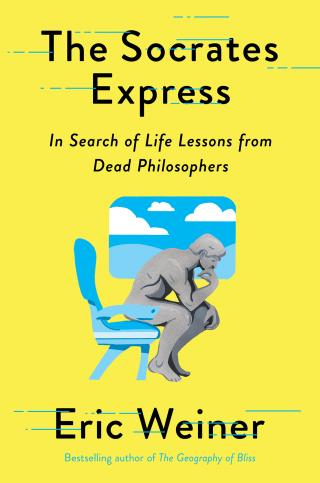
The Socrates Express
- Автор: Вейнер Эрик
- Год: 2020
- Язык: английский
- Год: Avid Reader Press / Simon & Schuster
- Жанр: География, путевые заметки

Электронная книга - «The Socrates Express». Краткое содержание книги:
We contemplate for the same reasons we travel: to see the world from a different perspective, to unearth hidden beauty and find new ways of being. We want to learn how to embrace wonder. Face regrets. Sustain hope.
Eric Weiner, *New York Times* bestselling author of *The Geography of Bliss* , combines his twin passions for philosophy and global travel in a pilgrimage that uncovers surprising life lessons from philosophers around the world, from Marcus Aurelius to Arthur Schopenhauer, Confucius to Montaigne. Traveling by train (the most thoughtful mode of transport) he traversed thousands of miles, making stops in Athens, Delhi,...
As I begin to trace my own narrative arc, I, too, notice serendipities. The new friend who materialized when needed most. The dream job that appeared at precisely the right time, and the subsequent firing from said job, which wasn’t so dreamy after all. I’m reminded of what an Icelandic composer named Hilmar once told me: “I met everyone I needed to meet when I needed to meet them.” That is a wise observation, one accessible only to someone who has lived awhile.
In the Great Summing Up we don’t merely trace our narrative arc. We construct it, one memory at a time. Beauvoir describes it in tactile terms, deploying the language of the craftsman. “At present I am concerned with recovering my life—reviving forgotten memories, re-reading, re-seeing, rounding off incomplete pieces of knowledge, filling gaps, clarifying obscurities, gathering scattered elements together.”
Too much recollection isn’t good. We risk remaining shackled to our past selves: forever the heroic soldier or beautiful young woman. This kind of past is frozen, and a frozen past is a dead past.
Another hazard of recollection—one that trips up Beauvoir for a while—is the “what-if trap.” Looking back, she ruminates on choices not made, paths not taken. What if she were born in a different era, or to a different family? She might have fallen ill and never completed her studies. She might have never met Sartre. Such thoughts, she eventually realizes, lead nowhere. So she lets them go. “I am satisfied with my fate and that I should not want it changed in any way at all,” she says, answering Nietzsche’s demon with a resounding Da capo. Again.
2: Make Friends
The latest research confirms what Epicurus observed two millennia ago: friendship is one of our greatest sources of happiness. The quality of our relationships is the most important variable in the happiness equation. Beauvoir knew this intuitively. “My relations with others—my affections, my friendships—hold the most important place in my life,” she writes in her memoir, All Said and Done.
Friends matter when you’re young. They matter more when you’re old. In addition to the usual benefits—shared interests, a shoulder to cry on—friends link your present self with your past self. That’s why losing a friend is especially painful when you’re older. You’re losing not only a friend but a piece of your past, too. A piece of yourself.
Beauvoir’s friendship with Sartre, spanning half a century, was her most important, but another, begun much later in life, came a close second.
Beauvoir guarded her time jealously but was a sucker for entreaties from students. So when a letter arrived from one Sylvie Le Bon, a seventeen-year-old philosophy student from Brittany, Beauvoir readily agreed to meet.
They connected instantly and soon were inseparable. They saw each other nearly every day. They read the same books, saw the same shows, and on weekends went for long drives in the French countryside. They had season subscriptions to the opera and took vacations in Europe and beyond.
Beauvoir felt rejuvenated by the friendship with this woman forty years her junior. “There is such an interchange between us that I lose the sense of my age: she draws me forward into her future, and there are times when the present recovers a dimension that it had lost.” (Beauvoir bristled at suggestions the two were lovers. “We are very very very good friends,” she said.)
It was Sylvie who lifted Beauvoir’s spirits when she stumbled across a negative review. It was Sylvie who helped her navigate the world of young feminism. And it was Sylvie who rescued Beauvoir from depression after Sartre’s death.
She and Sylvie took a cruise through the Norwegian fjords. She began to write again. Says Sylvie: “It was as if she had put it all behind her. She talked about our relationship and said it gave her a taste for life, a reason to live. She said, ‘I don’t live for you, but I live thanks to you, through you.’ And that was the kind of relationship we had.”
3: Stop Caring What Others Think
Something curious and wonderful happens when we age. We no longer care what others think of us. More precisely, we realize they weren’t thinking of us in the first place.
And so it was with Simone de Beauvoir. She grew more sure of herself, more accepting of her idiosyncrasies. More humble, too. She had her Copernican Moment, losing “the childish illusion of standing in the very middle of the world.”
This came as a tremendous relief. We are planets, each of us, not suns. We absorb the light, reflect it. We do not create it.
This sort of de-caring helps explain why old age can be intellectually liberating. “By a curious paradox,” says Beauvoir, “it is often at the very moment that the aged man, having become old, has doubts about the value of his entire work that he carries it to its highest point of perfection.” This was true for Rembrandt, Michelangelo, Verdi, Monet, and others. No longer seeking praise, they were free to doubt their own work and thus, as Beauvoir puts it, “go beyond themselves.”
Consider the fate of one of Beauvoir’s last books. A collection of short stories, The Woman Destroyed, was published on her sixtieth birthday and universally panned. Critics dismissed it as “the bitter expression of an old woman who nobody wanted anymore, either in life or literature.” Beauvoir, unfazed, continued to write.
4: Stay Curious
The problem with the elderly is not that they act too young but that they don’t act young enough. They act like twenty-seven-year-olds when they should be emulating seven-year-olds. Old age is a time to reconnect with curiosity or, better yet, wonder. What is a philosopher, after all, but a seven-year-old with a bigger brain?
“None are so old as those who have outlived enthusiasm,” Thoreau said. Beauvoir never outlived enthusiasm. She never stopped wondering. She talked about cinema and opera like a professional critic. She read newspapers regularly and discussed world events with authority and genuine passion. She developed a new interest in the Americas. She despised Ronald Reagan. (Nothing keeps decrepitude at bay like a healthy and vigorous hatred.) She met with scholars and journalists, dispensed favors, and saw friends, usually in her trademark red bathrobe.
Pursuits she had abandoned a decade ago interested her again. At age fifty-two, she claimed no interest in seeing a world “emptied of its marvels,” but a decade later was on the road again, confident that “travel is one of the few things that can bring novelty back into our lives.” She subscribed to the playwright Eugène Ionesco’s formula: two days in a new country are worth thirty in familiar surroundings. Travel enabled her to remain open to the world, receptive to its beauty. On the road, she was at peace. “I live in a moment that embraces eternity,” she said. “I forget my own existence.”
5: Pursue Projects
Old age, Beauvoir believed, should rouse passion, not passivity, and that passion must be directed outward. Have projects, not pastimes. Projects provide meaning. As she says: “There is only one solution if old age is not to be an absurd parody of our former life and that is to go on pursuing ends that give our existence meaning—devotion to individuals, to groups or to causes, social, political, intellectual or creative work.”
Beauvoir was more politically active in her seventies than in her twenties. After decades of hesitancy, she lent her name to many causes. She protested the French wars in Indochina and Algeria, the American one in Vietnam. She intervened on behalf of imprisoned rebels, censored artists, evicted tenants.
She was following a long tradition of elder activism. Voltaire, so bold on the page, only translated that boldness into action late in life. The British philosopher Bertrand Russell, at age eighty-nine, was jailed for seven days for taking part in an antinuclear demonstration. (The magistrate offered to exempt Russell from prison if he promised to behave himself. “No, I won’t,” he replied.) Benjamin Spock, the renowned American pediatrician, was convicted in 1968 on charges related to his protesting the Vietnam War. He was eighty years old. “At my age, why should I be afraid to make public protests?” he said. This is one of the advantages of old age: you have more to give and less to lose. “A blazing, fearless passion in an old man’s frail body is a moving sight,” says Beauvoir.