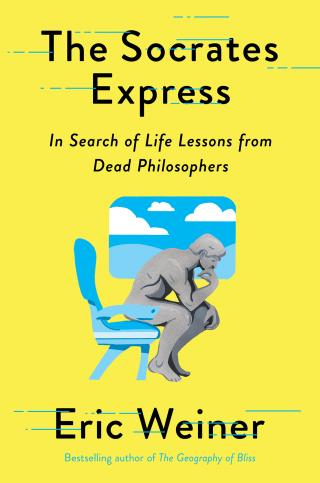
The Socrates Express
- Автор: Вейнер Эрик
- Год: 2020
- Язык: английский
- Год: Avid Reader Press / Simon & Schuster
- Жанр: География, путевые заметки

Электронная книга - «The Socrates Express». Краткое содержание книги:
We contemplate for the same reasons we travel: to see the world from a different perspective, to unearth hidden beauty and find new ways of being. We want to learn how to embrace wonder. Face regrets. Sustain hope.
Eric Weiner, *New York Times* bestselling author of *The Geography of Bliss* , combines his twin passions for philosophy and global travel in a pilgrimage that uncovers surprising life lessons from philosophers around the world, from Marcus Aurelius to Arthur Schopenhauer, Confucius to Montaigne. Traveling by train (the most thoughtful mode of transport) he traversed thousands of miles, making stops in Athens, Delhi,...
6: Be a Poet of Habit
We think of the aged as creatures of habit, and pity them for it. But should we? Beauvoir didn’t think so. Habit isn’t necessarily bad, and possesses a beauty of its own.
We need habits. Without them, our lives threaten to splinter into a million meaningless pieces. Habits tether us to this world, to our world. Habits are useful, provided we recall why we formed them and continually question their value to us. We must own the habit, and not the other way around.
Beauvoir gives the example of a man who plays cards every afternoon. He freely chooses to play cards at this café at this time. The habit has meaning. But if he grows angry because, say, “his” table is occupied one day, then the habit has eroded into a “lifeless” demand, one that restricts his freedom rather than expands it.
A habit is not a rut. Think of it as a container—or, if you will, a bag. A bag enables us to hold the pieces of our lives. This makes a bag useful. We get into trouble when we confuse a bag with its contents, habits with the meaning they contain.
In her sixties, Beauvoir embraced the poetry of habit. She did what she always did: she wrote, she read, she listened to music. But she did not read the same books, listen to the same music. “In their rhythm, in the way I fill them, and in the people I see, my days resemble one another. Yet my life does not seem at all stagnant to me.” Beauvoir owned her habits.
7: Do Nothing
There is a time for activity, and there is a time for idleness. Kairos. As a culture, we value the former but not the latter. Beauvoir and Sartre were certainly prolific, but they could occasionally stop doing and just be. Their summers in Rome were a time of expansive nothingness. Beauvoir set aside her projects and her endless striving and “bathed” herself in Rome. The Beaver at rest.
And though “acceptance” is not a word she used often, Beauvoir did achieve something akin to that. On the eve of her seventy-fifth birthday, she said: “There is something to this getting old after all.” Like Nietzsche, she had no regrets. “I have enjoyed everything as much as I could and as long as I could.”
8: Embrace the Absurdity
When I was growing up, a single cartoon adorned our refrigerator. I don’t recall when my mom posted it there. In my mind, it was always there. The cartoon depicted a mad scientist in a room populated by monsters of all shapes and colors. Sitting dejectedly alongside his giant laser machine, the scientist says to his assistant: “Twenty-seven years making monsters and what does it get me? A roomful of monsters.”
Albert Camus would chuckle at the cartoon. The French-Algerian writer was a leading proponent of a philosophy called Absurdism. The world is irrational. It makes no sense. All our accomplishments crumble under the unforgiving boot of time. Yet we persist. This is Absurdity. This is life. An elaborate stage production performed enthusiastically and repeatedly to an empty theater. Beauvoir was wrong, the Absurdists would say. Old age isn’t life’s parody. Life is life’s parody. Old age is simply the punch line.
How to respond to such absurdity? We can ignore it, for a while. Our Fitbits and 401(k)s give the illusion of progress, of meaning. We monitor calories burned, interest earned, and assume we’re getting somewhere. My life has meaning. I can see it flashing brightly on this tiny screen. But Sisyphus wearing a Fitbit is just as absurd as Sisyphus without one. More absurd, in fact, for he is seduced by the illusion of progress while the Fitbit-free Sisyphus is not. Absurdity quantified is more, not less absurd.
Interesting, but what does this have to do with growing old? Isn’t life just as absurd when we’re twenty-five years old as when we’re seventy-five? Yes, but at seventy-five we’re more aware of it. We’ve amassed enough accolades, saved enough money, to know how meaningless they are. Sisyphus at twenty-five still holds out hope that maybe, maybe this time the rock won’t roll down the hill. Sisyphus at seventy-five has no such illusions.
Sisyphus’s task, and ours, too, is to accept “the certainty of a crushing fate, without the resignation that ought to accompany it,” says Camus. We must imagine Sisyphus happy. But how? How can a conscious, intelligent being find happiness in such a monotonous, pointless task?
By throwing himself into his task, despite its futility, because of its futility. “His fate belongs to him,” says Camus. “His rock is his thing.… Each atom of that stone, each mineral flake of that night-filled mountain, in itself forms a world. The struggle itself toward the heights is enough to fill a man’s heart.”
Beauvoir didn’t subscribe fully to Camus’s Absurdism, but she did embrace a “passionate heroism,” as she called it, delighting in the magic of work for its own sake. Standing in a roomful of monsters, she continued, until the very end, to create more.
9: Disengage Constructively
As we age, we cling more tightly to life. We must learn how to let go. We need to practice what I call Constructive Disengagement. It is not apathy, a turning away from the world. It is a gentle stepping back. You are still a passenger on the train, still care about your fellow passengers, but are less unnerved by each bump and shimmy, less concerned about reaching your destination.
Bertrand Russell, who lived until the age of ninety-seven, suggests expanding the circle of your interests, making them “wider and more impersonal, until bit by bit the walls of the ego recede, and your life becomes increasingly merged in the universal life.”
Think of a single life as a river. At first, it’s narrowly contained within its banks, rushing past boulders, under bridges, over waterfalls. “Gradually the river grows wider, the banks recede, the waters flow more quietly, and in the end, without any visible break, they become merged in the sea, and painlessly lose their individual being.”
This, I think, is the final task of old age: not a narrowing of our waters but a widening. Not raging against the dying of the light but trusting that the light lives in others. The wisdom of kairos. Everything has its time. Even this.
10: Pass the Torch
What the French critic Paul Valéry said of poems applies equally to our lives. They’re never finished, only abandoned. Unfinished business isn’t a sign of failure. The opposite. The person who departs this world with no unfinished business hasn’t lived fully.
As our future shrinks, other futures grow. Our unfinished business will be finished by others. This thought, perhaps more than any other, takes the sting out of old age. As Beauvoir said: “I love young people and if in their schemes I recognize my own, then I feel that my life will be prolonged after I am in my grave.”
There are no guarantees, of course. The young generation might make a mess of our projects, just as we did the previous generation’s. We stake no claim. We are like travelers at an inn, just passing through, observing the “No Smoking” sign, leaving the room the way we found it, and perhaps dropping a note or two in the suggestion box.
I’m not ready to pass the torch. Not yet. I am not old. But if—no, when—I collide with old age, what note would I leave for my daughter?