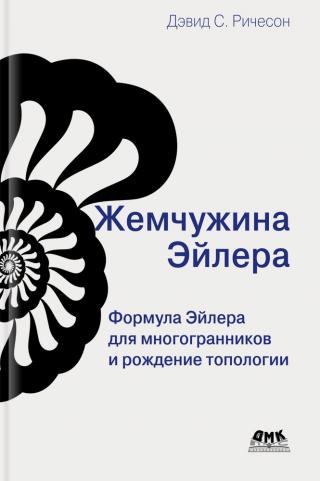
Жемчужина Эйлера
- Автор: Ричесон Дэвид С.
- Год: 2021
- Язык: русский
- Жанр: Прочее научное

Электронная книга - «Жемчужина Эйлера». Краткое содержание книги:
В 1750 году Эйлер заметил, что любой многогранник, имеющий V вершин, E ребер и F граней, удовлетворяет соотношению V – E + F = 2. Из книги вы узнаете, что греки совсем не заметили эту формулу, что Декарт был в шаге от ее открытия, что математики XIX века обобщили ее в направлениях, о которых Эйлер и не подозревал, а в XX веке было доказано, что у любого тела есть своя формула Эйлера. На тщательно подобранных примерах представлены многие элегантные и неожиданные применения этой формулы, например: почему на Земле всегда существует точка, где нет ветра, как измерить площадь лесного участка, посчитав деревья на нем, и сколько разноцветных карандашей необходимо для раскрашивания любой карты.
Издание предназначено для широкого круга любителей математики.
---. (1963). Morse theory. Based on lecture notes by M. Spivak and R. Wells. Annals of Mathematics Studies, no. 51. Princeton, NJ: Princeton University Press.
---. (2003). Towards the Poincare conjecture and the classification of 3-manifolds. Notices Amer. Math. Soc. 50 (10), 1226-1233.
Mobius, A. F. (1863). Theorie der elementaren Verwandschaften. Abhandlun-gen Sachsische Gesellschaft der Wissenschaften 15, 18-57. Also in Gesammelte Werke, vol. 2, Leipzig, 1886, 433-471.
---. (1865). Ueber die Bestimmung des Inhaltes eines Ponders. Abhand-lungen Sachsische Gesellschaft der Wissenschaften 17, 31-68. Gesammelte Werke, vol. 2, Leipzig, 1886, 473-512.
Morgan, J. W., and G. Tian (2006). Ricci flow and the Poincare conjecture. http://arXiv:org/abs/math.DG/0607607.
Morse, M. (1929). Singular points of vector fields under general boundary conditions. Amer. J. Math. 41, 165-178.
Murasugi, K. (1958). On the genus of the alternating knot. I, II. J. Math. Soc. Japan 10, 94-105, 235-248.
---. (1987). Jones polynomials and classical conjectures in knot theory. Topology 26 (2), 187-194.
Nasar, S., and D. Gruber (2006). Manifold destiny: A legendary problem and the battle over who solved it. The New Yorker, August 28, 44-57.
Nash, C. (1999). Topology and physics-a historical essay. In I. M. James (ed.), History of topology, 359-415. Amsterdam: North-Holland.
Papakyriakopoulos, C. (1943). A new proof for the invariance of the homology groups of a complex. Bull. Soc. Math. Grece 22, 1-154.
Perelman, G. (2002). The entropy formula for the Ricci flow and its geometric applications. http://arxiv.org/abs/math.DG/0211159.
---. (2003a). Finite extinction time for the solutions to the Ricci flow on certain three-manifolds. ttp://arxiv.org/abs/math.DG/0307245.
---. (2003b). Ricci flow with surgery on three-manifolds. http://arxiv.org/ abs/math.DG/0303109.
Peterson, I. (2003). Recycling topology. Science News Online 163 (17), April 26.
Pick, G. (1899). Geometrisches zur zahlenlehre. Sitzungber. Lotos, Naturwissen Zeitschrift, Prague 19, 311-319.
Plato (1921). Theaetetus. Sophist. With an English translation by H. N. Fowler. New York: G. P. Putnam's Sons.
---. (1972). Philebus and Epinomis. Translation and introduction by A. E. Taylor. London: Dawsons of Pall Mall.
---. (2000). Timaeus. Translated with an introduction by Donald J. Zeyl. Indianapolis: Hacket Publishing.
Poincare, H. (1881). Memoire sur les courbes definies par une equation dif-ferentielle. J. de Math. 7, 375-422.
---. (1885). Sur les courbes defines par les equations differentielles. Journal de mathematiques 1 (4), 167-244.
---. (1895). Analysis situs. J. Ec. Polytech ser. 2 1, 1-123.
---. (1899). Complement a l'analysis situs. Rend. Circ. Math. D. Palermo 13, 285-343.
---. (1900). Second complement a l'analysis situs. Proc. Lond. Math. Soc. 32, 277-308.
---. (1902a). Sur certaines surfaces algebriques; troisieme complement a l'analysis situs. Bull. Soc. Math. France 30, 49-70.
---. (1902b). Sur les cycles algebriques; quatrieme complement a l'analysis situs. J. de Math. 8, 169-214.
---. (1904). Cinquieme complement a l'analysis situs. Rend. Circ. Math. D. Palermo 18, 45-110.
---.(1913). The foundations of science: Science and hypothesis, the value of science, science and method. Science and Education. New York: The Science Press.
Poinsot, L. (1810). Memoire sur les polygones et les polyedres. Journal de l'ecole polytechnique 4, 16-48.
Polya, G. (1954). Induction and analogy in mathematics. Vol. 1 of Mathematics and plausible reasoning. Princeton, NJ: Princeton University Press.
Pont, J.-C. (1974). La topologie algebrique des origines а Poincare. Paris: Presses Universitaires de France.
Przytycki, J. (1992). A history of knot theory from Vandermonde to Jones. Aportaciones Matematicas Comunicaciones 11, 173-185.
Rado, T. (1925). Uber den begriff von Riemannsche flache. Acta Univ. Szeged 2, 101-120.
Ranicki, A. A., A. J. Casson, D. P. Sullivan, M. A. Armstrong, C. P. Rourke, and G. E. Cooke (1996). The Hauptvermutung book, volume 1 of K-Monographs in Mathematics. A collection of papers of the topology of manifolds. Dordrecht: Kluwer Academic Publishers.
Read, J. (1966). Prelude to chemistry: An outline of alchemy, its literature and relationships. Cambridge, MA: The M.I.T. Press.
Riasanovsky, N. V. (1993). A History of Russia (5th ed.). New York: Oxford University Press.
Richeson, D. (2007). The polyhedral formula. In R. Bradley and E. Sandifer (eds.), Leonhard Euler: Life, work and legacy. Vol. 5 of Studies in the history and philosophy of mathematics, 421-39. Amsterdam: Elsevier.
Riemann, G. F. B. (1851). Grundlagen fur eine allgemeine Theorie derFunctionen einer veranderlichen complexen Grosse. PhD thesis, Gottingen.
---. (1857). Theorie der Abel'schen Functionen. Journal fur Mathematik 54, 101-155. Also in Gesammelte Mathematische Werke und Wissenschaftlicher Nachlass, Berlin: Springer, 1990, 88-142.
Russell, B. (1957). The study of mathematics. In Mysticism and Logic, 55-69. Garden City, NY: Doubleday.
---. (1967). The autobiography of Bertrand Russell, vol. 1. Boston: Little, Brown.
Sachs, H., M. Stiebitz, and R. J. Wilson (1988). An historical note: Euler's Konigsberg letters. Journal of Graph Theory 12 (1), 133-139.
Salzberg, H. W. (1991). From caveman to chemist: Circumstances and achievements. Washington DC: American Chemical Society.
Samelson, H. (1995). Descartes and differential geometry. In Geo metry, topology, & physics, Conf. Proc. Lecture Notes in Geometry and Topology, IV, 323-328. Cambridge, MA: Internat. Press.
---. (1996). In defense of Euler. Enseign. Math. (2) 42 (3-4), 377-382.
Sandifer, E. (2004). How Euler did it: V, E and F, parts 1 and 2. Mathematical Association of America Online. http://www.maa.org/news/howeulerdidit.html.
Sarkaria, K. S. (1999). The topological work of Henri Poincare. In History of topology, 123-167. Amsterdam: North-Holland.
Schechter, B. (1998). My brain is open: The mathematical journeys of Paul Erdos. New York: Touchstone.
Schlafli, L. (1901). Theorie der vielfachen Kontinuitat. Denkschr. Schweiz. naturf. Ges. 38, 1-237.
Scholz, E. (1999). The concept of manifold, 1850-1950. In I. M. James (ed.), History of topology, 25-64. Amsterdam: North-Holland.
Seifert, H. (1934). Uber das Geschlecht von Knotten. Math. Ann. 110, 571-592.
Seifert, H., and W. Threlfall (1980). Seifert and Threlfalclass="underline" A textbook of topology, vol. 89 of Pure and Applied Mathematics. Translated from the German edition of 1934 by Michael A. Goldman, with a preface by Joan S. Birman. With «Topolo-gy of 3-dimensional fibered spaces» by Seifert, translated from the German by Wolfgang Heil. New York: Academic Press. Harcourt Brace Jovanovich Publishers.
Senechal, M. (1988). A visit to the polyhedron kingdom. In M. Senechal and G. Fleck (eds.), Shaping space: A polyhedral approach, proceedings of 1984 conference held in Northampton, MA, 3-43. Boston, Design Science Collection, Birkhauser Boston.
Shakespeare, W. (1992). Hamlet. New York: Dover.
---. (2002). Twelfth night. Woodbury, CT: Barron's Educational Series.
Simmons, G. F. (1992). Calculus gems: Brief lives and memorable mathematics. With portraits by Maceo Mitchell. New York: McGraw-Hill.
Simpson, J., and E. Weiner (eds.) (1989). Oxford English Dictionary (2nd ed.). Oxford: Clarendon Press.
Sloane, N. J. A. (2007). The online encyclopedia of integer sequences. http://www.research.att.com/~njas/sequences.
Smale, S. (1961). Generalized Poincare's conjecture in dimensions greater than four. Ann. of Math. (2) 74, 391-406.
---. (1990). The story of the higher dimensional Poincare conjecture (what really actually happened on the beaches of Rio). Math. Intelligencer 12 (2), 44-51.
---. (1998). Mathematical problems for the next century. Math. Intelligencer 20 (2), 7-15.
Sommerville, D. M. Y. (1958). An introduction to the geometry of n dimensions. New York: Dover.