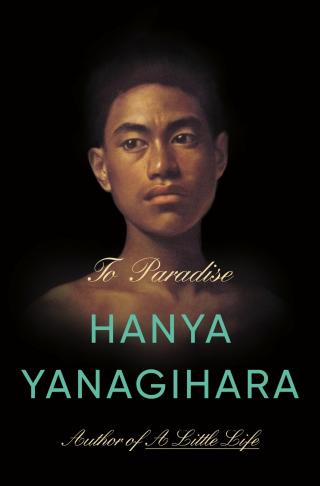
To Paradise
- Автор: Yanagihara Hanya
- Год: 2022
- Язык: английский
- Год: Knopf Doubleday Publishing Group
- Жанр: Современная русская и зарубежная проза

Электронная книга - «To Paradise». Краткое содержание книги:
In an alternate version of 1893 America, New York is part of the Free States, where people may live and love whomever they please (or so it seems). The fragile young scion of a distinguished family resists betrothal to a worthy suitor, drawn to a charming music teacher of no means. In a 1993 Manhattan besieged by the AIDS epidemic, a young Hawaiian man lives with his much older, wealthier partner, hiding his troubled childhood and the fate of his father. And in 2093, in a world riven by plagues and governed by totalitarian rule, a powerful scientist's damaged granddaughter tries to navigate life without him--and solve the mystery of her husband's disappearances.
These three sections are joined in an enthralling and...
“Let me tell you why. Imagine that heart again, but this time swiped with a smear of oil. Not cooking oil but motor oil, the thick, gluey black kind, the kind that sticks to your hands and clothes like tar. It’s just a small bit of oil, you think, and eventually it’ll get washed away. And so you try to forget about it. But that isn’t what happens. What happens instead is that with each beat, with each thump of your heart, that oil, that little mark, spreads and spreads. The arteries carry it away; the veins carry it back. And with each journey through your body, it leaves a deposit, so that eventually—not right away, but over time—every organ, every blood vessel, every cell, has been tainted by that oil. Sometimes you can’t even see it—but you know it’s there. Because by this time, brothers and sisters, that oil is everywhere: It’s coating the inside of your veins; it’s lining your large intestine and liver; it’s slicking your spleen and kidneys. Your brain. That little bit of oil, that little splotch that you thought you could ignore, it’s now everywhere. And now there is no way to clean it out; the only way to clean it out is to stop the heart altogether—the only way to clean it out is to burn the body pure of it. The only way to clean it is to end it. You want to eliminate the stain, you’ve got to eliminate the host.
“Now. Now. What does this have to do with us here in Hawai‘i, you might be saying. The country, you might be saying, is not a body. The metaphor doesn’t hold. But doesn’t it? Here we sit, brothers and sisters, in this beautiful place far from Oakland. And yet it’s not far at all. Because here’s the thing, brothers and sisters: You do have pineapples here. You do have rainbows. You do have hula girls. But none of those things are yours. Those pineapple fields Brother Louis took me to see? Who’re they owned by? Not by you. Those rainbows? You have them, but can you see them for those high-rises going up, those hotels and condominiums in Waikīkī? And who owns those buildings? Do you? How about you? Those hula girls—those are your sisters, your brown-skinned sisters, and yet you’re letting them dance…for whom?
“This is the dissonance of living here. This is the lie you’ve been fed. I look at all of you here, your brown faces, your kinky hair, and then I look at who’s running this place. I look at who your elected officials are. I look at who runs your banks, your businesses, your schools. They don’t look like you. So: You’re poor? You got no money? You want to go to school? You want to buy a house? And yet you can’t? And why? Why do you think that is? Is it because you’re all stupid? Is it because you don’t deserve to go to school, to have someplace to live? Is it because you’re bad?
“Or is it because you’ve let yourselves sleep, because you’ve let yourselves forget? You live in a land not of milk and honey but of sugar and sun, and yet you’ve become drunk on it. You’ve become lazy on it. You’ve become complacent on it. And what’s happened, while you surfed and sang and swayed your hips? Your land, your very soul, has been taken from you, bit by bit by bit, right beneath your brown noses, while you watched it happen and did nothing—nothing—to stop it. Anyone watching you would think you wanted to give it all up. ‘Take my land!’ you said. ‘Take it all! Because I don’t care. I won’t stand in your way.’ ”
He took a breath then, rocked back on his heels, swiped a red bandanna across his forehead. The crowd had been utterly still, but now a hiss sizzled in the air, like a flock of insects, and when he spoke next, his voice was kinder, softer, almost placating.
“Brothers and sisters. We have something else in common. We are both from lands of kings. We both were kings and queens and princes and princesses. We both had wealth, handed down from father to son to grandson to great-grandson. You all are lucky, though. Because you remember your kings and queens. You know their names. You know where they’re buried. It’s 1969, my friends. Nineteen sixty-nine. That means it’s only been seventy-one years since your land was stolen by the Americans, seventy-six since your queen was betrayed by the American devils. And here you are—not all of you, mind, but enough of you, brothers and sisters, enough of you—calling yourselves American. American? You believe that ‘America is for everyone’ bullshit? America is not for everyone—it is not for us. You know that, don’t you? In your hearts and in your souls? You know that America despises you, don’t you? They want your land, your fields, and your mountains, but America don’t want you.
“This land was never their land. Legally, it’s barely their land. This land was taken. That is not your fault. But letting it stay taken? Well, that is your fault.
“You’ve let them buy you off, brothers and sisters. You’ve let them promise that they would give you some of your land back. But look around you: You know that there are more of you in prison than anyone else here? You know that there are more of you in poverty than anyone else? You know that there are more of you that go hungry than anyone else? You know that you die younger, that your babies die sooner, that you die in childbirth more than anyone else? You are Hawaiians. This land is yours. It’s time to take it back. Why are you living on your land like tenants? Why are you scared to ask for what’s yours? When I walk through Waikīkī—as I did yesterday—why are you smiling, thanking these white devils, these thieves, for coming to your land? ‘Oh, thank you for visiting! Aloha for visiting! Thank you for coming to our islands—we hope you have a good time!’ Thank you? Thank you for what? For making you beggars in your own land? For turning you, you kings and queens, into jesters and clowns?”
Again, that hiss, and the audience seemed to recoil as one, leaning away from him. Throughout this part of the speech, he had grown quieter and quieter, but when he spoke again, after letting the silence hang in the air a few unbearable seconds, his voice was strong once more.
“This is your land, brothers and sisters. It is up to you to reclaim it. You can do it. You must do it. If you don’t do it for yourself, no one will. Who should respect you if you don’t ask for respect?
“Before I came here, before I came to visit your land—your land—I did some research. I went to the public library, and I started reading. And although there were a lot of lies in the books, as there are in almost all books, my brothers and sisters, it doesn’t matter, because you learn how to read between the lies; you learn how to read the truth that lurks behind those falsehoods. And it was there, in my reading, that I found this song. I know many of you will know this song, but I’m going to recite to you without music, in English, so you can really hear the words:
“Famous are the children of Hawai‘i
Ever loyal to the land
When the evil-hearted messenger comes
With his greedy document of extortion—”
He had only said the first line when the singing began, and although he’d said he wanted us to listen to the lyrics, he clapped his hands together when the melody started, and then again when the first person, his friend Brother Louis, stood to dance. This was a song we all knew, written shortly after the queen was overthrown. I had always considered it an old song, even though, as Bethesda had said, it wasn’t so old at all—there were people alive today who would have heard it played by the Royal Hawaiian Band shortly after it had been written; there were people in the room whose grandparents would have remembered seeing the queen in her black bombazine, waving to them from the palace steps.
Now he stood and watched us, his smile wide again, as if he had willed all of this to happen, as if he had brought us back to life after a long hibernation and was witnessing us remember who we were. I hadn’t liked the pride on his face, as if we were his clever children and he our tireless teacher. Each stanza was sung once in Hawaiian and then again in English, and I hadn’t liked how he recited along with the translation, referring to the sheet of paper he’d taken from his pants pocket.
But mostly, I hadn’t liked the look I’d seen on Edward’s face when I had glanced his way: rapt as I’d never before seen him, his fist raised in the air like Bethesda’s, practically bellowing the song’s most famous lyrics, as if there were before him an audience of thousands, and all of them had gathered to hear him say something they had never heard before. ʻAʻole aʻe kau i ka pūlima Do not fix a signature Maluna o ka pepa o ka ʻenemi To the paper of the enemy Hoʻohui ʻāina kūʻai hewa With its sin of annexation I ka pono sivila aʻo ke kanaka And sale of the civil rights of the people ʻAʻole mākou aʻe minamina We do not value I ka puʻu kālā a ke aupuni The government’s hills of money Ua lawa mākou i ka pōhaku We are satisfied with the stones I ka ʻai kamahaʻo o ka ʻāina The wondrous food of the land.