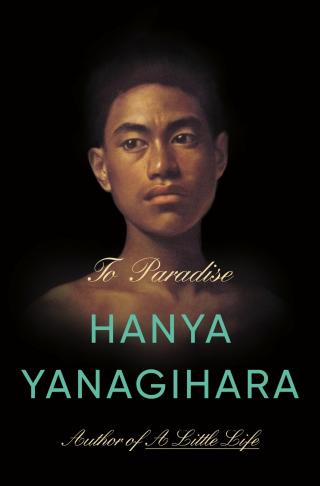
To Paradise
- Автор: Yanagihara Hanya
- Год: 2022
- Язык: английский
- Год: Knopf Doubleday Publishing Group
- Жанр: Современная русская и зарубежная проза

Электронная книга - «To Paradise». Краткое содержание книги:
In an alternate version of 1893 America, New York is part of the Free States, where people may live and love whomever they please (or so it seems). The fragile young scion of a distinguished family resists betrothal to a worthy suitor, drawn to a charming music teacher of no means. In a 1993 Manhattan besieged by the AIDS epidemic, a young Hawaiian man lives with his much older, wealthier partner, hiding his troubled childhood and the fate of his father. And in 2093, in a world riven by plagues and governed by totalitarian rule, a powerful scientist's damaged granddaughter tries to navigate life without him--and solve the mystery of her husband's disappearances.
These three sections are joined in an enthralling and...
And here I must restate that I never blamed you for leaving me. I was not your responsibility; you were mine. You had to find your way out of a situation you should never have been in at all.
Over the years, I kept waiting for the day you would ask about your mother, but you never did. I’ll admit that I was relieved, although, later, I came to realize that you might not have asked because you wanted to protect me, because you were always trying to protect me, when I was the one who should have been protecting you. Your apparent lack of interest in your mother was the subject of a fight I had with your grandmother, one of the few times I stood up to her. “It’s strange,” she had said, after a parent-teacher conference we had attended, in which your teacher had mentioned that she didn’t know anything about your mother, “strange how incurious he is.” She was implying that this meant you were slow, somehow, slow or tepid, and I barked at her. “So you want him to start asking?” I demanded, and she shrugged, slightly, not lifting her eyes from her quilting ring. “Of course not,” she said. “I just think it’s odd that he doesn’t.” I was furious with her. “He’s just a little boy,” I said, “and he believes what you told him. I can’t believe you’re complaining about the fact that he trusts you, that you’re trying to make it sound like a flaw.” I got up and left the room, and that night, she had Jane prepare rice pudding, your favorite, which I knew was her way of apologizing to you, even though you would never know that it was an apology.
Eventually, it became easy for us to pretend that you’d never had a mother at all. There was a Japanese folktale that you had liked me to tell you, about a boy who was born from a peach and found by an old childless couple. “Read me ‘Momotaro’ again,” you’d say, and then, when I had, “Again.” After a while, I began telling you a version about a boy, Mangotaro, who was discovered inside a mango hanging from the tree in our yard, and how that boy grew up to have many adventures and make many friends. The story always ended with the boy leaving his father and grandmother and aunt and uncle and going far away, where he would have new adventures and make new friends. I knew, even then, that my job was to remain, and yours was to leave, to go somewhere I would never see, to have a life of your own.
“What happens next?” you’d ask when the story was over, and I’d kissed you good night.
“You’ll have to come back and tell me someday,” I’d say.
Kawika: It happened again. I had a dream that I was standing, and not just standing but walking. My hands were extended before me, like a zombie, and I was shuffling one foot and then the other. And then I realized that, again, I wasn’t dreaming but really walking, and I began to concentrate, using my hands to touch the walls, edging my way around the room.
My bed is in the center of the room, which I knew because I’d heard my mother complain about it—Why, she wondered, was it in the center, instead of pressed up against one wall or another?—and yet I was glad of it, because it made the space easier to navigate. Here was the wall of windows that looked over the garden; here was the doorway to the bathroom where I was taken for my baths and showers; here was the door—locked—to, I imagined, the hallway. Here was a chest of drawers, on top of which were a few bottles, some heavy, some light, some glass, some plastic. I opened the top drawers and felt my shorts, my T-shirts. The floor was cold, tile or stone, but as I neared my bed, I encountered a different surface, which I recognized as a woven lauhala mat, satiny beneath my feet, the same kind as I’d had in my room back home. They kept the whole room cool, Jane used to say, and even though they splintered and shagged, they were easy to replace every few months.
After I found my way back to bed, I lay awake for a long time, for I had realized: What if I were to leave? If I could walk, was it not possible that other things would return to me as well? My eyesight, for example? My speech? What if I were to walk out of here one night? What if I were to come find you? Wouldn’t that be a surprise? To see you again, to hold you again? I knew that, in the meantime, I wouldn’t tell anyone, not until I’d practiced more, and, indeed, the walk, as short as it was, had left me panting. But now you know, too. I’m going to come find you—I’m going to walk there myself.
I had been walking as well the day I reencountered Edward. It was 1969, and I had had you for just four months—you weren’t yet a year old. A few times a week, I had Matthew drive us down to Kapi‘olani Park, where I’d push you among the monkeypod and shower trees; sometimes we’d stop to watch the cricket club play their matches. Or sometimes I’d walk you over to Kaimana Beach, where I used to linger to watch the fishermen.
Back then—and maybe even now—it was unusual to see a young man pushing a carriage, and sometimes people would laugh. I never said anything, though, never spoke back, just kept moving. So that morning, when I felt, rather than saw, someone stop to stare, I didn’t think anything of it, and it wasn’t until the person spoke my name that I too stopped, and then only because I recognized the voice.
“How’ve you been?” he asked, as if it had been just a week, rather than nearly a decade, since we had seen each other last.
“Pretty good,” I said, shaking his hand. I had heard he had moved to Los Angeles, where he had gone to college, and told him so, but he shrugged. “I just came back,” he said. Then he looked into the carriage. “Whose baby is that?” he asked.
“Mine,” I said, and he blinked. Another person might have brayed in astonishment, or thought I was joking, but he only nodded. I remembered that he had never joked, and never thought anyone else was joking, either.
“Your son,” he said, as if tasting the word. “Little Kawika,” he said, testing out the name. “Or does he go by ‘David’?”
“No, Kawika,” I said, and he smiled, slightly.
“Good,” he said.
Somehow it was arranged that we should go get something to eat, and we loaded everything into his beat-up car and drove to Chinatown, where we went to my twenty-five-cent wonton min restaurant. On the way, I asked about his mother, and I knew by his silence, the way his face twisted before he answered, that she was dead—breast cancer, he said. It was why he was home.
“I wish I had known,” I said; I felt as if I had been punched. But he shrugged. “It was slow, and then quick,” he said. “She didn’t suffer too much. I buried her in Honoka‘a.”
After that lunch, we began seeing each other again. It wasn’t as if we discussed it: He just told me he’d pick me up on Sunday at noon and we could go to the beach, and I agreed. Over the weeks and then months, we saw more and more of each other, until I was seeing him at least every other day. Curiously, we rarely discussed where he’d been, or where I’d been, or what we’d done in the years since we saw each other last, or why we had drifted apart in the first place. But although the past was not so much forgotten as it was excised, we were both careful—again, without ever discussing it—about not letting my mother discover our renewed communication. When he came, I would wait (sometimes with you, sometimes alone) on the porch if she was out, or at the bottom of the hill if she was home, which is where Edward dropped me off as well.
It’s difficult to remember what we discussed in those days. This may surprise you to hear, but it took me many months to realize that Edward had changed in some fundamental way—I don’t mean the kind of change we all experience when we move from childhood to adulthood, but that, in his beliefs and convictions, he had become someone I no longer recognized. Part of this, I’m embarrassed to say, is that, because he looked very much the same, I assumed he was very much the same. I knew, from television news reports, that the mainland was full of long-haired hippies, and while there were hippies in Honolulu as well, there was no sense of rage, of revolution. Everything came late to Hawai‘i—even our papers carried day-old news—and so, if you had seen Edward then, you wouldn’t have been able to immediately identify him as a political radical by sight alone. Yes, his hair was longer, fluffier, than mine, but it was always clean; the effect was less intimidating than it was merely pretty.