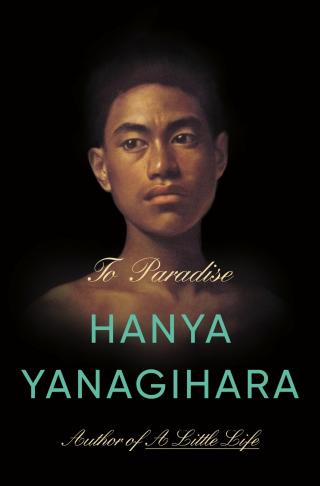
To Paradise
- Автор: Yanagihara Hanya
- Год: 2022
- Язык: английский
- Год: Knopf Doubleday Publishing Group
- Жанр: Современная русская и зарубежная проза

Электронная книга - «To Paradise». Краткое содержание книги:
In an alternate version of 1893 America, New York is part of the Free States, where people may live and love whomever they please (or so it seems). The fragile young scion of a distinguished family resists betrothal to a worthy suitor, drawn to a charming music teacher of no means. In a 1993 Manhattan besieged by the AIDS epidemic, a young Hawaiian man lives with his much older, wealthier partner, hiding his troubled childhood and the fate of his father. And in 2093, in a world riven by plagues and governed by totalitarian rule, a powerful scientist's damaged granddaughter tries to navigate life without him--and solve the mystery of her husband's disappearances.
These three sections are joined in an enthralling and...
“It’s not a matter of being Hawaiian or not Hawaiian,” my mother said, “it’s tradition.”
“Yes, but whose tradition?” Edward asked.
“Why, everyone’s,” she said.
“Not mine,” Edward said.
“I should think it is,” my mother said, and then, to me, “Please pass me the rice, Wika.”
“Well, it’s not mine,” Edward repeated.
She didn’t respond. It wasn’t until many years later that I was able to appreciate my mother’s equanimity that night. There was nothing obviously argumentative in Edward’s tone, but she had known anyway, known long before I had—I hadn’t grown up with anyone challenging who I was or what I deserved, but she had. Her right to her name and her birth had always been questioned. She knew when someone was trying to provoke her.
“It’s a Christian tradition,” he finally said into her silence. “Not ours.”
She allowed herself a small smile, looking up from her plate to do so. “So there aren’t such things as Christian Hawaiians, then?” she asked.
He shrugged. “Not if you’re a real Hawaiian.”
Her smile grew wider, tenser. “I see,” she said. “My grandfather would be surprised to hear that—he was a Christian, you know; he served in the king’s court.”
He shrugged again. “I’m not saying there aren’t such things as Christian Hawaiians,” he said, “just that the two are in opposition to each other.” (Later, he would repeat the same thing to me, extending the point past what he knew firsthand: “It’s like how people always talk about the black Christian experience. But don’t the blacks know that they’re celebrating the tools of their oppressor? They were encouraged to be Christian so they would think something better awaited them in the afterlife, after years of being abused. Christianity was a form of mind control, and it still is. All that moralizing, all that talk of sin—they swallowed it, and now they’re kept imprisoned by it.”) When she still said nothing, he kept talking. “It was Christians who took away our dance, our language, our religion, our land—even our queen. Which you should know.” She looked up then, startled, as did I—no one had ever before confronted my mother like that—and he stared back at her. “So it just seems bizarre that any true Hawaiian could believe in an ideology whose practitioners robbed them of everything.”
(Real Hawaiian, true Hawaiian—it was the first time I would hear him use those phrases, and soon I would be sick of the terms, as much because I felt accused by them as because I didn’t understand them. All I knew was that a real Hawaiian was something I was not: A real Hawaiian was angrier, poorer, more strident. He spoke the language, fluently; he danced, powerfully; he sang, soulfully. He was not only not American, he would be angry if you ever called him that. The only thing I had in common with a real Hawaiian was my skin and my blood, though later, even my family would become a deficit, proof of my accommodationist tendencies. Even my name would be deemed not Hawaiian enough, even though it had been the name of a Hawaiian king—it was the Hawaiianization of a Christian name, and therefore not Hawaiian at all.)
We might have sat there, frozen, forever had my mother not looked over to me—no doubt in anger—and gasped. “Wika!” I heard her say, and when I opened my eyes next, I was in my bed in a darkened room.
She was sitting next to me. “Careful,” she said, when I tried to sit, “you had a seizure and hit your head. The doctor said you should stay in bed for another day. Kawika’s fine,” she continued, when I began to speak.
For a while, we were silent. Then she spoke again. “I don’t want you to see Edward anymore, do you understand me, Wika?” she asked.
I could have laughed, I could have scoffed, I could have told her that I was an adult, that she could no longer tell me who I could talk to or not. I could have told her that I found Edward alarming as well, but exciting, too, and that I was going to keep seeing him.
But I did none of those things. I simply nodded, and closed my eyes, and before I fell asleep again, I heard her say, “Good boy,” and then felt her lay her palm on my forehead, and as I lost consciousness, I had the feeling that I was a child again, and that I was being given the chance to live my life all over, and this time, I would do everything correctly.
I kept my promise. I did not see Edward. He called, but I didn’t come to the phone; he stopped by the house, but I made Jane say I wasn’t there. I stayed inside and I watched you grow. When I went out, I was anxious: Honolulu was (and is) a small town on a small island, and I was always afraid I would encounter him, but I somehow never did.
Nothing changed for me in those three years I was in hiding. But you changed: You learned to speak, first in sentences and then paragraphs; you learned to run, and to read, and to swim. Matthew taught you to climb up to the lowest branch of the mango tree; Jane taught you how to tell a juicy mango from a fibrous one. You learned a few words in Hawaiian, which my mother taught you, and a few in Tagalog, which Jane taught you, but only in secret: Your grandmother didn’t like the sound of the language, and you knew not to speak it in front of her. You learned which foods you liked—like me, you preferred salt over sugar—and you made friends, effortlessly, in a way I had never been capable of doing. You learned to call for help when I had one of my seizures, and then, when I emerged from it, to come pat the side of my face, and I would grab your hand in mine. These were the years when you loved me the most. You could never love me more than, or even as much as, I loved and love you, but in that period, we were closest in mutual affection.
You changed, and so did the rest of the world. Every night on television there was at least one report about the day’s protests: First there were people protesting against the war in Vietnam, and then there were people protesting for blacks, and then for women, and then for homosexuals. I watched them on our little black-and-white set, those swaying, shifting masses of people in San Francisco, and Washington, D.C., and New York, and Oakland, and Chicago—I always wondered if Bethesda, who had left the island directly after his speech, was in one of those crowds. The protestors were almost always young, and although I too was young, not yet thirty in 1973, I felt much older—I didn’t recognize myself in any of them; I felt no affinity for them or their struggles or their passions. It wasn’t just that I didn’t look like them; it was that I couldn’t understand their fervor. They had been born with access to and an understanding of extremes, but I had not. I wanted time to slip past me, one year indistinguishable from the next, you the only calendar I had. But they wanted to stop time—stop it, and then speed it up, making it go faster and faster until the entire world burst into flames and would have to start over.
There were changes here, too. Sometimes there would be stories on TV about the Keiki kū Ali‘i. This was a group of native Hawaiians who, depending on which member you asked and on which day, were demanding either Hawai‘i’s secession from the United States, or the restoration of the monarchy, or nation-within-a-nation status for native Hawaiians, or the creation of a Hawaiian state. They wanted Hawaiian language classes to be mandatory in schools, and they wanted a king or queen, and they wanted all haoles to get out. They didn’t even want to call themselves Hawaiian anymore: Now they were kanaka maoli.
Watching these reports always felt like an illicit activity, and fear that one of them might air while I was in the room with my mother made me stop watching the early-evening news altogether. I only did so when I knew she’d be out of the house, and even then, I kept the volume low, so if she came back early I’d be able to hear her and turn off the television. I’d sit close to the set, ready to switch it off in a flash, my palms tacky with sweat.