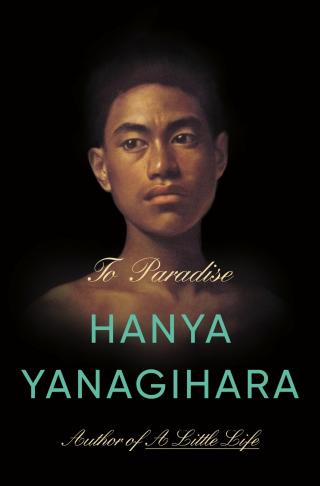
To Paradise
- Автор: Yanagihara Hanya
- Год: 2022
- Язык: английский
- Год: Knopf Doubleday Publishing Group
- Жанр: Современная русская и зарубежная проза

Электронная книга - «To Paradise». Краткое содержание книги:
In an alternate version of 1893 America, New York is part of the Free States, where people may live and love whomever they please (or so it seems). The fragile young scion of a distinguished family resists betrothal to a worthy suitor, drawn to a charming music teacher of no means. In a 1993 Manhattan besieged by the AIDS epidemic, a young Hawaiian man lives with his much older, wealthier partner, hiding his troubled childhood and the fate of his father. And in 2093, in a world riven by plagues and governed by totalitarian rule, a powerful scientist's damaged granddaughter tries to navigate life without him--and solve the mystery of her husband's disappearances.
These three sections are joined in an enthralling and...
The tribesman did, scratching and jumping, and then, after a pause during which he looked at the audience, his eyes opened wide, his mouth, which had been circled with red lipstick, stretched taut, he made a lunging leap at the president, trying to take a bite out of his cheek.
“Help!” shouted the president. “Help!” The two began to run around the stage, the tribesman’s teeth coming together in a sharp wooden click as he bit down on air, cackling and whooping as he chased the president into the wings.
The two actors returned to the stage to loud applause. The audience had been laughing the entire time, in an exaggerated, obscene way, almost as if they’d never laughed before and were just learning how. Only two of us were silent: me, and an upperclassman from Ghana whom I didn’t know. I watched him watching the stage, his face still and clenched, and realized he thought it was about him and his home, but I knew it was about me and mine—the cardboard palm trees, the ferns tied in clumsy bunches around the savage’s ankles and wrists, the lei made of cut-up plastic straws and newsprint flowers. It was a cheap, coarse costume, cheaply and coarsely made, dismissive even in its ridicule. This is what they thought of me, I realized, and later, when Edward first mentioned Lipo-wao-nahele, it was this night that I remembered, the sensation of watching, frozen, as everything I was, and everything my family was, was brutally dismembered, stripped naked, and pushed onto the stage to be howled at.
How could I have remained there, after that? I packed a bag and took a bus south, to Manhattan, where I checked in to the Plaza, the only hotel whose name I knew. I sent a telegram to my uncle William, who managed my father’s estate, asking him to wire me money and not tell my mother; he sent one back saying he would, but he wouldn’t be able to keep this from her forever, and he hoped I was being smart.
I spent the days walking. Every morning, I went to a diner near Carnegie Hall for breakfast, where I could have fried eggs and potatoes and bacon and coffee for far less than I’d have to pay at the hotel, and then I walked north or south or east or west. I had a tweed coat, expensive and handsome but not quite warm enough, and as I walked, I breathed on my hands, and when I could bear the cold no longer, I would find a diner or coffee shop and go inside to have a hot chocolate and get warm.
My identity changed with the neighborhood I found myself in. In midtown, they thought I might be black, but in Harlem, they knew I wasn’t. I was spoken to in Spanish and Portuguese and Italian and even Hindi, and when I answered, “I’m Hawaiian,” I would invariably be told that they or their brother or cousin had been there after the war, and asked what I was doing up here, so far from home, when I could be on the beach with a pretty little hula girl. I never had an answer to these questions, but they didn’t expect one—it was all they knew to ask, but no one wanted to hear what I had to say.
On my eighth day, though—Uncle William had sent me a telegram that morning saying that my mother had been alerted by the bursar’s office that I had left school, and was instructing him to send me a ticket home, which would be waiting for me that evening—I was walking back to the hotel from Washington Square Park, where I’d gone to see the arch. It was very cold that afternoon, whipping wind, and the city seemed to mirror my mood, which was gray and bleak.
I had walked north on Broadway, and as I turned east on Central Park South, I almost stumbled into a beggar. I had seen him before; he was a squat, dark, beaten man, always on this corner, in a much too long black coat—he held before him with both hands an old-fashioned felt bowler, the kind that had been fashionable thirty years ago, and which he shook as people passed. “Spare a dime, sir?” he would call. “Spare a nickel?”
I was passing him, about to murmur my regrets, when he saw me, and as he did, he suddenly snapped, soldierlike, to his full height, before bowing at the waist. I heard him gasp. “Your Highness,” he said, to the pavement.
My first reaction was shame. I looked around me, but no one was staring at us; no one had seen.
He gazed up at me, his eyes wet. I could see now that he was one of mine, one of us: His face was one I knew in shape and color and form, if not in its specifics. “Prince Kawika,” he said, his voice slurry with emotion and alcohol; I could smell it on him. “I knew your father,” he said, “I knew your father.” And then he shook his hat at me. “Please, Your Highness,” he said, “please give something to one of your subjects, so far from home.”
There was nothing sly in his voice, only beseechment. Only later, back in my room, would I wonder why he was so far from home, how he had ended up begging on a street corner in New York, and if he had really known my father—it was possible, after all. For true royalists, which this man seemed to be, statehood was an insult, a loss of hope. “Please, Your Highness, I’m very hungry.” His hat was dark, and I could see only a few coins inside, sliding around in the bowl of shiny felt.
I took out my wallet and hurriedly gave him everything I had—about forty dollars, I thought—and then I hurried on, moving away from his cries of thanks. I was Prince Woogawooga of the Ooga-ooga, except, instead of running after someone, I was running from him, as if he would pursue me, this man who called himself my subject. He was hungry, and he would open his mouth, and when he closed his jaws, I would be within them, my head being chewed to bits, waiting for the play to be over.
—
I went home; I enrolled in the University of Hawai‘i, which the graduates of my school only attended if they were poor or had poor grades. Upon graduating, I was given a job at what had been my father’s company, except it wasn’t actually a company, insofar as it produced nothing, sold nothing, and bought nothing—it was a collection of my family’s remaining real-estate holdings and investments, and aside from Uncle William, who was a lawyer, and an accountant, there was a clerk and a secretary.
Initially, I showed up every day at eight. But within a few months, it became clear that my presence was superfluous. My title was “estate manager,” but there was nothing to manage. The trust was conservative, and a few times a year, some stocks would be bought or sold and the dividends reinvested. A rabbity Chinese man was contracted to gather rents from the various residential properties and, if the renters refused to or were unable to pay, a Samoan, enormous and terrifying, was sent on a follow-up visit. The trust’s goals were deliberately unambitious, because ambition entailed risk, and after the resolution of my father’s debts, the focus was on maintenance, on providing enough for my mother and me to live on, and, if they planned correctly, my great-grandchildren and great-great-grandchildren as well.
Once it became clear that the firm would totter on whether I was there or not, I began taking long breaks. The offices were downtown in a beautiful old Spanish-style building, and I would leave at eleven, before the lunch crowds, and walk the few blocks to Chinatown. I drew a salary, but I lived modestly—I would go to a restaurant that served a bowl of pork-and-shrimp wonton min for a quarter, and after paying I would wander the streets, past the hawkers arranging their pyramids of starfruit and rambutan, past the apothecaries with their bins of shriveled roots and dried seeds, their rows of glass jars filled with a cloudy liquid and curls of herbs and different unidentifiable animal paws, shorn of their fur. Nothing ever changed in Hawai‘i; it was as if every day I walked onto a stage set, and every morning, long before I woke, it was unfurled, swept clean, and readied for me to pass through it again.
Of course I was lonely. Some of the boys who I had been able to pretend were my friends in high school came back to town as well, but they were busy with graduate school or their new jobs, and much of my time was spent as it had been when I was a child: in my bedroom at my mother’s house, or in the sunroom watching television on the little black-and-white set I had bought with some of my salary. On weekends, I went to watch the fishermen at Waimānalo or Kaimana; I went to the movies. I turned twenty-two, and then twenty-three.