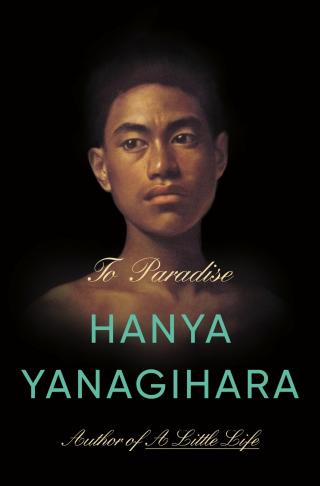
To Paradise
- Автор: Yanagihara Hanya
- Год: 2022
- Язык: английский
- Год: Knopf Doubleday Publishing Group
- Жанр: Современная русская и зарубежная проза

Электронная книга - «To Paradise». Краткое содержание книги:
In an alternate version of 1893 America, New York is part of the Free States, where people may live and love whomever they please (or so it seems). The fragile young scion of a distinguished family resists betrothal to a worthy suitor, drawn to a charming music teacher of no means. In a 1993 Manhattan besieged by the AIDS epidemic, a young Hawaiian man lives with his much older, wealthier partner, hiding his troubled childhood and the fate of his father. And in 2093, in a world riven by plagues and governed by totalitarian rule, a powerful scientist's damaged granddaughter tries to navigate life without him--and solve the mystery of her husband's disappearances.
These three sections are joined in an enthralling and...
One of the most difficult concepts for me to understand was this idea that I, and my mother, belonged to an us at all. Those thick brown men, slow-moving and massive, whom I saw drunk and dozing in the park: They may have been Hawaiian, but I felt no kinship toward them. “They’re kings too, brother,” Edward reprimanded me, and although I didn’t say it, I thought of what my mother would tell me when I was young: “Only a few people are kings, Wika.” Perhaps I was like my mother in the end, though I meant no harm; she would have seen those people as unlike her because she thought them beneath her, while I saw them as unlike me because I was scared of them. I wouldn’t deny that we were of the same race, but we were different sorts of people, and that was what divided us.
I had assumed all along that Edward was a member of Keiki kū Ali‘i—in my dreams, as I have said, he was not only a member but their leader. But that turned out not to be true. He had been a member, he told me, but he had soon afterward left. “Bunch of ignoramuses,” he scoffed. “Didn’t know how to organize themselves.” He had tried to teach them what he knew about organizing from his time on the mainland; he had pushed them toward being more expansive, more radical in their approach. But they had wanted only small things, he said: more land set aside for poor Hawaiians, more social welfare programs. “That’s the problem with this place—it’s too provincial,” he often said. For, as appalled as he would be if this were pointed out to him, he too could be a snob; he too thought himself better.
I had played an unwitting role in his disenchantment with the group, he said. It was he who had pushed for the restoration of the monarchy, he who had introduced the language of secession and overthrow. “I told them, I already know the king,” he said, and although it was less a compliment than a statement of fact—I would be king, after all; would have been king—it was as if he’d praised me anyway, and I felt my cheeks grow warm. Yet talk of secession and overthrow had proven, he said, too intimidating for most of the members, who feared it would jeopardize their chances to earn other concessions from the state; they quarreled, and Edward lost. “A shame,” he told me now, letting his fingers flutter out the car window. “They’re so small-minded.” We were on our way toward Waimānalo, on the eastern coast, and as he zagged down the road, I stared out at the ocean, a wrinkled sheet of blue.
We had meant to stop at a plate-lunch place Edward liked just before Sherwood Forest, but we instead drove on. At some point I had a seizure, and I could feel my head slumping against the seat and hear the sound of Edward’s voice, even though I couldn’t distinguish his words, and the sun throbbed behind my eyelids. When I woke, we were parked beneath a large acacia tree. The car smelled like fried meat, and I looked over to see Edward staring back at me and eating a hamburger. “Wake up, lolo,” he said, but good-naturedly, “I got you a burger,” but I shook my head, which made me dizzier—I was too nauseated to eat after one of my attacks. He shrugged. “Suit yourself,” he said, and ate the other burger, and by the time he was done, I was feeling a little better.
He had something to show me, he said, and we got out of the car and began walking. We were somewhere in the very northern part of the island—I could tell by how empty it was. We were standing in a large plain of sun-dried, unshorn grass, and around us was nothing: no houses, no buildings, no cars. Behind us were the mountains, and in front of us was the ocean.
“Let’s go to the water,” Edward said, and I followed him. On our way, we walked across a bumpy, silty dirt path; there was no paved road in sight. As we went, the tall grasses grew sparser and thinner and eventually gave way to sand, and then we were on a beach, where waves lapped against the shore and withdrew, again and again.
I cannot describe to you what made it seem so foreign. Perhaps it was the lack of people, though back then there were still places on the island where you could go and be alone. Yet there was something that felt especially isolated about this area, isolated and abandoned. Though I was unable—and am still now not able—to say why: Here was sand, grass, mountain, the same three elements you would find all over the island. The trees, palms and monkeypods and halas and acacias, were the same as we had in the valley; the stalks of heliconia were the same. And yet it was different in some unexplainable way. Later, I would try to tell myself that I had known from the moment I saw this land that I would return to it, but that was fiction. What is more likely is the opposite: That, given what happened there, I’ve begun to remember it differently, as a place that felt meaningful, when at the time it hadn’t struck me as special at all, just a piece of unoccupied land.
“What do you think of it?” Edward asked, finally, and I looked up at the sky.
“It’s pretty,” I said.
He nodded, slowly, as if I’d said something profound. “It’s yours,” he said.
This was the kind of thing he’d taken to saying, gesturing out the window at beaches, where kids ran up and down the sand, lofting kites in the air, or at parking lots, or on our walks through Chinatown: This land is yours, he’d say, and sometimes he meant it was mine because of who my ancestors were, and sometimes he meant it was mine because it was also his, and the land belonged to us because we were Hawaiians.
But when I turned, I found he was staring at me. “It’s yours,” he repeated. “Yours and Kawika’s. Here,” he continued, before I could speak, and pulled from his pocket a piece of paper, which he quickly unfolded and presented to me. “I went down to the property records office in the state building,” he said, excited. “I looked up your family’s records. You own this land, Wika—it was your father’s, and now it’s yours.”
I looked at the paper. “Lot 45090, Hau‘ula, 30.3 acres,” I read, but I was suddenly unable to read anything else, and I handed it back to him.
I was at once very tired and thirsty; the sun above us was too hot. “I need to lie down again,” I said to him, and felt the ground beneath me crater and then sink, and my head fall, as if in slow motion, into Edward’s palms. For a while, there was silence. “You big lolo,” I heard him say at last, but as if from far away, and his voice was fond. “You dummy,” he said, “you dummy, you dummy, you dummy,” repeating the word like a caress, while above me the sun stopped in its path, turning everything around me a bright, unyielding white.
Kawika: I can now walk all the way around my room without getting tired. I keep the wall on my right and use my hand to guide me: The walls are stucco and cool and bumpy, and I can sometimes convince myself I’m feeling something living, like the skin of a reptile. Tomorrow night I’ll attempt walking down the hallway. Last night I tried the handle for the first time, assuming it was locked, but it depressed easily in my hand, so easily I was almost disappointed. But then I remembered that I had something new to try, and that with each night I was able to prove myself able to walk farther and farther, I was getting closer to you.
Your grandmother came to visit me today. She talked about the price of pork, and her new neighbors, of whom she clearly disapproves—he’s Japanese, raised in Kaka‘ako; she’s haole, from Vermont; they’re both research scientists who got rich manufacturing some sort of antiviral—and a blight that’s infected the ‘ōhai ali‘i tree; I had hoped she might have news of you, but she didn’t. It’s been so long since she’s mentioned you, and sometimes I worry that something’s happened. But this is only during daylight—somehow, at night, I know you’re safe. You may be far from me, maybe too far, but I know for certain that you’re alive, alive and healthy. Recently, I’ve been having a dream of you with a woman; you two are walking down Fifty-seventh Street, just as I once did, your arms linked. You turn to her and she smiles. I can’t see her face, only that she’s dark-haired, like your mother was, but I know she’s beautiful, and that you’re happy. Maybe this is what you’re doing right now? I like to think it is.