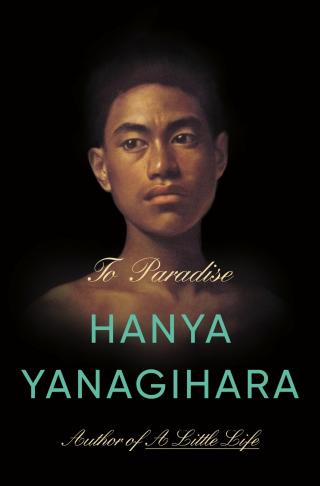
To Paradise
- Автор: Yanagihara Hanya
- Год: 2022
- Язык: английский
- Год: Knopf Doubleday Publishing Group
- Жанр: Современная русская и зарубежная проза

Электронная книга - «To Paradise». Краткое содержание книги:
In an alternate version of 1893 America, New York is part of the Free States, where people may live and love whomever they please (or so it seems). The fragile young scion of a distinguished family resists betrothal to a worthy suitor, drawn to a charming music teacher of no means. In a 1993 Manhattan besieged by the AIDS epidemic, a young Hawaiian man lives with his much older, wealthier partner, hiding his troubled childhood and the fate of his father. And in 2093, in a world riven by plagues and governed by totalitarian rule, a powerful scientist's damaged granddaughter tries to navigate life without him--and solve the mystery of her husband's disappearances.
These three sections are joined in an enthralling and...
When the evil-hearted messenger comes
With his greedy document of extortion—”
He had only said the first line when the singing began, and although he’d said he wanted us to listen to the lyrics, he clapped his hands together when the melody started, and then again when the first person, his friend Brother Louis, stood to dance. This was a song we all knew, written shortly after the queen was overthrown. I had always considered it an old song, even though, as Bethesda had said, it wasn’t so old at all—there were people alive today who would have heard it played by the Royal Hawaiian Band shortly after it had been written; there were people in the room whose grandparents would have remembered seeing the queen in her black bombazine, waving to them from the palace steps.
Now he stood and watched us, his smile wide again, as if he had willed all of this to happen, as if he had brought us back to life after a long hibernation and was witnessing us remember who we were. I hadn’t liked the pride on his face, as if we were his clever children and he our tireless teacher. Each stanza was sung once in Hawaiian and then again in English, and I hadn’t liked how he recited along with the translation, referring to the sheet of paper he’d taken from his pants pocket.
But mostly, I hadn’t liked the look I’d seen on Edward’s face when I had glanced his way: rapt as I’d never before seen him, his fist raised in the air like Bethesda’s, practically bellowing the song’s most famous lyrics, as if there were before him an audience of thousands, and all of them had gathered to hear him say something they had never heard before. ʻAʻole aʻe kau i ka pūlima Do not fix a signature Maluna o ka pepa o ka ʻenemi To the paper of the enemy Hoʻohui ʻāina kūʻai hewa With its sin of annexation I ka pono sivila aʻo ke kanaka And sale of the civil rights of the people ʻAʻole mākou aʻe minamina We do not value I ka puʻu kālā a ke aupuni The government’s hills of money Ua lawa mākou i ka pōhaku We are satisfied with the stones I ka ʻai kamahaʻo o ka ʻāina The wondrous food of the land.
If you were to ask my mother what happened next—not that I can, and not that anyone else would—she would say it was sudden, a complete surprise. But that isn’t true. Though I can also understand why she might feel that way. There were years of apparent inactivity followed by—without warning, she would probably say—a rupture. One night, you and I were there in the house on O‘ahu Avenue, lying in our beds; the next night, we were not. Later, I know, she would discuss our departure as a disappearance, something abrupt and unexpected. Sometimes, she would characterize it as a loss, as if the two of us were buttons or safety pins. But I knew it was more of a vanishing, a bar of soap smoothing and rounding itself into nothingness, diminishing beneath her fingertips.
There was another person, however, who would have agreed with my mother’s characterization of the events that followed, and ironically, that person was Edward. Later, he would say that he had been “transformed” by that night at Hale Kealoha, that it had been a kind of resurrection. I believe he felt that. On the ride back to town that night, we had been mostly silent, me because I was uncertain what I thought about Bethesda and what he had said, Edward because he had been so thunderstruck by it. As he drove, he would occasionally strike the steering wheel with the heel of his hand, bursting out with a “Damn!” or “Man!” or “Christ!,” and had I not been so unsettled, I might even have thought it was funny. Funny, or alarming—Edward, who showed so little excitement about anything, capable only of expulsions of sound, rather than speech.
Bethesda’s lecture had been recorded, and Edward procured a copy. In the weeks that followed, we would lie on the mattress in the bedroom he was renting from a family in the valley, listening to it again and again on his reel-to-reel, until we both had it memorized—not just the speech itself but the audience’s angry gasp, the creak of the floor as Bethesda shifted his weight from one foot to the other, the crowd’s singing, faint and tinny, atop of which Bethesda’s occasional claps were like explosions.
And yet, even after that night, it took some months for me to realize that something irrevocable had changed for Edward. I had never known him (insofar as I knew him at all) to be a dabbler or a bounder, someone who vaulted from one enthusiasm to another, so it wasn’t as if I witnessed his increasing interest in Hawaiian sovereignty and thought it was just a phase—rather, I’m convinced that he hid something of his transformation from me. I don’t believe it was because he was being duplicitous; I think it was because it was precious to him, precious and personal and also to some degree unfathomable, and he wanted to nurture it in private, where no one could see it and comment on it.
But if I could date the beginning of his different self, it was probably in December 1970, about a year after we listened to Bethesda in that house in Nu‘uanu. Even then, my mother was largely unaware that Edward had reentered my life—he still dropped me off at the bottom of the hill; he had still never come to the house. Before I got out of the car, I’d ask him if he wanted to come in, and every time, he’d say no, and I’d be relieved. But one night, I asked and he said, “Sure, why not?,” as if accepting were a regular occurrence, based on nothing more than his mood.
“Oh,” I replied. I couldn’t pretend he was kidding—as I’ve said, he didn’t kid. And so I got out of the car and he, after a second, followed.
As we walked up the hill, I grew more and more anxious, and when we reached the house, I mumbled something about needing to check on you—on the days I brought you with me, I’d sit in the back seat and hold you in my arms—and sprinted upstairs to look at you, asleep in your bed. We’d recently moved you into a little bed of your own, low to the ground and surrounded by cushions, because you were an active, squirmy sleeper and sometimes rolled off the futon and onto the floor. “Kawika,” I remember whispering to you, “what should I do?” But you didn’t answer, of course—you were asleep, and you were only two.
By the time I returned downstairs, my mother and Edward had already encountered each other and were waiting for me at the dinner table. “Edward tells me that you’ve reacquainted yourselves,” she said, after we’d served ourselves, and I nodded. “Don’t nod, speak,” she said, and I cleared my throat and made myself speak.
“Yes,” I said.
She turned to Edward. “What are you doing this Christmas?” she asked, as if she saw Edward every month, as if she knew enough about how he normally spent Christmas to understand whether this year’s celebrations would be typical or unusual.
“Nothing,” he said, and then, after a pause, “I see you have a tree.”
He spoke neutrally enough, but my mother, already suspicious of him, and therefore alert, straightened. “Yes,” she replied, also neutrally.
“That’s not very Hawaiian, is it?” he asked.
We all looked at the tree in the corner of the sunroom. We had a tree because we always had a tree. Every year, a limited number were imported from the mainland and made available to buy at great expense. There was nothing special about it except its sweet, uriney scent, which for many years I associated with the entire mainland. The mainland was asphalt and snow and highways and the fragrance of pine trees, the country trapped in perpetual winter. We took no particular pains in decorating it—indeed, it was Jane who did most of the ornamentation—but this year it seemed more interesting than before, because now you were here, and old enough to pull on its branches and laugh when you were scolded for doing so.