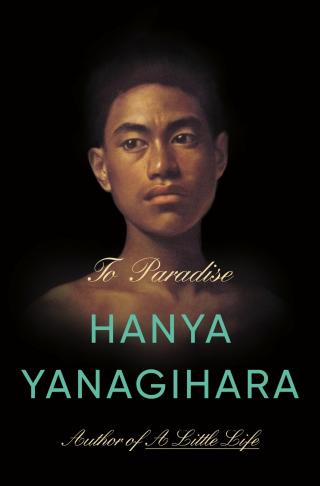
To Paradise
- Автор: Yanagihara Hanya
- Год: 2022
- Язык: английский
- Год: Knopf Doubleday Publishing Group
- Жанр: Современная русская и зарубежная проза

Электронная книга - «To Paradise». Краткое содержание книги:
In an alternate version of 1893 America, New York is part of the Free States, where people may live and love whomever they please (or so it seems). The fragile young scion of a distinguished family resists betrothal to a worthy suitor, drawn to a charming music teacher of no means. In a 1993 Manhattan besieged by the AIDS epidemic, a young Hawaiian man lives with his much older, wealthier partner, hiding his troubled childhood and the fate of his father. And in 2093, in a world riven by plagues and governed by totalitarian rule, a powerful scientist's damaged granddaughter tries to navigate life without him--and solve the mystery of her husband's disappearances.
These three sections are joined in an enthralling and...
I felt oddly protective—not of my mother but of the protestors, those wild-haired young men and women, my peers, chanting and raising their fists in an imitation of the Black Power members. I already knew what my mother thought of them—“What fools,” she’d murmured, almost sympathetically, after the end of the first segment that had aired and which we had watched together, in mesmerized silence, a year ago, “they don’t even know what they want. And how do they think they’ll get it? You can’t ask for the restoration of the monarchy and a new state at the same time”—and I for some reason didn’t want to hear her insult them further. I knew this was irrational, in part because I didn’t disagree with her: They did look ridiculous, in their T-shirts and big hair, breaking into ragged chants and song when the camera turned to them; their spokespeople could barely speak proper English, yet they stumbled in Hawaiian, too. I was embarrassed for them. They were so loud.
And yet I also envied them. Except for you, I had never felt such ardor for anything. I looked at those men and women and I knew what they wanted—their want was greater than logic or organization. I had always been told that I should try to live my life with happiness, but could happiness give you the zeal, the energy, that anger clearly could? Theirs was the kind of avidity that seemed to override any other desire—if you had it, you might never want again. At night, I’d experiment with pretending I was one of them: Could I ever be that incensed? Could I ever desire something so much? Could I ever feel that wronged?
I could not. But I began trying. As I have said, I had never before much considered what it meant to be Hawaiian. It was like considering being male, or human—they were things I was, and the fact that I was them seemed always to be enough to me. I began wondering if there was in fact another way to be, if I had been wrong this entire time, if I was somehow incapable of seeing what these other people seemed to see so clearly.
I went to the library, where I read books I had already read about the overthrow; I went to the museum, where my great-grandfather’s feather cape was displayed in a glass case, donated—the cape and the case—by my father. I tried to feel something—but all I could feel was a faint sense of amused disbelief that it was not the haoles who were doing things in my name but these activists themselves. Keiki kū Ali‘i: the children of royalty. But I really was a child of royalty. When they talked of a king who would be someday restored, they meant me, by rights, and yet they didn’t know who I was; they spoke of the king returning, yet they never thought to ask the king himself if he would want to return. But I also knew that what I was would always be more significant than who I was—indeed, what I was was the only thing that made who I was significant at all. Why would they ever think to ask me?
They wouldn’t, but Edward would. I’ll admit that, while I was too cowardly to speak to him, I was always looking for him. I squinted at the television, scanning the gang of protestors trying to infiltrate the governor’s office, the mayor’s office, the university president’s office. But although I saw Louis—Brother Louis—once or twice, I never saw Edward. Yet I always believed that he was there anyway, just out of camera range, leaning against a wall and surveying the crowd. In my imaginings, he even became something of a leader, elusive and evasive, bestowing his rare smile like a blessing on his followers when they did something to please him. At night, I dreamed of him standing in a shadow-filled house much like Hale Kealoha, giving a speech, and when I woke, I was astonished and full of admiration for him, his eloquence and elegance, until I realized that the words I had been so captivated by were not his but Bethesda’s, now recited back to myself so many times that they had become a hymn of my subconscious, like the state anthem or the song that Jane had sung to me as a boy, and which I now sang to you: Yellow bird, up high in banana tree / Yellow bird, you sit all alone like me…
So, when I finally did encounter him, I was only surprised it had taken as long as it had. It was a Wednesday, which I know because every Wednesday, after dropping you off at school, I took a long walk, all the way to Waikīkī, where I sat beneath one of the trees in Kapi‘olani Park we had sat beneath together when you were a baby, and ate a package of crackers. Each package had eight crackers, but I’d only eat seven; the last I’d crumble into ash and feed to the mynah birds, and then I’d get up again and keep walking.
“Wika,” I heard someone say, and when I looked up, there he was, walking toward me.
“Well, well,” he said, smiling. “Long time, no see, brother.”
The smiling was new. So was the “brother.” His hair was even longer now, almost blond in parts from the sun, and twisted into a bun, though strands of it floated around his head. He was tanner, which made his eyes look lighter and brighter, but the skin around them had wrinkled, and he had lost weight. He wore a faded aloha shirt, bleached a pale blue, and cutoff jeans—he looked both younger and older than I’d remembered him.
What remained the same was his lack of surprise at encountering me. “You hungry?” he asked, and when I said I was, he said we should walk to Chinatown and get some noodles. “Don’t have the car anymore,” he said, and when I made a sound of concern, or sympathy, he shrugged. “Doesn’t matter,” he said. “I’ll get it back. I just don’t have it now.” His left incisor was stained the color of tea.
The biggest change was his new volubility. (In those first six months of our most recent reacquaintance, I was always measuring what was different in him and what was familiar, which invariably led to the same unnerving realization: I didn’t know who he was. I knew a few facts, I had a few impressions, but the rest I had conjured, making him into whoever I needed him to be.) Over lunch, and then the following months, he talked more and more, until there were days when we would drive for hours (the car, which had vanished mysteriously, had reappeared just as mysteriously) and he would talk and talk and talk, and at times I would stop listening altogether, just lean my head back against the seat and let his words wash over me, as if it were a boring news report on the radio.
What did he talk about? Well, first, there was how he talked; he had adapted a kind of pidgin inflection, except because he hadn’t grown up speaking pidgin—he was a scholarship boy, after all; he wouldn’t have gotten into the school if his mother hadn’t been vigilant about his speaking standard English—it sounded artificial and weirdly formal. Even I could appreciate how rich and robustly casual pidgin sounded when spoken by natives: It wasn’t a language for exchanging ideas but one for trading jokes and insults and gossip. But Edward made it, or tried to make it, a language of instruction.
He didn’t need to ask if I understood the way things were—he knew I didn’t. I didn’t understand why our fate as Hawaiians was linked to black people’s fate on the mainland (“There are no black people in Hawai‘i,” I reminded him, echoing my mother’s statement as we watched a news report about some protest among blacks on the mainland one day. “There are no Negroes in Hawai‘i,” she had announced, the ghost of what she didn’t bother to say next—Thank goodness—hovering in the air between us). I didn’t understand how we’d been used as pawns, or his argument that the Orientals were taking advantage of us—many of the Orientals I knew and saw were clearly poor or, at the very least, far from rich, and yet, to Edward, they were as much to blame as the haole missionaries for the disappearance of our land. “You see them now, buying houses, opening businesses,” he said. “If they’re poor, they won’t stay poor forever.” Yet it seemed impossible to separate the Orientals and the haoles from who we were—every Hawaiian I knew was also part Oriental, or part haole, or both, or in some cases, like Edward’s (though I did not say this), mostly haole.