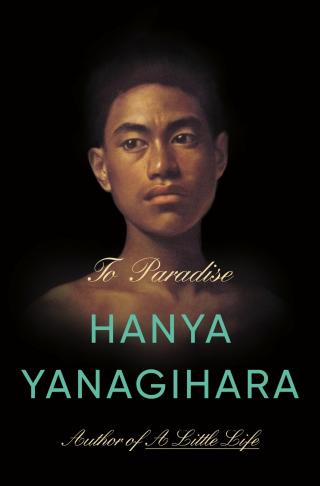
To Paradise
- Автор: Yanagihara Hanya
- Год: 2022
- Язык: английский
- Год: Knopf Doubleday Publishing Group
- Жанр: Современная русская и зарубежная проза

Электронная книга - «To Paradise». Краткое содержание книги:
In an alternate version of 1893 America, New York is part of the Free States, where people may live and love whomever they please (or so it seems). The fragile young scion of a distinguished family resists betrothal to a worthy suitor, drawn to a charming music teacher of no means. In a 1993 Manhattan besieged by the AIDS epidemic, a young Hawaiian man lives with his much older, wealthier partner, hiding his troubled childhood and the fate of his father. And in 2093, in a world riven by plagues and governed by totalitarian rule, a powerful scientist's damaged granddaughter tries to navigate life without him--and solve the mystery of her husband's disappearances.
These three sections are joined in an enthralling and...
One day when I was twenty-four, I was driving back to town. It was late in the evening. By this time, I had stopped going to work entirely, phasing myself out of the life of the office until I simply never returned. No one seemed upset or even surprised by this; it was my money, after all, and it continued to come to me in the form of a paycheck, every two weeks.
I was driving through Kailua, which was at the time a very small town, with none of the stores and restaurants it would have a decade later, when I passed a bus stop. Two times a month, I drove around the entire island, one week going east, the next, west. It was a way to pass the time, and I would sit on the beach near the stone church in Lā‘ie, where my father had once handed out money, and look at the sea. The bus stop was beneath a streetlamp, one of the few on the road, and seated at its bench was a young woman. I was driving slow enough so that I could see she had dark hair pulled back from her face, and wore a printed-orange cotton skirt—in the light, she appeared to be glowing. She sat very straight, her legs together, her hands folded in her lap, her purse strap looped over one wrist.
I don’t know why I didn’t just drive on, but I didn’t. I turned around in the road, which was deserted, and returned to her.
“Hello,” I said, when I was close to her, and she looked back at me.
“Hello,” she said.
“Where are you going?” I asked.
“I’m waiting for the bus to town,” she said.
“The bus doesn’t run this late,” I said, and for the first time, she looked worried.
“Oh, no,” she said. “I have to get back to the dorm or they’ll lock the doors.”
“I can drop you off,” I offered, and she hesitated, looking up and down the dark, empty road. “You can sit in the back seat,” I added.
At this she nodded, and smiled. “Thank you,” she said, “I’d be very grateful.”
She sat the same way as she had at the bus stop: erect and poised, her eyes straight ahead. I studied her in the rearview mirror. “I’m a student at the university,” she finally said, as if by way of an offering.
“What year are you?” I asked.
“A junior,” she said, “but I’m only here for the year.”
She was on an exchange program, she said; the next year she would return to Minneapolis, and graduate from her college there. Her name was Alice.
I began seeing her. She lived in one of the girls’ dormitories, Frear Hall, and I would wait in the lobby until she came down. Every Wednesday, she took weaving lessons in Kailua with an old Hawaiian lady, for which she always wore a modest, knee-length skirt and her hair pulled back. Otherwise, she wore jeans and let her hair loose. I could tell from its texture and the shape of her nose that she wasn’t entirely haole, but I didn’t understand what she actually was. “I’m Spanish,” she said, but I knew from my time on the mainland that “Spanish” could sometimes mean Mexican, or Puerto Rican, or something else altogether. She talked about her studies, and how she had come here because she wanted to be somewhere warm for once in her life, but had grown to love it, about how she wanted to go back home and become a teacher, and about how she missed her mother (her father was dead) and little brother. She talked about how she wanted a life full of adventure, about how living in Hawai‘i was a little like living abroad, and someday, she would live in China, and India, and, when the war was over, Thailand, too. We talked about what was happening in Vietnam, and about the election, and about music; in each case, she had more to say than I did. Sometimes she asked about my life, but there wasn’t much to tell. And yet she seemed to like me well enough; she was very gentle with me, and when I made mistakes, fumbling for too long with her clothes, she placed my hands on her shoulders and unbuttoned her dress herself.
We had sex in her room one night when her roommate was out. She had to tell me what to do, and how, and at first I was embarrassed, and then I felt nothing at all. Afterward, I thought about the experience: It had been neither pleasant nor unpleasant, but I was glad I had done it and glad it was over. I felt I had crossed some important threshold, one that marked me as an adult even as my daily life belied it. If it had been less enjoyable than I had assumed it would be, it had also been easier, and we met for a few times more, and it made me feel like my life was moving forward.
—
Now comes the part you know, Kawika, which is also the hard part.
Of course Alice knew who my family was, but it seemed she hadn’t realized its full implications until she had returned home. By the time the letter arrived at the firm, I had had the first of my seizures. Initially, I assumed they were headaches: The world would quiet and flatten, and shifting fields of color—of the kind we used to see together after we stared at the sun and then shut our eyes—would float across my field of vision. When I came to, it might be a minute later or an hour, and then I would be woozy and disoriented. After I was diagnosed, I lost my driver’s license; from there on, Matthew would have to drive me, and if Matthew was unavailable, my mother.
So I cannot quite remember the exact sequence of events that brought you home to me. I know your grandmother told you that your mother had effectively abandoned you, writing to Uncle William and telling him that someone had to come retrieve you because she was leaving Minneapolis again, this time to study in Japan, and her own mother was in no position to take care of a baby. Later, Uncle William told me that, while Alice had contacted the firm, it was your grandmother who, upon receiving evidence that you were in fact a Bingham, offered your mother money. Alice, your mother, countered with a different sum, one that Uncle William warned your grandmother would necessitate selling the house in Hāna. “Do it,” she told him, and she didn’t need to explain why: You would be the heir of the family, and there was no guarantee that I would ever produce another. She had to take the opportunity she was presented. A month later, Uncle William flew to Minnesota and had the papers countersigned; when he returned, it was with you. It was an echo of my mother’s own alleged origins, though neither of us ever acknowledged that.
I cannot say which version was true. I can say she had never told me—not that she was pregnant, not that she had given birth. She disappeared from my life after the end of the 1967 school year. I do know that she is indeed dead—she married at some point in the early seventies, to a man she met while a student in Kobe; they were killed in a boating accident in ’74. But as for why neither she nor her family ever made contact with you—I can only imagine it was because the terms of arrangement she made with your grandmother prohibited it.
You cannot be bitter about this, Kawika—not bitter toward your grandmother, or toward Alice. One wanted you very badly, and the other hadn’t planned on becoming a mother.
I can also say that you are and always were the joy of my life, that having you made me feel I might have something to contribute after all. You were still a baby when I got you, and in those years when you were learning to roll over, and sit, and walk, and talk, my mother and I were in harmony—because of you. Sometimes we would sit on the floor in the sunroom, watching you kick your legs and babble, and as we laughed or clapped at your efforts, we would sometimes catch each other’s eye, and it was as if we were not mother and son but husband and wife, and you were our child.
She was always proud of you, Kawika, as I was and as I am. She still is, I know it—she’s just disappointed, because she misses you, as I miss you too.