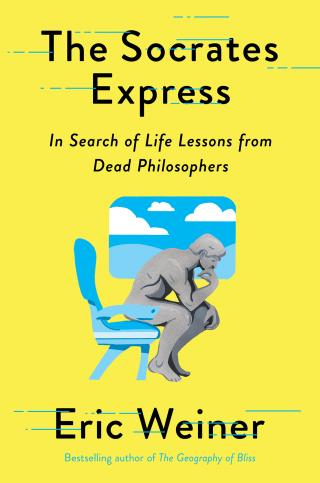
The Socrates Express
- Автор: Вейнер Эрик
- Год: 2020
- Язык: английский
- Год: Avid Reader Press / Simon & Schuster
- Жанр: География, путевые заметки

Электронная книга - «The Socrates Express». Краткое содержание книги:
We contemplate for the same reasons we travel: to see the world from a different perspective, to unearth hidden beauty and find new ways of being. We want to learn how to embrace wonder. Face regrets. Sustain hope.
Eric Weiner, *New York Times* bestselling author of *The Geography of Bliss* , combines his twin passions for philosophy and global travel in a pilgrimage that uncovers surprising life lessons from philosophers around the world, from Marcus Aurelius to Arthur Schopenhauer, Confucius to Montaigne. Traveling by train (the most thoughtful mode of transport) he traversed thousands of miles, making stops in Athens, Delhi,...
“Yes, I do, very much so.”
What do you mean by good?
Here I confess I haven’t a clue. Only the vaguest notions—inchoate, cartoonish images—spring to mind: ice cream sundaes, band recitals, soccer practice, homework coaching, college tours, jokes when she’s feeling down, and even if she’s not, sleepover pickups, yin to my wife’s yang. Good cop, mostly.
These are fine images, Socrates would say, but what do they add up to? You don’t really know what you mean when you say “good father,” do you? And, with a final twist of the philosophical knife, Socrates would suggest that until I knew, really knew, what I mean by “good father,” I couldn’t possibly become one. I was chasing a ghost.
For Socrates, all misdeeds, such as bad parenting, are committed not out of malice but ignorance. If we understood the ramification of our missteps—not only for our children but for ourselves, too—we wouldn’t commit them. A genuine understanding of a particular virtue leads to virtuous behavior. Automatically. To know—truly know—what it means to be a good father is to be one.
It was Take Your Child to Work Day. I always dread this day. Other parents take their children to shiny, serious offices with conference rooms and phone banks and gravitas. My office (one of them anyway) is a local diner called Tastee. The food does not live up to its name, but the booths are large, the waitresses friendly, and the coffee infinite. This year, for the first time, my daughter agreed to tag along.
How to break through to a thirteen-year-old is a mystery the world’s great philosophers have yet to solve. If a tree falls in the woods and her friends don’t share it on Snapchat, it didn’t fall. Sonya showed no interest in my work, in philosophy, in anything, it seems, beyond her teenage world. I suspected the only reason she agreed to go to work with me that morning was so she could skip a day of school.
As we picked at our breakfast—heart-healthy omelet for me, chocolate chip pancakes for her—I stared down the great void that is parenthood. I felt inadequate and, worse, invisible. What would Socrates do?
He would ask questions, of course. I’d been wrestling with one question in particular, a sort of meta question. Is that old saw true—is there really no such thing as a stupid question? I put this question to my daughter, who, with a barely perceptible twitch of her left eyebrow, indicated: I have registered your question, Father, and deemed it unworthy of a response, so I shall now return to my pancakes and Snapchat.
I persisted, like Socrates. “Is there such a thing as a stupid question?” I repeated, louder.
She lifted her head from the screen and thought for a while. At least I surmised she was thinking. Then, to my amazement, she spoke.
“Yes,” she said. “A stupid question is one you already know the answer to.” And with that she returned to her pancakes and her phone and her adolescent pique.
Not for the first, or last, time had she surprised me. She was right. Unless you happen to be a prosecutor, asking a question you already know the answer to is indeed stupid. We do this more often than you might think, and in various ways. We might ask a question to show off our knowledge, or to elicit information that buttresses an unswerving, unexamined conviction we already hold.
For Socrates, none of these qualified as serious questions. A serious question steps into uncharted waters. A serious question carries risk, like striking a match in a dark room. You don’t know what you’ll find when the room illuminates—monsters or miracles—but you strike the match anyway. That’s why serious questions are uttered not confidently but clumsily, hesitantly, with all the gangly awkwardness of a teenager.
For Socrates, nothing was more important, or courageous.
Professor Jacob Needleman pours me another glass of lemon-infused water, his hands slow but steady. The ice cubes clink as they strike the glass. The California light has grown softer, the colors richer, as the sun dips low.
I ask Needleman more about himself. He takes a deep, wheezy breath and transports me back to the 1940s Philadelphia of his youth. Elias and he continued their philosophical gabfests on the stone wall, though with decreasing frequency. One day when Jacob phoned Elias’s home, his mother answered and, in a peculiar voice, said he was resting. Jacob knew something was wrong well before he heard the word “leukemia.”
He recalls one of the last questions he experienced with Elias. “I wonder what happens to a person when we fall asleep,” Jacob asked his friend. “Where does he go?”
For the first time, Elias had no answer. He died shortly before his fourteenth birthday.
Death, especially an unnaturally early one, has a way of focusing the mind. Questions flooded Jacob’s. Why Elias and not him? What should we do with this short time allotted? He received no satisfying answers from his parents or his teachers or his rabbi. So he turned to Socrates and philosophy.
“Why philosophy?” I ask.
“Why do you love something? You feel called. Called to the ultimate questions. Who are we? What are we? Why are we here? Human beings need meaning. So, yes, it was a calling.”
Jacob’s parents weren’t thrilled with his calling. “As the older son, I was obliged by God to become a doctor,” he deadpans. Jacob did become a doctor, only not the medical kind. He earned a PhD in philosophy. He still recalls the first time he was introduced socially as “Dr. Needleman” in his mother’s presence. She interrupted to point out, “He’s not the kind of doctor that does anybody any good, you know.”
Needleman spent the rest of his life proving her wrong. He amassed academic accolades and promotions, always eager to reach a wider audience. He couldn’t fathom why these “ultimate questions” received so little attention. “Our culture has no place where the ultimate questions are honored as questions. Every institution and social form we have is devoted either to solving problems or providing pleasure,” Needleman says.
He pauses, letting his words loiter in the soft California air. He’s right, I realize. Solving a problem before you experience it is like trying to cook a meal before buying groceries. Yet so often we reach for the quickest solution, or the most expedient pleasure. Anything to avoid sitting with our ignorance.
My eyes wander across the Oakland Hills, a dusty brown this time of year. My ears register the pleasant jingle of a nearby wind chime, mingling with a wordless presence that fills the space between me and Jacob Needleman, and connects us.
Socrates was suspicious of the written word. It lies lifeless on the page, and travels in only one direction, from author to reader. You cannot talk to a book, not even a good book.
That’s why I decide not to read Plato’s dialogues but to listen to them. I download the lot. I’m not sure what the ancient Greek word for “megabyte” is, but it’s an awful lot of them.
The dialogues become the soundtrack of my life. I listen as I ride the train and as I drive my daughter to soccer practice. I listen as I pump my legs on the elliptical. I cook to Socrates and I drink to Socrates. I wake to Socrates and I go to sleep to Socrates.
The dialogues feature Socrates and one or more interlocutor wrestling with the meaning of, say, justice or courage or love. These are no dry treatises. They are full-throated conversations, at turns contentious and, to my surprise, funny, too. “A wisdom full of pranks,” as Nietzsche put it.
A conversation with Socrates was often infuriating and disorienting, as one character from the Dialogues, Nicias, attests. “Anyone who is close to Socrates and enters into conversation with him is liable to be drawn into an argument, and whatever subject he may start, he will be continually carried round and round by him, until at last he finds that he has to give an account both of his present and past life, and when he is once entangled Socrates will not let him go until he has completely and thoroughly sifted him.”