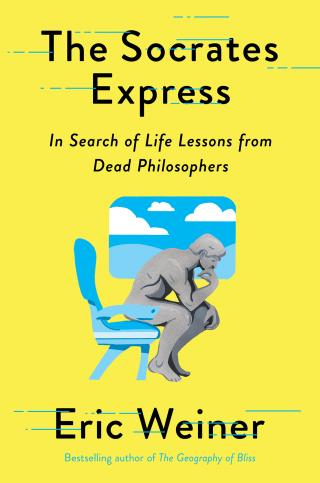
The Socrates Express
- Автор: Вейнер Эрик
- Год: 2020
- Язык: английский
- Год: Avid Reader Press / Simon & Schuster
- Жанр: География, путевые заметки

Электронная книга - «The Socrates Express». Краткое содержание книги:
We contemplate for the same reasons we travel: to see the world from a different perspective, to unearth hidden beauty and find new ways of being. We want to learn how to embrace wonder. Face regrets. Sustain hope.
Eric Weiner, *New York Times* bestselling author of *The Geography of Bliss* , combines his twin passions for philosophy and global travel in a pilgrimage that uncovers surprising life lessons from philosophers around the world, from Marcus Aurelius to Arthur Schopenhauer, Confucius to Montaigne. Traveling by train (the most thoughtful mode of transport) he traversed thousands of miles, making stops in Athens, Delhi,...
Marcus no doubt missed Rome. Especially his wife, Faustina, loving, if not always faithful. The past decade had not been easy, marred not only by those nettlesome Germanic tribes but also an abortive revolt by the scheming Cassius. Then there were his children. Faustina bore at least thirteen. Fewer than half survived childhood.
Marcus was a rarity: a philosopher-king. What was it that drove the most powerful man in the world to study philosophy? As emperor, he could do, or not do, as he pleased. Why take time from his busy schedule to read the classics and ponder life’s imponderables?
Marcus’s early years offer a few clues. He had that rarest of childhoods: a happy one. Bookish, he’d rather read than go to the circus. This tendency put him in a distinct minority of Roman schoolchildren.
Later, enamored of the Greek way of life, he’d sleep on the hard ground covered only in a pallium, a philosopher’s threadbare cloak, until his mother scolded him and insisted he give up “this nonsense” and sleep in a proper bed.
The Romans viewed Greek philosophy the way most of us view opera: something worthy and beautiful, and we really should go more often, but it’s so darned difficult to follow and, besides, who has time? Romans liked the idea of philosophy more than actual philosophy. This made Marcus, an actual philosopher, highly suspect. Even as emperor, people snickered behind his back.
Marcus was an accidental emperor. He never wanted the job. It was his predecessor, Hadrian, who set events in motion that led to Marcus being crowned emperor in AD 161. He was forty years old.
Marcus enjoyed a honeymoon period. For six months. Then came a deadly flood, the plague, and the invasions. Aside from these wars, Marcus had relatively little blood on his hands. It’s living proof that absolute power does not always corrupt absolutely. Marcus routinely handed down lenient sentences for deserters and other lawbreakers. When the empire faced a financial crisis he auctioned off imperial goodies—robes, goblets, statues, and paintings—rather than raise taxes. And in an act I find particularly touching, he decreed that all tightrope walkers, often young boys, should henceforth perform over thick, spongy mattresses.
Marcus displayed great courage in battle but, as biographer Frank McLynn says, his most courageous feat was “his constant strivings to curb his natural pessimism.” I can relate. I, too, wrestle with the forces of negativity, always scheming to recruit me to their side. For we wannabe optimists, a half-empty glass is better than no glass at all, or one that has shattered into a hundred slivers and pierced a major artery. It’s all a matter of perspective.
Marcus had trouble sleeping. He suffered from indeterminate chest and stomach pains. His physician, an arrogant but accomplished man named Galen, had prescribed theriac (possibly laced with opium) to help him sleep.
Marcus, like me, aspired to be a morning person. A wide gap, though, separates actual morning people from aspiring morning people. Lying here now, feeling the train’s gentle rocking, the Amtrak blanket warm against my body, it is a gap that feels insurmountable.
You’d think nothing could be easier. Place one foot on the floor, then the other. Pull yourself to a vertical position. Yet I fail to achieve vertical status. Not even diagonal. What’s wrong with me? Help me, Marcus.
Meditations is unlike any book I’ve read. It is not really a book at all. It is an exhortation. A compilation of reminders and pep talks. Roman refrigerator notes. What Marcus Aurelius fears most is not death but forgetting. He constantly reminds himself to live fully. Marcus had no intention of publishing his refrigerator notes. They were intended for himself. You don’t so much read Marcus as eavesdrop on him.
I like what I hear. I like Marcus’s honesty. I like how he lays himself bare on the page, exposing his fears and vulnerabilities. Here the most powerful man in the world confesses to insomnia and panic attacks and to his, at best, perfunctory performance as a lover. (“He deposits his sperm and leaves,” is how he describes the act of copulation.) Marcus never lost sight of the Stoic precept that all philosophy begins with an awareness of our weakness.
Marcus constructs no grand philosophical system, to be picked apart by generations of earnest graduate students. This is philosophy as therapy, with Marcus playing the role of both therapist and patient. Meditations is, as translator Gregory Hays observes, “a self-help book in the most literal sense.”
Time and again, Marcus exhorts himself to stop thinking and act. Stop describing a good man. Be one. The difference between philosophy and talking about philosophy is the difference between drinking wine and talking about wine. A single sip of a good pinot noir tells you more about a vintage than years of rigorous oenology.
Marcus’s ideas didn’t simply materialize. No philosopher’s does. He was a Stoic, but not exclusively. He imbibed other sources: Heraclitus, Socrates, Plato, the Cynics, and Epicureans. Marcus, like all great philosophers, was a wisdom scavenger. What mattered was an idea’s value, not its source.
To read Meditations is to witness an act of philosophy in real time. Marcus is live-streaming his thoughts, uncensored. I am watching “someone in the process of training himself to be a human being,” as the classicist Pierre Hadot puts it.
Several entries in Meditations begin with the phrase “When you have trouble getting out of bed…” As I read further, it occurs to me that much of the book is a covert treatise on the Great Bed Question. Not only how to get out of bed but why bother? Camus’s suicide question swaddled in a fluffy down comforter. Marcus seesaws between opposing views, debating himself.
“What do I have to complain of, if I’m going to do what I was born for—the things I was brought into the world to do?”
“Or is this what I was created for? To huddle under the blankets and stay warm?”
“But it’s nice here.…”
“So you were born to feel ‘nice’? Instead of doing things and experiencing them?”
Back and forth he goes. Hamlet under the covers. He knows there are great deeds to do, great thoughts to think.
If only he could get out of bed.
“Good mooooorning, passengers. Peek-a-boo, I see you. The café is still open and serving!”
Miss Oliver is back, more cloyingly cheerful than ever.
That’s it. I am now seriously considering getting out of bed. Any minute now. I examine my Styrofoam coffee cup and notice fragments of Amtrak wisdom. “Change How You See the World” and, on the other side, “Experience the Taste of a Better World.” Not exactly erudite, I concede, but I find the childlike simplicity endearing.
Sonya, my thirteen-year-old daughter, likes her sleep as much as I do. “I self-identify as a lazy human being,” she announced one day. Trying to pry her out of bed on weekday mornings requires a marshaling of resources not seen since Normandy. Yet on weekends and snow days, she springs to life, unaided. When I asked about this discrepancy, she explained, philosophically, “It’s the activity that gets you out of bed, not the alarm clock.”
She’s right. When I struggle to get out of bed, it is not the bed that is my enemy, or even the world out there. It is my projections. Lying under the covers, I imagine a hostile world determined to upend me. Just like Marcus. True, his world featured belligerent barbarians, the plague, and palace revolts. Obstacles are relative, though. One person’s messy desk is another’s ruffian invasion.
Perhaps the greatest obstacle is other people. Marcus doesn’t go as far as the French philosopher Jean-Paul Sartre, who famously declared “hell is other people,” but he comes close. “When you wake in the morning, tell yourself: the people you deal with today will be meddling, ungrateful, arrogant, jealous, and surly.” Little has changed since Marcus’s day.