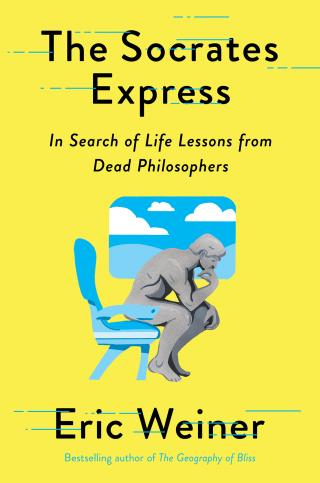
The Socrates Express
- Автор: Вейнер Эрик
- Год: 2020
- Язык: английский
- Год: Avid Reader Press / Simon & Schuster
- Жанр: География, путевые заметки

Электронная книга - «The Socrates Express». Краткое содержание книги:
We contemplate for the same reasons we travel: to see the world from a different perspective, to unearth hidden beauty and find new ways of being. We want to learn how to embrace wonder. Face regrets. Sustain hope.
Eric Weiner, *New York Times* bestselling author of *The Geography of Bliss* , combines his twin passions for philosophy and global travel in a pilgrimage that uncovers surprising life lessons from philosophers around the world, from Marcus Aurelius to Arthur Schopenhauer, Confucius to Montaigne. Traveling by train (the most thoughtful mode of transport) he traversed thousands of miles, making stops in Athens, Delhi,...
I thought I knew how to walk, but reading Rousseau, I now question even that basic skill. Yes, I can put one foot in front of the other, repeating as necessary, but that is merely bipedal locomotion. It is not walking.
You can tell a lot about a person by how they walk. The Pentagon recently developed advanced radar that can identify up to 95 percent of individual walks, as distinct as a person’s fingerprints or signature. Everyone has a walking style.
I have several, and they, like my moods, vacillate. I either charge ahead full tilt, like a Black Friday shopper, or lumber like an out-of-shape elephant that’s just downed the all-you-can-eat Indian buffet. Should you find yourself walking behind me, don’t. I am not an easy man to follow.
I wake in Neuchâtel, a city Rousseau didn’t care for, and take the train to a small town called Môtiers, which he cared for even less. “The vilest and most venomous place that one could inhabit,” Rousseau recalled. Apparently, the feeling was mutual.
The house that Rousseau despised in the town he despised is now a small museum, proving that there’s nothing a lot of time and a little curation can’t remedy. A plaque marks the dates that Rousseau lived here: July 10, 1762, to September 8, 1765. Factually accurate, yes, but incomplete. It fails to capture the poisonous animosity between Rousseau and the residents of Môtiers, furious over his writing.
Inside, I find early editions of the two books that ignited that anger: Emile and The Social Contract. I also spot a portrait of Rousseau wearing a caftan, a flowing tunic popular in the Middle East. It was comfortable, but odd-looking. It irked the townsfolk, as did Rousseau’s daily walks, which became fodder for ridicule. One day, that simmering animosity boiled over. Residents, egged on by the town minister, hurled stones at Rousseau’s house. Rousseau, a man who often misread social signals, got this one right. He fled Môtiers, never to return. I do the same.
That evening, back in Neuchâtel, I install myself at a crêperie, order a glass of chardonnay, which I hope pairs well with early Romanticism, and retrieve Rousseau’s memoir from my backpack. I dive in. You don’t dip into Rousseau. You plunge headfirst or not at all.
What grabs my attention and doesn’t let go is the language. Clear, accessible, not your typical philosophical gobbledygook. Nice, I think, taking another sip of my chardonnay, which does in fact pair well.
Soon I realize that the clarity is accompanied by something else. Rousseau is—how do I put this politely?—a drama queen. So impassioned are the words that I swear the pages feel moist. Rousseau cries, regularly and voluminously. He is prone to fits of rapture. He has been known to swoon. He is forever abandoning himself to “the sweetest melancholy” or “the fatality of my lot” or, my favorite, “the indolent and solitary life.” His preferred organ, the heart, is busy. It is either “opening” or “kindling” or “stirring.” Mostly, it beats. It beats with “impatience” or with “joy” or, on more than one occasion, “violently.”
I usually find this sort of cardiac writing off-putting, but not Rousseau’s. The words, while overwrought, are free of artifice. Rousseau isn’t faking it.
Rousseau’s philosophy can be summed up in four words: nature good, society bad. He believed in the “natural goodness of man.” In his Discourse on Inequality, he paints a picture of man in his natural state, “wandering in the forests, without industry, without speech, without domicile, without want and without liaisons, with no need of his fellow-men, likewise with no desire to harm them.” Nobody is born mean-spirited, petty, vindictive, paranoid. Society makes them that way. Rousseau’s “savage man” lives in each moment with no regrets about the past or worries about the future.
Much of what we take to be human nature is social habit, Rousseau believes. We’re convinced our love of smoked Brie or Instagram is natural when it is cultural. After all, in the 1970s people thought shag carpeting and neckties as wide as a runway were “natural.” Only now do we recognize them for the abominations they are. Even something as “natural” as scenery is prone to cultural influence. For most of European history, people considered mountains barbaric; no sane person would voluntarily travel to one. Only in the eighteenth century did they become objects of admiration. The good news, says Rousseau, is we can change these social habits, provided we recognize them for what they are: social artifices as easily jettisoned as an old pair of bell-bottom jeans.
Rousseau’s Savage Man regularly experiences feelings of self-love, which Rousseau calls amour-de-soi. This healthy emotion differs from the more egoistical variety, which he calls amour-propre. The first stems from human nature, the second from society. Amour-de-soi is the joy you feel when singing in the shower. Amour-propre is the joy you feel while singing at Radio City Music Hall. You may sing poorly in the shower but the delight is yours alone, independent of others’ opinions, and therefore, Rousseau argued, more authentic.
So you can see why Rousseau walked. Walking requires none of the trappings of civilization: no domesticated animals, no carriages, no roads. The walker is free, unencumbered. Pure amour-de-soi.
Sometimes a single walk changes everything. So it was with Rousseau one summer afternoon in 1749. He was on his usual six-mile jaunt from Paris to Vincennes to visit fellow philosopher and friend Denis Diderot, imprisoned for writings deemed blasphemous. It was an especially hot day, and the road was dusty. Rousseau stopped to rest. Sitting in the shade, idly leafing through an issue of Mercure de France, he spotted a prize offered by the Academy of Dijon for the best essay on the topic “Whether the restoration of the sciences and arts has contributed to purify morals.”
Rousseau felt dizzy, disoriented, “like a drunkard.” In that moment, he recalls, “I beheld a different universe and became a different man.” His essay won first prize, launching his career into a high orbit.
Might Rousseau have had the same revelation while sitting in his study, or riding in a carriage? Perhaps, but the walk had primed his imagination. The mind thrives at three miles per hour, the speed of a moderately paced walk. Freed of the pettiness of the office, the tyranny of expectations, it roams, and when the mind roams, unexpected and wonderful things happen. Not always, but more often than you’d think. Walking supplies just the right balance of stimulation and repose, exertion and idleness.
When we walk, we are simultaneously doing and not-doing. On one level, our minds are engaged: focusing on the terrain ahead, cognizant of the periphery. Yet none of this thinking occupies much cerebral space. There’s plenty left over for meandering, and freak following.
No wonder so many philosophers walked. Socrates, of course, liked nothing more than strolling in the agora. Nietzsche regularly embarked on spirited two-hour jaunts in the Swiss Alps, convinced “all truly great thoughts are conceived by walking.” Thomas Hobbes had a walking stick custom made with a portable inkwell attached so he could record his thoughts as he ambled. Thoreau regularly took four-hour treks across the Concord countryside, his capacious pockets overflowing with nuts, seeds, flowers, Indian arrowheads, and other treasures. Immanuel Kant, naturally, maintained a highly regimented walking routine. Every day, he’d eat lunch at 12:45 p.m., then depart for a one-hour constitutional—never more, never less—on the same boulevard in Königsberg, Prussia (now Russia). So unwavering was Kant’s routine that the people of Königsberg set their watches by his perambulations.
Good walkers, all of them. None, though, compares with Rousseau. He’d regularly walk twenty miles in a single day. He once walked three hundred miles from Geneva to Paris. It took him two weeks.