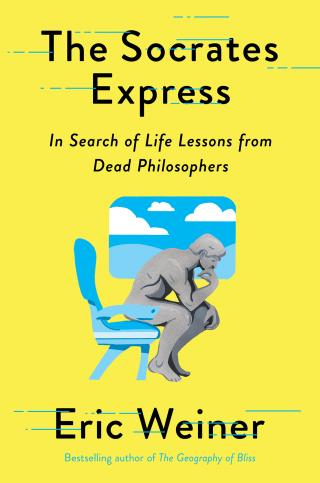
The Socrates Express
- Автор: Вейнер Эрик
- Год: 2020
- Язык: английский
- Год: Avid Reader Press / Simon & Schuster
- Жанр: География, путевые заметки

Электронная книга - «The Socrates Express». Краткое содержание книги:
We contemplate for the same reasons we travel: to see the world from a different perspective, to unearth hidden beauty and find new ways of being. We want to learn how to embrace wonder. Face regrets. Sustain hope.
Eric Weiner, *New York Times* bestselling author of *The Geography of Bliss* , combines his twin passions for philosophy and global travel in a pilgrimage that uncovers surprising life lessons from philosophers around the world, from Marcus Aurelius to Arthur Schopenhauer, Confucius to Montaigne. Traveling by train (the most thoughtful mode of transport) he traversed thousands of miles, making stops in Athens, Delhi,...
This otherness, if not the public masturbation, makes sense. Philosophy is all about questioning assumptions, rocking the boat. Captains rarely rock their own boats. They have too much at stake. Not philosophers. They’re outliers. Aliens.
Socrates was a practitioner of “Crazy Wisdom.” Found in traditions as disparate as Tibetan Buddhism and Christianity, Crazy Wisdom operates on the premise that the path to wisdom is crooked. We must zig before we can zag.
Crazy Wisdom means casting aside social norms and risking ostracism, or worse, to jolt others into understanding. The original shock therapy. No one likes to be shocked, and we often dismiss practitioners of Crazy Wisdom as more crazy than wise. Here is how Socrates’s student Alcibiades describes him: “He will talk of pack-asses and blacksmiths, cobblers and tanners, and he always seems to be repeating the same things so that someone who wasn’t used to his style and wasn’t very quick on the uptake would naturally take it for the most utter nonsense.” Yet, Alcibiades concludes, spend some time truly listening to Socrates and you realize it’s anything but nonsense. “This talk,” he says, “is almost the talk of a god.”
As he pours another cup of Earl Gray, Jacob Needleman tells me about the first question he experienced. He recalls it clearly. Jacob was eleven years old. He and his friend Elias Barkhordian were sitting on a low stone wall in their Philadelphia neighborhood, just as they did several times a week, even on days when the wall was covered in ice and snow.
A year older than Jacob, Elias was tall for his age, “with a big, round face and brilliant, dark eyes.” The two enjoyed chewing over weighty scientific questions, about everything from the movement of electrons to the nature of dreams. These questions intrigued young Jacob, but on this particular day, Elias asked a question that floored him: “Who created God?”
Jacob recalls staring at Elias’s “great, smooth forehead as though I was trying to look into his brain” and realizing that “when he asked that question he was not merely challenging me, but challenging the whole universe. It sent an extraordinary feeling of freedom through me. And I remember saying to myself the words, This is my best friend.”
Jacob Needleman was smitten with the unexpected joy of asking, and experiencing, big questions.
Socrates’s story parallels Jacob’s. The setting, of course, is different—the mean streets of Athens, not Philadelphia—but the trajectory is similar. There was a pivot to a new and unexpected direction and, again, a friend was responsible, in Socrates’s case a young man named Chaerephon. One day, Chaerephon visited the oracle at Delphi and asked the soothsayer a question: Is there any man in Athens wiser than Socrates?
“No,” came the reply. “There is none.”
When Chaerephon relayed the oracle’s words to Socrates, he was flummoxed. No one wiser than he? How could this be? He was a mere stonecutter’s son who knew nothing. Oracles, though, are never wrong, so Socrates decided to investigate. He buttonholed revered Athenians, everyone from poets to generals. Socrates soon discovered these men were not as wise as they thought they were. The general couldn’t tell him what courage is, the poet couldn’t define poetry. Everywhere he turned he encountered people who “do not know the things that they do not know.”
Perhaps the oracle was right, Socrates concluded. Maybe he did possess a kind of wisdom, the wisdom of knowing what he didn’t know. For Socrates, the worst kind of ignorance was the kind that masquerades as knowledge. Better a wide and honest ignorance than a narrow and suspect knowledge.
It is the introduction of this innocent ignorance, this “marvelous new naiveté,” as the philosopher Karl Jaspers puts it, that is Socrates’s greatest contribution to human inquiry, one that still drives the philosophical impulse today.
Socrates was not the first philosopher. Many came before him: Pythagoras, Parmenides, Democritus, and Thales, to name a few. These men turned their gaze heavenward. They strived to explain the cosmos, to penetrate the mysteries of the natural world. Results were mixed. Thales, brilliant in many ways, was convinced all matter in the universe consisted of water. Like Socrates, these philosophers asked questions, but theirs were mainly “what” and “why” questions. What is everything made of? Why do the stars disappear during the day?
These sort of questions didn’t interest Socrates. They were unanswerable, he thought, and, in the end, unimportant. The universe may be fascinating, but it’s not much of a conversationalist, and conversation was what Socrates craved the most.
“Every question is a cry to understand the world,” said the cosmologist Carl Sagan. Socrates would agree, up to a point. Every question is a cry to understand ourselves. Socrates was interested in “how” questions. How can I lead a happier, more meaningful life? How can I practice justice? How can I know myself?
Socrates couldn’t fathom why his fellow Athenians weren’t more interested in these kinds of questions, given their zest for improvement, be it a better way of making statues or practicing democracy. Athenians, it seemed to Socrates, worked tirelessly to improve everything—except themselves. That needed to change, he thought, and he made it his life’s mission to do so.
This marked a major shift in philosophy. No longer is it fuzzy-headed speculation about the cosmos. It is about life, your life, and how to make the most of it. It is practical. Indispensable. As the Roman politician and philosopher Cicero said, “Socrates was the first to call Philosophy down from the heavens, and establish it in the towns, and introduce her into people’s homes.”
Socrates didn’t behave the way we think philosophers must. He displayed no interest in amassing followers. (When students inquired about other philosophers, Socrates happily directed them.) He bequeathed no body of knowledge, no theories or doctrines. He published no dense tomes. In fact, he never wrote a single word. We know Socrates today thanks to a handful of ancient sources, most notably his student Plato.
There is no such thing as “Socratic thought,” only Socratic thinking. Socrates was all means, no ends. We remember the gadfly of Athens today not for what he knew but how he went about knowing it. He cared more about method than knowledge. Knowledge doesn’t age well. Methods do.
Scholars deploy many fancy terms to describe Socrates’s method: the dialectic, the elenchus, inductive reasoning. I prefer a simpler term: talking. I realize that doesn’t sound sophisticated, and probably won’t snag me the Nobel Prize, but it’s true. Socrates talked to people. “Enlightened kibitzing,” the contemporary philosopher Robert Solomon calls it. I love that. It brings philosophy down to earth and elevates it at the same time.
The examined life demands distance. We must step back from ourselves to see ourselves more clearly. The best way to achieve this perspective is through conversation. For Socrates, philosophy and conversation were virtually synonymous.
Socrates talked to all sorts of people: politicians, generals, craftsmen, as well as women, slaves, and children. He talked about all sorts of subjects, too, but only important ones. Socrates wasn’t much for chitchat. He knew life was short and he wasn’t about to waste one second of his allotted time on trivialities. “We are considering how to live the best possible life,” he said, exasperated, to a sophist named Gorgias. “What question can be more serious than this to a person who has any sense at all?”
As much as he loved conversation, Socrates, I think, saw it as simply another tool in his kit. All this enlightened kibitzing had a goaclass="underline" to know himself. By talking to others he learned how to converse with himself.