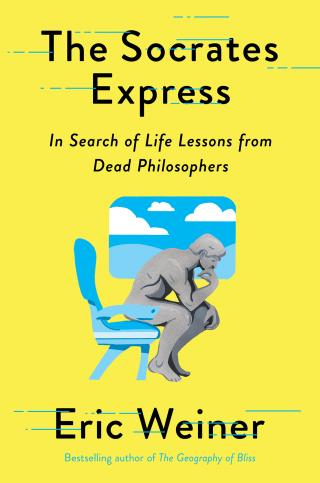
The Socrates Express
- Автор: Вейнер Эрик
- Год: 2020
- Язык: английский
- Год: Avid Reader Press / Simon & Schuster
- Жанр: География, путевые заметки

Электронная книга - «The Socrates Express». Краткое содержание книги:
We contemplate for the same reasons we travel: to see the world from a different perspective, to unearth hidden beauty and find new ways of being. We want to learn how to embrace wonder. Face regrets. Sustain hope.
Eric Weiner, *New York Times* bestselling author of *The Geography of Bliss* , combines his twin passions for philosophy and global travel in a pilgrimage that uncovers surprising life lessons from philosophers around the world, from Marcus Aurelius to Arthur Schopenhauer, Confucius to Montaigne. Traveling by train (the most thoughtful mode of transport) he traversed thousands of miles, making stops in Athens, Delhi,...
There’s a simpler and less profound possibility: the hemlock had begun to take effect, and an addled Socrates was mumbling gibberish. No one knows for certain, and probably no one ever will.
I do know this: it is deliciously fitting that the King of Questions departed in a cloud of them, leaving us scratching our heads, wondering. Socrates couldn’t resist planting one more puzzle in our minds. One more question to experience.
3. How to Walk like Rousseau
2:42 p.m. On board Swiss Federal Railways, Train No. 59, en route from Basel to Neuchâtel.
I glance out my window and watch the Swiss countryside unfurl in slow motion. At least I think it’s slow. Speed is relative. Train travel, viewed through the rosy haze of nostalgia, represents a throwback to a simpler, analog time. I take the train to change the rhythm of my life, to remind myself what dawdling feels like.
It wasn’t always this way. When people first rode trains, in the nineteenth century, they reacted with an unease bordering on terror. “I felt like a projectile,” said one early passenger. “Like a human parcel,” said another. The speed—faster than humans had ever traveled on land—transformed the hallowed countryside into an ungodly blur. In a letter dated August 22, 1837, Victor Hugo described the view from his train’s window: “The flowers by the side of the road are no longer flowers but flecks, or rather streaks, of red or white… everything becomes a streak; the grainfields are great shocks of yellow hair; fields of alfalfa, long green tresses.… [F]rom time to time, a shadow, a shape, a specter appears and disappears with lightning speed behind the window.” Hugo’s train was traveling at about 15 miles per hour. Speed is relative.
The art critic John Ruskin, one of the loudest voices decrying this newfangled form of transport, devised a maxim that still holds true: “All traveling becomes dull in exact proportion to its rapidity.”
As my Swiss train glides (Swiss trains really do glide) through the landscape, whisper-quiet, I wonder what Ruskin would make of air travel. Nothing good, I’m sure.
Transportation traces its own evolutionary arc, a survival of the fastest that erases its antecedents as it speeds ahead. We’re moving too fast to pause and ask how exactly we got here, strapped into an aluminum tube and hurtling through space at a speed so fast it doesn’t blur the scenery but obliterates it. This acceleration didn’t just happen, of course, any more than our outsize brains and opposable thumbs just happened. Before the airplane was the train and before the train the coach and before the coach the saddle. We need to reach further back, though, to the beginning.
In the beginning was the foot.
Jean-Jacques Rousseau was a man of multitudes: philosopher, novelist, composer, essayist, botanist, autodidact, fugitive, political theorist, masochist. Most of all, he was a walker. He walked often and he walked alone. Yes, a stroll with a close friend has its pleasures, as do walking clubs, but at its heart walking is a private act. We walk by ourselves and for ourselves. Freedom is walking’s essence. The freedom to depart and return when we wish, to meander, to, as Robert Louis Stevenson put it, “follow this way or that, as the freak takes you.”
Rousseau followed his freak. It took him across Europe, from Venice to Paris, Turin to Lyons, and beyond. Rousseau was among the first truly rootless souls, what today we’d call an urban nomad. At home everywhere, and nowhere.
For most of human history, walking was not optional. If you wanted to get anywhere, you had to walk. Today walking is a choice. Rousseau didn’t have as many choices as we do—train travel was not yet invented—but he had some. An extensive network of carriage service crisscrossed Europe. He detested carriage travel and walked whenever he could. “I have never thought so much, existed so much, lived so much, been so much myself… as in the journeys which I have made alone and on foot,” he said. Walking saved Rousseau’s life. It also killed him.
Rousseau grew up in Geneva, the son of an irascible watchmaker named Isaac. His mother died shortly after his birth, a trauma that haunted him. Young Rousseau regularly teamed up with friends to explore the countryside. “I always went farther than any of them without thinking about my return, unless others thought of it for me,” he recalls in his memoir, The Confessions.
One pleasant spring afternoon, in 1728, Rousseau took a walk that changed the vector of his life. He was sixteen years old, apprenticed to an engraver, a job he despised, and feeling “restless, disconnected with everything and with myself.” A typical sixteen-year-old. He had ventured outside the city. It was getting late. He knew he had to return before the city’s gates closed for the night. Rousseau had missed two curfews in the past, and been beaten by his employer. He dreaded what might happen this time.
He ran frantically, but it was no use. He was too late. Sleeping outside the city walls that night, Rousseau vowed never to return to Geneva. From that day, he led a nomadic life, traveling ceaselessly, and almost always by foot.
Rousseau lived in many cities but was not a city person. He describes his first encounter with Paris, a city most of us associate with beauty and romance, this way: “I saw nothing but dirty stinking little streets, ugly black houses, a general air of squalor and poverty, beggars, carters, menders of clothes, sellers of herb-drinks and old hats.” Then there were the people of Paris, “tiresome” and forever mouthing “stupid witticisms.” No, not a city person.
Not a people person, either. Rousseau was what today we’d call high maintenance. “A difficult friend, a disappointing lover, and an impossible employee,” says author Leo Damrosch in his excellent biography of Rousseau.
Walking enabled Rousseau to escape the eyes of others. He was shy. Severely nearsighted, an insomniac like Marcus, and with a lifelong urinary problem (eventually diagnosed as an enlarged prostate) that required frequent visits to the toilet, he avoided social contact whenever possible. Throughout his life, he imagined people were staring at him. It probably didn’t help that he had an odd compulsion to expose his rear end to strangers. Rousseau was an avowed masochist who enjoyed a good spanking, like the one he received as a delinquent schoolboy. “I found in the pain, in the shame even, a mixture of sensuality that left me desiring more,” he writes in his memoir, among the first to contain such personal, and salacious, details.
Walking was an obvious fit with Rousseau’s philosophy. He advocated a return to nature, and what is more natural than walking? Natural, that is, for most of us.
I am no Rousseau. I am not a child of nature—or even a distant cousin. I do not go camping, nor do I go glamping. My car is not adorned with a bumper sticker that says “I’d rather be fishing.” Ditto hunting, camping (see above), spelunking, kayaking, snorkeling, rock climbing, and bird-watching. I do not own hiking boots. I do not own a sleeping bag. I do not own a crampon. I do own several backpacks, but they are sleek models with names like “city edition” and “urban renegade.”
Mother Nature is something of a nag. She’s constantly reminding me of my core incompetence. I do not know how to pitch a tent or unpitch a tent or do anything involving a tent. I do not know how to navigate using the stars or the sun or any other celestial bodies. My incompetence extends beyond the natural world. I do not know how to change the air filter on my car or talk to my teenage daughter or ease the suffering of an aging parent or do downward dog or sit quietly with my thoughts for more than five seconds without my head exploding.