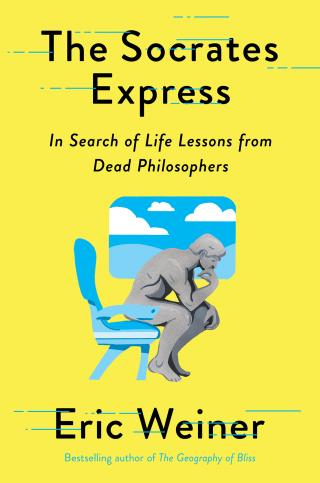
The Socrates Express
- Автор: Вейнер Эрик
- Год: 2020
- Язык: английский
- Год: Avid Reader Press / Simon & Schuster
- Жанр: География, путевые заметки

Электронная книга - «The Socrates Express». Краткое содержание книги:
We contemplate for the same reasons we travel: to see the world from a different perspective, to unearth hidden beauty and find new ways of being. We want to learn how to embrace wonder. Face regrets. Sustain hope.
Eric Weiner, *New York Times* bestselling author of *The Geography of Bliss* , combines his twin passions for philosophy and global travel in a pilgrimage that uncovers surprising life lessons from philosophers around the world, from Marcus Aurelius to Arthur Schopenhauer, Confucius to Montaigne. Traveling by train (the most thoughtful mode of transport) he traversed thousands of miles, making stops in Athens, Delhi,...
Silence is not my usual state. Words are like oxygen for me. Yet I silently turned Jennifer’s question over in my mind, looked at it from different angles. A good question triggers more questions, and sure enough Jennifer’s single query sparked dozens of my own. I was no longer conversing with her but with myself.
This is exactly what Socrates aimed to induce: a state of ruthless self-interrogation, questioning not only what we know but who we are, in hopes of eliciting a radical shift in perspective.
Tolstoy’s novella The Death of Ivan Ilyich contains one of my favorite passages in literature, perhaps because it is so unexpectedly redemptive, and also involves a train. The protagonist is a successful government official. He is terminally ill, gripped by fear and regret. Toward the end of the story, the dread lifts, replaced by a new perspective “like the sensation one sometimes experiences in a railway carriage when one thinks one is going backwards while one is really going forwards and suddenly becomes aware of the real direction.”
Looking back at my conversation with Jennifer, I realize how I, like Ivan, suddenly intuited my real direction. It was the most Socratic experience I’ve ever had. It took place not in the dusty streets of ancient Athens but on my friend’s deck in Montclair, New Jersey. No matter. Genuine wisdom isn’t bound by place and time. It’s portable.
Now, whenever I’m striving to achieve something, anything, I stop and ask: What does success look like? To be honest, I haven’t answered that question, and may never do so. That’s okay. I’ve changed the prescription on my glasses, and can see more clearly.
The doors glide open. I step into a sleek subway car, shiny and metallic. In modern Greek parlance, I am embarking on a metaforá. Derived from the ancient root metamorphoo, to transform completely from the inside out, it is where we get the English word “metaphor.” Today, Greeks use metaforá to denote travel on public transport. Whenever someone takes a bus to work or the subway to meet friends or a streetcar to pick up dry cleaning, she is, in a way, taking a metaphor, and engaging in a transformative act. I love Greece. Everything exists on two levels, often more. Even a subway ride offers the promise of self-renewal.
Not only does the Athens subway run smoothly, but a history lesson comes with each ride. When it was under construction, workers unearthed ancient artifacts from the city’s golden age. Archaeologists removed some of the artifacts (“rescue archaeology,” it’s called) but others were incorporated into the stations, so that today locals call their subway “a museum with a train running through it.”
I have come to Greece, the land of metaphors, to walk where Socrates walked, to breathe the air he breathed. I have come to remind myself that Socrates was not an idea but a man, flesh and bone. Socrates wondered, but he didn’t wonder just anywhere. He wondered here, in Athens, a city he loved like no other.
I disembark at the Agora Station and walk. The agora, or marketplace, was Socrates’s favorite haunt. It was a crowded and smelly place, rife with hawkers and thieves and everyone else. Socrates loved it. The agora was his classroom, and his theater.
Archaeologists began excavating the site relatively late, in 1931, decades after other big digs, including those at Pompeii and Olympia. They’ve made up for lost time, though, as the thousands of artifacts recovered attest: pottery shards, inscriptions, sculptures, coins, and other ancient treasures.
Today the site, spread over two dozen acres, is mostly rubble, but enough remains of the old marketplace that, with a bit of imagination, I can picture the scene. I can see hawkers selling their wares, everything from spices to water clocks; defendants awaiting trial; young men loitering, as young men do. Taking it all in is Socrates, barefoot, those crablike eyes swiveling wildly, on the prowl for philosophical companions. Socrates practiced retail philosophy. He didn’t wait for people to come to him. He went to them.
“The unexamined life is not worth living,” Socrates famously said. When I first heard that, as a mopey teenager, I sighed. Life is difficult enough. You want me to examine it, too? The examined life. I don’t care for the term. For starters, it contains the root “exam,” which stirs dormant memories of number-two pencils and cold doctor hands. It sounds like too much work. We can do better. So, with all due respect, I offer two corollaries to Socrates’s examined life.
Corollary Number One: The examined life that doesn’t produce practical results isn’t worth living. Contemplating one’s navel has its pleasures but it is far more satisfying to see results, a better navel. Eudaimonia, the Greeks called it. Often translated as “happiness,” the word signifies something larger: a flourishing, meaningful life. Consider, as the contemporary philosopher Robert Solomon suggests, two people. One has an elaborate theory of generosity, while the other does not. “Generosity just flows from him, unthinkingly, as water flows from a fountain.” The second person is clearly leading the exemplary, meaningful life.
Corollary Number Two: The unexamined life may not be worth living, but neither is the overexamined one. “Ask yourself if you are happy and you cease to be so,” said the British philosopher John Stuart Mill, articulating the Pleasure Paradox (also known as Paradox of Hedonism). The more we try to seize happiness the more it slips from our grasp. Happiness is a by-product, never an objective. It’s an unexpected windfall from a life lived well.
So was Socrates wrong about this whole unexamined life nonsense? Or am I missing something?
My instinct is to answer those questions quickly so I can scratch them off my to-do list and move on. I restrain this impulse. Instead, I let the question loiter in the soft Greek air, unanswered but not unexamined. Then I take a metaphor back to my hotel.
Socrates was a failure. I know that sounds harsh, but it’s true. Many of the dialogues end not with a thunder-of-Zeus breakthrough but an impasse. Philosophy produces more problems than it solves. That is its nature.
Socrates didn’t publish, and he perished, executed by his fellow Athenians. Again, his alleged crimes were impiety and corrupting the youth but, really, he was executed for asking too many impertinent questions. He was philosophy’s first martyr.
After his trial, his fate sealed, he gathered with a few of his followers. They were heartbroken, but not Socrates; he remained sanguine, and coyly opaque, until the end. “And now it is time to go, I to die, and you to live, but which of us goes to a better thing is unknown to all but God,” he said.
Those are excellent last words, and indeed that is how many a biography of Socrates ends. There’s only one problem. They were not the philosopher’s last words. Plato, in a dialogue called Phaedo, tells us what transpired during Socrates’s final minutes.
“Crito,” says Socrates, speaking to his friend. “We owe a rooster to Asclepius; make this offering to him and do not forget.”
“It shall be done,” replied Crito. “But have you anything else to say?”
There was no reply. Socrates was dead.
What to make of this seemingly pedestrian exit? For centuries, scholars have pondered that question. Some interpret Socrates’s last words darkly. At the time, roosters were offered to the god of healing, Asclepius, so perhaps Socrates was saying life is like a disease we must cure. Or maybe it was Socrates’s way of calling us back down to earth, even as he ascended to heaven. Maybe he was reminding us, as we grapple with life’s big questions, not to forget the small stuff. Don’t overlook your obligations as a citizen and a friend. Be a person of honor. If you owe someone a rooster, give him a rooster.