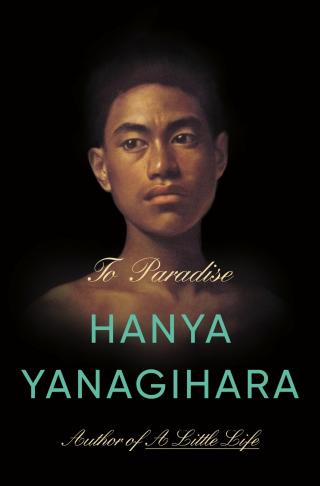
To Paradise
- Автор: Yanagihara Hanya
- Год: 2022
- Язык: английский
- Год: Knopf Doubleday Publishing Group
- Жанр: Современная русская и зарубежная проза

Электронная книга - «To Paradise». Краткое содержание книги:
In an alternate version of 1893 America, New York is part of the Free States, where people may live and love whomever they please (or so it seems). The fragile young scion of a distinguished family resists betrothal to a worthy suitor, drawn to a charming music teacher of no means. In a 1993 Manhattan besieged by the AIDS epidemic, a young Hawaiian man lives with his much older, wealthier partner, hiding his troubled childhood and the fate of his father. And in 2093, in a world riven by plagues and governed by totalitarian rule, a powerful scientist's damaged granddaughter tries to navigate life without him--and solve the mystery of her husband's disappearances.
These three sections are joined in an enthralling and...
There are, however, two encounters from those years apart that stood out for me. The first took place when I was around thirteen. I had overheard an exchange between two girls in my grade. One of the girls, it was well-known, had a crush on Edward. But her friend disapproved. “You can’t, Belle,” she hissed. “Why not?” Belle asked. “Because,” said the first girl, her voice dropping, “his mother. She’s a dancer.”
Since he had matriculated, Edward was occasionally the subject of—not rumors, because they were all true, but stories. Eventually, we came to learn who the scholarship students were, and their parents’ occupations were sometimes whispered from child to child, all mimicking the voices their own parents used to discuss the newcomers. Edward had no father, and his mother was a waitress, but he was spared from outright ridicule: He was good at sports, and moreover, he didn’t seem to care what people said, which was partly what motivated the stories—I think the other students hoped that they might provoke him to react, but he never did.
At least he wasn’t Oriental. This was in the years of the quota, when only ten percent of the school’s population was Oriental, even though the territory’s actual population was around thirty percent. Most of the Orientals who did attend arrived, in some cases, having never worn shoes, just rubber slippers. They were all on scholarships, identified by their public-school teachers as promising and bright, and subjected to multiple tests before they gained admission. Their parents worked on the island’s final sugarcane plantation or in the canning factories, and on weekends and in the summer, they worked there, too, cutting cane or picking pine, as they called it, in the fields, loading it onto the trucks. There was a boy, Harry, who had begun at the school in seventh grade whose father was a night-soil collector, someone who cleaned out the plantation outhouses and transferred the human feces there to—where, we didn’t know. It was said he smelled like shit, and although he too always sat alone at lunch, eating his rice sandwiches, I never thought of introducing myself to him: I looked down on him as well.
Hearing about Mrs. Bishop made me miss her. Indeed, she was what I missed most about my friendship with Edward: the way she held me by the shoulders and then pulled me in for a hug, laughing; the way she kissed me on the forehead when I left their house for the evening; the way she told me she hoped she’d see me again soon.
I had never listened to the talk about Edward, but now I did, and after a few weeks, I learned that, while Mrs. Bishop was still a waitress at Mizumoto’s, she was now also dancing three nights a week at a restaurant called Forsythia. This was a popular place near Mizumoto’s, a hangout for union men of all ethnicities. Matthew’s brother, of whom he was very proud, was a union representative for the Filipino cannery employees, and I knew he sometimes went to Forsythia, because occasionally Jane would beckon me into the kitchen after school and, with a flourish, present the restaurant’s yellow bakery box, in which would sit a guava chiffon cake, its surface a glossy rose-pink.
“From Matthew’s brother,” she’d say—she was proud of him, too, and pride made her even more generous. “Have a big slice, Wika. Have more.”
I didn’t understand why I wanted to see her so badly. But one Friday afternoon, I told Matthew and Jane I had to stay late to help paint sets for the annual school play, and then I cycled over. Forsythia (much later, I would wonder who had chosen this name, as it wasn’t a plant that grew in Hawai‘i, and no one knew what it was) was at the end of a row of small, mostly Japanese-owned stores of the sort that surrounded the Bishops’ house, and though its stucco exterior had been painted a bright yellow, it was designed to resemble a Japanese teahouse, with a peaked roof and small windows cut high into the walls. In the rear of the building, though, near one of the corners, there was a long, skinny window, and it was to here that I quietly wheeled my bike.
I sat down to wait. The kitchen entrance was a few feet away, but there was a dumpster, and I hid behind that. A Hawaiian music group performed here on Fridays and the weekends, playing all the big-band standards, music my father had liked to listen to—“Nani Waimea,” “Moonlight in Hawai‘i,” “Ē Lili‘u ē”—and it was after the fourth song that I heard the guitarist announce, “And now, gentlemen—and some ladies, yeah?—please join me in welcoming the lovely Miss Victoria Nāmāhānaikaleleokalani Bishop!”
The crowd cheered, and I looked through the window to see Mrs. Bishop, in a close-fitting yellow holokū printed with white hibiscus, a lei of orange puakenikeni around her head, her hair coiled into a bun, her lips scarlet, ascend to the small stage. She waved to the audience, which was clapping, and I watched as she danced to “My Yellow Ginger Lei” and “Pālolo.” She was a beautiful dancer, and although I didn’t speak more than a few words of Hawaiian, I understood the lyrics from watching her movements.
It occurred to me as I watched her, her face lit with happiness, that, although I had always liked her, part of me had wanted to see her degraded in some way. “Dancing,” in my classmates’ voices, had sounded so sordid, something a desperate woman would have to do, and something in me had craved witnessing it. Watching her now, queenly and elegant, was both a relief and, as much as I hated to admit it, a disappointment—I realized that I resented her son after all, that I wanted him to have something to be ashamed of, and that I had wanted that something to be his mother, who had always been kind to me, kind in a way her son could never be. She was not dancing because she had been forced to out of circumstance—she was dancing because she loved to dance, and although she dipped her head graciously at the crowd’s applause, it was also clear that her joy was separate from their approval.
I left before her set was over. But in bed that night, I lay awake thinking of the night I had departed the Bishops’ house for the first time and had turned back to see them in the kitchen together, laughing and talking in the house’s warm yellow light. Now I revised that memory: They had put a record on the player, and Mrs. Bishop, still in her Mizumoto’s uniform, was dancing, and Edward was strumming his ukulele, playing along. Outside, in the tiny yard, were crowded all of Edward’s and my classmates, and all of the patrons from Forsythia as well, all of us watching and clapping, though mother and son never turned to acknowledge us—to them, there was only each other, and it was as if we didn’t exist.
—
That was the first incident I wanted to tell you about. The second occurred three years later, in 1959.
It was August 21, and the school year had just begun. I was in tenth grade, almost sixteen. Now that we were in high school, I saw more of Edward than I had in the previous years, when we had been assigned to single, different classrooms. Now we moved from teacher to teacher, and sometimes we were in the same class. His earlier spell of popularity, when it had been discovered he could play sports, had tempered, and now I mostly saw him around the same three or four boys. As always, we nodded at each other in passing, and sometimes we even spoke a few words if we were in proximity—I think I messed up on that chem test. Oh, me too—but no one would have identified us as friends.
I was in English class when the intercom crackled and the principal’s voice, rapid and emotional, started speaking: President Eisenhower had signed a bill granting Hawai‘i statehood. We were now officially the fiftieth American state. Many of the students, and my teacher, began clapping.
We were given the rest of the day off in celebration. For most of us, this was a formality, but I knew that Matthew and Jane would be excited; they had lived in the territory for thirty years—they wanted to be able to vote, which was not something I’d considered.