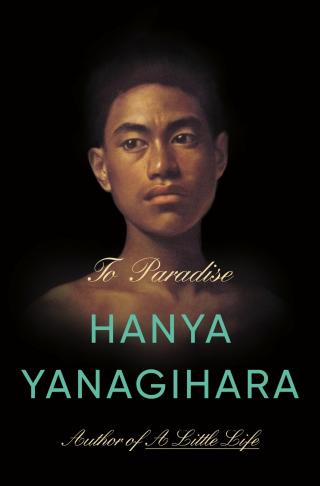
To Paradise
- Автор: Yanagihara Hanya
- Год: 2022
- Язык: английский
- Год: Knopf Doubleday Publishing Group
- Жанр: Современная русская и зарубежная проза

Электронная книга - «To Paradise». Краткое содержание книги:
In an alternate version of 1893 America, New York is part of the Free States, where people may live and love whomever they please (or so it seems). The fragile young scion of a distinguished family resists betrothal to a worthy suitor, drawn to a charming music teacher of no means. In a 1993 Manhattan besieged by the AIDS epidemic, a young Hawaiian man lives with his much older, wealthier partner, hiding his troubled childhood and the fate of his father. And in 2093, in a world riven by plagues and governed by totalitarian rule, a powerful scientist's damaged granddaughter tries to navigate life without him--and solve the mystery of her husband's disappearances.
These three sections are joined in an enthralling and...
I was walking up toward the campus’s western gate when I saw Edward heading south. The first thing I noticed was how slowly he was moving; other students were passing him by, talking about what they were going to do with their unexpected free day, but he appeared to be sleepwalking.
I was nearing him when he suddenly looked up and saw me. “Hi,” I said, and then, when he didn’t respond, “What’re you going to do with your day off?”
For a moment, he didn’t answer, and I thought that he perhaps hadn’t heard me. But then he said, “This is horrible news.”
He spoke so quietly that I at first thought I’d misheard him. “Oh,” I said, stupidly.
But it was like I’d tried to argue with him. “It’s horrible news,” he repeated tonelessly, “horrible.” And then he turned from me and kept walking. I remember thinking he looked lonely, even though I’d seen him alone many times and had never associated his aloneness with loneliness, the way I did with mine. This time, though, something felt different. He looked—though I wouldn’t have had the word for it then—bereft, and although I couldn’t see his face, there was something about his back, the slump of his shoulders, that, had I not known better, would have made me think he had just suffered a terrible loss.
—
I understand that that incident, knowing what you do of Edward, might not seem particularly notable. But it was uncharacteristic of the Edward I knew—admittedly not very well—back then. However, I would have known—through him or through gossip—if he had expressed any strong sentiments about native Hawaiian rights, even given the fact that the very idea of native Hawaiian rights had not yet been invented. (Now I can hear Edward saying, “Of course it had been invented.” So, all right: It had not yet been named. Named, or popularized, not even on a small scale.) There were a few boys in our grade who were interested in politics—one, whose father was the territorial governor, even got it into his head that he would one day be president of the United States. But Edward was not one of them, which made what happened later all the more surprising.
I should add, though, that Edward was not the only person who was upset that day. Back home, I found my mother sitting in the sunroom, quilting. This was unusual, as she was typically with the Daughters on Friday afternoons, volunteering at a food kitchen that served Hawaiian families. When I entered the room, she looked up, and we stared at each other in silence.
“They let us out early,” I said. “Because of the announcement.”
She nodded. “I stayed home today,” she said. “I just couldn’t bear it.” She looked down at her quilt—it was a breadfruit pattern, dark green on white—and then back up at me. “This doesn’t change anything, you know, Kawika,” she said. “Your father should still be king. And someday, you should still be king, too. Remember that.”
It was a strange mix of tenses, a sentence of promises and grievances, reassurances and consolations.
“All right,” I said, and she nodded.
“This changes nothing,” she said. “This land is ours.” And then she looked back at her quilting ring, my signal that I was dismissed, and I went upstairs to my room.
I had no strong feelings about statehood. I thought of it as falling under the broad roof of “government,” and I had no interest in government. Who was in charge, which decisions were made—none of it affected me. A signature on a piece of paper was irrelevant to the facts of my own life. Our house, the people within it, my schooclass="underline" These things wouldn’t change. My burden was one not of citizenry but of legacy; I was David Bingham, my father’s son, and all that went with it. I suppose, looking back on it, I might even have been relieved—now that the islands’ fate was settled, it would perhaps mean that I would no longer bear the responsibility and obligation of trying to correct a history I had no hopes of changing.
—
It would be another decade, almost, before I returned to Edward’s orbit, but in those years, many things happened.
The first thing is that I graduated—we all did. Most of my classmates went to college on the mainland; it was what we had been groomed to do, after all—it was the entire point of the school. We were to go away and get our degrees, maybe do a bit of traveling, and then we would return after college or law school or medical school and get jobs in the most prestigious local banks and law firms and hospitals, which were owned or founded by our relatives and ancestors. Quite a few of us would go into government, leading the Departments of Transportation or Education or Agriculture.
At first, I was among their number. The dean had directed me toward an obscure liberal-arts school in the Hudson Valley of New York, and in September 1962, I left home.
It quickly became clear that I was not meant for the college. It may have been small, and expensive, and unknown, but the other students, most of whom were from rich but vaguely bohemian New York City families, were somehow much more sophisticated and much better educated than I was. It wasn’t that I had never traveled, but my travels had been oriented toward the East, and none of my new classmates seemed to care about the places I’d been. They’d all traveled to Europe, some of them every summer, and I was soon made aware of my own provinciality. Few of them knew that Hawai‘i had been a kingdom; more than one asked if I lived in a “real” house, by which they meant one made of stone, with a shingled roof. The first time, I hadn’t known how to reply, the question was so ludicrous, and stood there blinking until the other person moved away. The references they made, the books they quoted, the vacations they took, the food and wine they preferred, the people they all seemed to know—all of it whirred past me.
The strange thing, though, is that I didn’t resent them: I resented where I had come from. I cursed my school, where generations of Binghams had gone, for not better preparing me. What had I learned there that was useful? I had taken all the same subjects my new classmates had, but so much of my education, it seemed, had been taken up with learning Hawaiian history and bits of Hawaiian language, which I couldn’t even speak. How was that knowledge meant to be useful to me, when the rest of the world simply didn’t care? I didn’t dare bring up who my family was—I sensed that half of them wouldn’t believe me, and the other half would mock me.
I knew this for certain after the variety show. Every December, the college presented a series of brief sketches by different students satirizing various professors and administrators. One of the sketches was about the school’s president, who was always talking about recruiting students from new countries and unlikely places, trying to convince a Stone Age tribe boy—Prince Woogawooga of the Ooga-ooga, was his name—to attend the school. The student playing the tribe member had darkened his skin with brown shoe polish and wore an oversize diaper; on either side of his nose was taped one half of a cardboard bone, so that it looked as if the length of it had pierced though the bridge. On his head he wore a mop, its ropes dyed black and tied back from his face.
“Hello there, young man,” the student playing the president said. “You look like an intelligent young person.”
“Ooga booga, ooga booga,” hooted the student playing the tribesman prince, scratching beneath his arms like an ape and bouncing from foot to foot.
“We teach everything that a young man needs to learn in order to be considered educated,” the president continued, stoically ignoring the tribesman’s antics. “Geometry, history, literature, Latin; and, of course, sports: lacrosse, tennis, football, badminton.” And here he held out a badminton ball to the tribesman, who immediately stuffed it into his mouth.
“No, no!” cried the president, finally flustered. “This is not for eating, good man! Spit it out at once!”