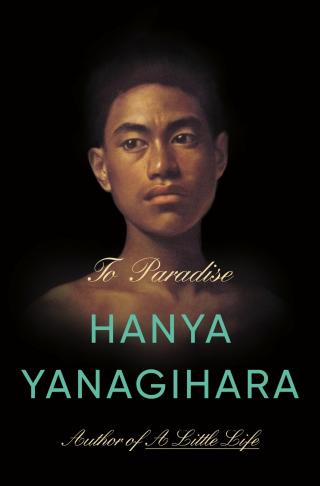
To Paradise
- Автор: Yanagihara Hanya
- Год: 2022
- Язык: английский
- Год: Knopf Doubleday Publishing Group
- Жанр: Современная русская и зарубежная проза

Электронная книга - «To Paradise». Краткое содержание книги:
In an alternate version of 1893 America, New York is part of the Free States, where people may live and love whomever they please (or so it seems). The fragile young scion of a distinguished family resists betrothal to a worthy suitor, drawn to a charming music teacher of no means. In a 1993 Manhattan besieged by the AIDS epidemic, a young Hawaiian man lives with his much older, wealthier partner, hiding his troubled childhood and the fate of his father. And in 2093, in a world riven by plagues and governed by totalitarian rule, a powerful scientist's damaged granddaughter tries to navigate life without him--and solve the mystery of her husband's disappearances.
These three sections are joined in an enthralling and...
Edward and I were in adjoining classrooms, and he waited for me at the building’s exit. We walked in silence through the middle-school campus, and then hopped over the low wall that encircled the school. He lived just a block south of this wall, in the middle of a poky street I’d often driven down with Matthew.
My first thought was that the house was charmed. The street was lined with small, single-story shops and businesses—a dry-goods shop, a hardware store, a grocer—and then, suddenly, as if conjured, was a tiny wooden house. The rest of the block was denuded of greenery, but looming over the structure was a large mango tree, so domineering and leafy that it seemed to be protecting the little building from sight. Nothing else grew in the lawn, not even grass, and the concrete path leading to the front porch had buckled from the tree’s roots, one of which had split a paving stone in two. The house itself was a miniature version of the kind you saw in my neighborhood—a plantation house, as I learned to call them, with a wide lanai and large windows shaded by metal awnings.
The next surprise was the door itself, which was actually closed. Everyone I knew kept their doors open until they went to bed; there was only the screen door, which you banged through as you entered and exited. I watched as Edward reached down the front of his shirt and drew out a key, which dangled from a cotton string that hung around his neck, and unlocked the door. He slipped off his zoris and walked in, and I waited, stupidly, for an invitation before I realized I was to follow him.
Inside, it was close, and dark, and after relocking the door, Edward went around the living room, cranking open the jalousies to let in the breeze, though the mango tree blocked all the light. But its shade also kept the house cool and heightened its sense of bewitchment.
“Do you want a snack?” Edward asked, already walking to the kitchen.
“Yes, please,” I said.
He returned to the living room a few moments later with two plates, one of which he gave to me. On it were arranged four soda crackers, each with a daub of mayonnaise. He sat down on one of the rattan couches, and I sat on the other, and we ate our snack in silence. I had never had mayonnaise on crackers before and wasn’t sure I liked it, or even if I was supposed to like it.
Edward ate his crackers quickly, as if it were a chore to be dispensed with, and then stood again. “Do you want to see my room?” he asked, and again, he asked almost sideways, as if he were addressing someone else in the room, although there was only me.
“Yes,” I said.
There were three closed doors to the left of the living room. He opened the one on the right, and we entered a bedroom. This room too was small, but it was also cozy, like the lair of a harmless animal. There was a narrow bed with a striped blanket on it, and strung across the ceiling from one corner to the opposite were chains of bright-colored construction paper. “My mother and I made those,” Edward explained, and although later I would remember how remarkable his tone was—so matter-of-fact, almost proud, when we were coming to an age in which announcing you made crafts, much less with your mother, was inadvisable—what I thought then was how foreign the idea was of making anything with your mother, especially something that you would hang from your ceiling, deliberately transforming your room into someplace messier and stranger than it had to be.
Now Edward turned and retrieved an object from the drawer beneath the table next to his bed. “Look at this,” he said, solemnly, and held out a black velvet box about the size of a deck of playing cards. He opened the hinged lid, and inside was a medal made of coppery metaclass="underline" It was the seal of our school and, on a scroll beneath, the words “Scholarship: 1953–1954.” He flipped it over to show me his name engraved on the back: Edward Paiea Bishop.
“What’s it for?” I asked, and he made a small, impatient sound.
“It’s not for anything,” he said. “They gave it to me when I got my scholarship.”
“Oh,” I said. I realized I was supposed to say something, but couldn’t decide what it might be. I didn’t know anyone else who was on a scholarship. In fact, until I had met Edward, I didn’t even know what a scholarship was, and had had to ask Jane for an explanation. “It’s nice,” I said, and he made the sound again.
“It’s stupid,” he said, but when he replaced the box in its drawer, he did so tenderly, smoothing his hand across its furred surface.
Then he reached into another drawer, this one tucked beneath his bed—over time, I would realize that, although the room was minute, it was as well-organized and efficient as a sailor’s berth, and that whoever had arranged it had accounted for all of Edward’s interests, all of his needs—and retrieved a cardboard box. “Checkers,” he said. “Want to play?”
As we played game after game of checkers, mostly in silence, I had time to consider what was most unusual about Edward’s house. It was not its size, or its darkness (though, curiously, the dim made it not gloomy but snug, and even as the afternoon stretched on, there was no need to turn on a lamp), but the fact that we were there all alone. In my house, I was never alone. If my mother was at one of her meetings, there was Jane, and, sometimes, Matthew. But Jane was always there. She was cooking in the kitchen, or she was dusting in the living room, or she was sweeping the upstairs hallway. The farthest she strayed was to the side of the house, to hang the laundry on the line, or, occasionally, to the driveway, to bring Matthew, who was washing the car, his lunch. Even at night, she and Matthew were only a few hundred feet away, in their apartment above the garage. But I had never before been to a classmate’s house where there was no mother. You didn’t expect to see a father—they were creatures who materialized only at dinnertime, never in the afternoon—but the mothers were always there, a presence as reliable as a couch or a table. Sitting there, on Edward’s bed, playing checkers, I had the sudden notion that he lived by himself. I had a vision of Edward making himself dinner on the stove (I was not allowed to touch the stove in my house), eating it at the kitchen table, washing the dishes, taking a bath, and putting himself to bed. There had been plenty of times when I had resented the lack of any true, meaningful privacy in my house, but suddenly the alternative—an absence of people, nothing but time and silence—seemed horrible, and it seemed to me that I should stay with Edward as long as I could, for when I left, he would have no one.
But as I was thinking this, there was a sound of the door opening, and then a woman’s voice, bright and cheerful, calling Edward’s name. “My mother,” Edward said, and for the first time, he smiled, a quick, bright grin, and climbed off the bed and hurried into the living room.
I followed, to see Edward’s mother kissing him, and then, before he could say anything, approaching me with her arms held out. “You must be Wika,” she said, smiling. “Edward’s told me so much about you,” and she pulled me close.
“It’s nice to meet you, Mrs. Bishop,” I remembered to say, and she beamed and squeezed me again. “Victoria,” she corrected me, and then, seeing my face, “or Auntie! Just not Mrs. Bishop.” She turned to Edward, her arms still wrapped around me. “Are you boys hungry?”
“No, we had a snack,” he said, and she smiled at him, too. “Good boy,” she said, and yet her praise seemed to include me as well.
I watched her as she went to the kitchen. She was the most beautiful mother I had ever seen, so beautiful that if I had encountered her in another context, I would never have associated her with motherhood at all. She had dark-blond hair twisted into a bun at the base of her head, and her skin was a dark gold as well—more light-filled than mine, but darker than her son’s—and she wore what was in those days considered a low-cut dress of pink cotton, with white bands at the sleeves and throat, and a full skirt that spun around her legs as she moved. She smelled delicious, like a combination of fried meat and, beneath that, the gardenia blossom she wore pinned behind her ear, and she didn’t walk but twirled through the little house as if it were a palace, someplace expansive and dazzling.