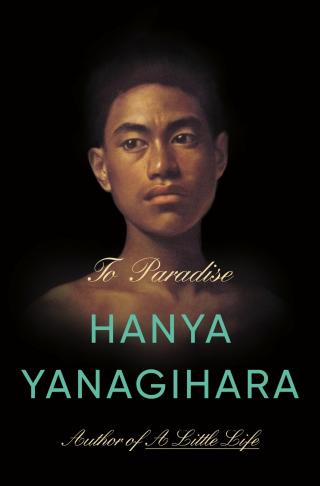
To Paradise
- Автор: Yanagihara Hanya
- Год: 2022
- Язык: английский
- Год: Knopf Doubleday Publishing Group
- Жанр: Современная русская и зарубежная проза

Электронная книга - «To Paradise». Краткое содержание книги:
In an alternate version of 1893 America, New York is part of the Free States, where people may live and love whomever they please (or so it seems). The fragile young scion of a distinguished family resists betrothal to a worthy suitor, drawn to a charming music teacher of no means. In a 1993 Manhattan besieged by the AIDS epidemic, a young Hawaiian man lives with his much older, wealthier partner, hiding his troubled childhood and the fate of his father. And in 2093, in a world riven by plagues and governed by totalitarian rule, a powerful scientist's damaged granddaughter tries to navigate life without him--and solve the mystery of her husband's disappearances.
These three sections are joined in an enthralling and...
“I don’t want it to look like an Afro,” I said, and he sat up from his usual slouch, leaning forward.
“What’s wrong with an Afro?” he asked, giving me that unblinking stare he sometimes did, when his eyes darkened, turned a deeper blue, and I began to stammer, as I did when I was nervous.
“Nothing,” I said. “Nothing’s wrong with an Afro.”
He leaned back and gazed at me for a long moment, and I had to look away. “A real Hawaiian wears his hair big,” he said. His own hair was curly but fine, like a child’s, and he wore it tied back with an elastic band. “Big and proud.” He began calling me Accountant after that, because he said I looked like I should be working in a bank somewhere, counting other people’s money. “Howzit, Accountant,” he’d say in greeting when he came to pick me up. “Business good?” It was a taunt, I knew, but at times it felt almost loving, a term of affection, something only we shared.
I never knew what to say when he criticized my mother. By this time, it had long ago been made clear that I could never make her happy, and yet I couldn’t help but feel protective of her, even though she’d never asked for my protection, and, indeed, I had none to give her. I would like to think, in retrospect, that part of what made me uncomfortable was his implication that there was only one way to be Hawaiian. But I hadn’t been sophisticated enough to think in those terms back then—the idea that my race compelled me to be one way or another at all was so foreign that it would have been like telling me that there was another, more correct way to breathe or swallow. I now know that all around me there were people my age who were having those very conversations: how to be black, or Oriental, or American, or a woman. But I had never heard those conversations, and when I finally did, it was in Edward’s company.
So instead I would just say, “She’s Hawaiian,” though even as I said it I could hear it sounded like a question: “She’s Hawaiian?”
Which is maybe why Edward answered as he did.
“No, she’s not,” he said.
But let me go back to when we first met. I was ten at the time, recently made fatherless. Edward was new that year. The school admitted new waves of students in kindergarten, fifth grade, seventh grade, and ninth grade. Later, Edward would curse the fact that we’d attended this school when we could have attended the school that only admitted students with Hawaiian blood. Our school had been granted by the king’s charter but was founded by missionaries. “Of course we didn’t learn about who we are and where we came from,” he’d said. “Of course we didn’t. That damn school’s entire mission was to colonize us into submission.” And yet he’d gone there as well. It was one of the many examples of things in my and Edward’s shared life that he would come to hate or be ashamed of, and my refusal or inability to be equally ashamed—though I was ashamed of plenty of other things—came to infuriate him, too.
I attended the school because members of my family had always attended the school. On the high-school part of the campus there was even a building called Bingham Hall, one of the first structures the missionaries had built, named for one of the reverends who would later marry the crown princess. Every Kawika Bingham who had attended the school—my father, and grandfather, and great-grandfather, and great-great-grandfather—posed for a photograph or drawing in front of the building, standing beneath the name, which had been tapped into stone.
No one from Edward’s family had ever attended the school, and it was only—he told me—because of a scholarship that he was able to go at all. He told me these things matter-of-factly, without self-pity or embarrassment, which I found remarkable.
We became friends slowly. Neither of us had any others. When I had been younger, there were some boys whose mothers wanted them to befriend me because of who my father was, who my mother was. It makes me cringe even now, the memory of one of them trudging across the playground toward me, introducing himself, asking if I wanted to play. I always said yes, and there’d be a lackluster game of catch. After a few days of this, I’d be invited to his house; Matthew would drive me if they didn’t live in the valley. There, I’d meet the boy’s mother, who would smile at me and serve us a snack: Vienna sausages and rice, or bread and passion fruit jam, or baked breadfruit with butter. There’d be another, silent game of catch, and then Matthew would drive me home. Depending on how ambitious the boy’s mother was, there might be another two or three invitations, but eventually they would stop, and at school, the boy would bolt toward his real friends at recess, never looking at me. They were never cruel to me, they never bullied me, but that was only because I wasn’t worth bullying. In the neighborhood, as I told you, there were boys who bullied me, but I grew used to that as well—it was a kind of attention.
I was friendless because I was boring, but Edward was friendless because he was strange. He didn’t look strange—his clothes weren’t as new as ours, but they were the same clothes, the same Hawaiian shirts and cotton pants—but he had, even then, a kind of inwardness; he was somehow able to suggest, without ever saying it, that he needed no one else, that he knew something that none of the rest of us did, and until we did, it wasn’t worth his trying to have a conversation with us.
It was early in the school year when he approached me one recess period. I was sitting, as I always did, at the base of the giant monkeypod tree, reading a comic book. The tree was at the top of the field, which sloped gently toward the southern end of campus, and as I read, I could watch my classmates—the boys playing soccer, the girls jumping rope. Then I looked up and saw Edward loping toward me, but something in his air made me think he was just walking in my direction, not that I was his destination.
Yet it was in front of me that he stopped. “You’re Kawika Bingham,” he said.
“Wika,” I said.
“What?” he asked.
“Wika,” I said. “People call me Wika.”
“Okay,” he said. “Wika.” And then he walked off. For a moment, I felt uncertain—was I Kawika Bingham?—and then I realized I was, because he had confirmed it.
The next day, he returned. “My mother wants you to come over after school tomorrow,” he said. He had a way of speaking in which he looked not at you but at a point beyond you, which meant that when he finally did turn his gaze directly to you—as he did now, waiting for my answer—it felt particularly intense, almost interrogatory.
“Okay,” I said. I didn’t know what else to say.
The following morning, I told Matthew and Jane that I was going to a classmate’s house after school. I told them quickly, quietly, as I ate my breakfast, for I knew, somehow, that my mother would not approve of Edward. This may have been unfair—my mother was not dismissive of people with less money than she had, at least not in a way I would have recognized at the time—but I knew I couldn’t tell her.
Matthew and Jane looked at each other. All of my other play dates had been arranged by the boys’ mothers with my mother; I had never arranged one on my own. I could tell they were happy for me, and trying not to make me self-conscious.
“You need me to come get you afterward, Wika?” asked Matthew, but I shook my head—I already knew that Edward lived near the school, which meant I’d be able to walk home, as usual.
Jane got up. “You’ll want to bring something to give his mother,” she said, and went to the pantry for one of her jars of mango jam. “Tell her she can send back the jar with you when she’s done and I’ll refill it next season, all right, Wika?” That seemed very optimistic—mango season had just ended, so, in order to get a refilled jar, Mrs. Bishop would have to count on her son and me remaining friends for another year. But I only said thank you, and put the jar in my backpack.