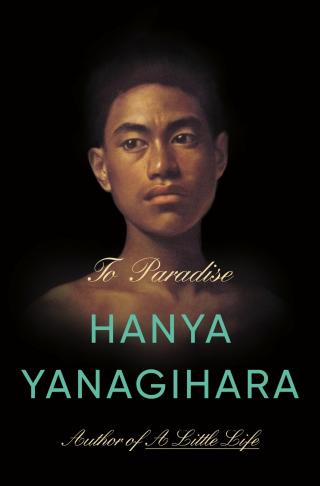
To Paradise
- Автор: Yanagihara Hanya
- Год: 2022
- Язык: английский
- Год: Knopf Doubleday Publishing Group
- Жанр: Современная русская и зарубежная проза

Электронная книга - «To Paradise». Краткое содержание книги:
In an alternate version of 1893 America, New York is part of the Free States, where people may live and love whomever they please (or so it seems). The fragile young scion of a distinguished family resists betrothal to a worthy suitor, drawn to a charming music teacher of no means. In a 1993 Manhattan besieged by the AIDS epidemic, a young Hawaiian man lives with his much older, wealthier partner, hiding his troubled childhood and the fate of his father. And in 2093, in a world riven by plagues and governed by totalitarian rule, a powerful scientist's damaged granddaughter tries to navigate life without him--and solve the mystery of her husband's disappearances.
These three sections are joined in an enthralling and...
It was only when she said that she hoped I was staying for dinner that I looked at the round-faced clock above the sink and realized that it was almost five-thirty, and I had told Matthew and Jane I’d be home an hour ago—never would I have assumed I would have wanted to stay at another boy’s house for so long. I could feel myself entering that stage of distress I often did when I knew I had done something wrong, but Mrs. Bishop told me not to worry, just to call home, and when Jane picked up, she sounded relieved. “Matthew will come get you now,” she said, before I even had a chance to ask if I could stay for dinner (which I wasn’t sure I wanted to do, anyway). “He’ll be there in ten minutes.”
“I have to go home,” I told Mrs. Bishop, when I had hung up, “I’m sorry,” and she smiled at me again.
“You’ll stay next time,” she said. She spoke in a slight singsong. “We’d like that, right, Edward?” And Edward nodded, though he was already moving about the kitchen with his mother, removing things from the refrigerator, and seemed to have forgotten I was still there.
Before I left, I gave her the jar of mango jam in my bag. “This is for you,” I said. “She”—I knew not to clarify that “she” was the housekeeper, and not my mother—“said you could give it back to me when it’s empty and then she’ll refill it next season.” But then I remembered the tree outside, and felt foolish, and was about to apologize when Mrs. Bishop pulled me close again.
“My favorite,” she said. “Tell your mother thank you.” She laughed. “I may need to ask her for the recipe—every year I swear I’m going to make jam, and every year I never do. I’m such a klutz in the kitchen, you see,” and she actually winked at me, as if she were letting me know a secret that no one else was privy to, not even her son.
I heard Matthew’s car pull up outside, and said goodbye to them both. But on the lanai, I turned and looked through the screen door and saw the two of them, mother and son, in the kitchen making dinner. Edward said something to his mother and she tipped her head back and laughed, and then reached over and rubbed the top of his head, playfully. They had turned the kitchen light on, and I had the strange sense that I was looking inside a diorama, at a scene of happiness I could witness but never enter.
—
“Bishop,” said my mother, later that night. “Bishop.”
I knew, even then, what she was thinking: Bishop was a famous name, an old name, almost as famous and old as our own. She was thinking that Edward was someone like us, and yet I knew he wasn’t, not in the way she meant.
“What does his father do?” she asked, and as I admitted I didn’t know, I realized that I hadn’t thought about his father at all. Part of this was, as I have said, because fathers were shadowy presences in all of our lives. You saw them on weekends and in the evenings, and if you were lucky, they were benevolent, distant beings, with an odd piece of candy for you, and if you were unlucky, they were chilly and remote, dispensers of whippings and spankings. My understanding of the world was very limited, but even I somehow comprehended that Edward didn’t have a father—or, more accurately, that Mrs. Bishop didn’t have a husband. The two of them, mother and son, were so complete together, cooking in that miniature kitchen, she playfully butting her hip against his side, he dramatically skidding to the right, his mother laughing at him, that there was no room for a father or a husband: They were a matched set, one female, one male, and another man would simply disrupt their symmetry.
“Well,” my mother said, “we should have them over for tea.”
And so, the following Sunday, they came. They couldn’t come on Saturday, I heard Jane tell my mother, because Mrs. Bishop had to work her shift. (“Her shift,” my mother echoed, in a tone that conveyed some meaning I couldn’t quite interpret. “All right, Jane, tell her Sunday.”) They arrived on foot, yet weren’t hot or flushed, which meant they had taken the bus and had walked to our house from the closest stop. Edward was wearing his school clothes. His mother was wearing another full-skirted cotton dress, this one hibiscus-yellow, her dark-blond hair in its knot, her lips painted a cheery red, even more beautiful than I’d remembered.
She was smiling as my mother approached her. “Mrs. Bishop, such a pleasure to meet you,” she said, to which Mrs. Bishop responded, as she had to me, “Please, call me Victoria.”
“Victoria,” my mother repeated, as if it were a foreign name and she wanted to make sure she was pronouncing it correctly, but she did not reciprocate the offer, though Mrs. Bishop seemed not to expect it.
“Thank you so much for having us over,” she said. “Edward”—she turned her beam to her son, who was looking at my mother with a steady, serious expression, not quite suspicious, but alert—“is new this year, and Wika has been so kind to him.” And now she turned to look at me, with that little wink, as if I had done her son a favor by talking to him, as if I had departed from my busy schedule in order to do so.
Even my mother seemed slightly taken aback by this. “Well, I’m very glad to hear Wika has a new friend,” she said. “Won’t you come in?”
We filed into the sunroom, where Jane served us shortbread, pouring the women coffee—“Oh! Thank you—Jane? Thank you, Jane, this looks delicious!”—and Edward and me guava juice. I had seen other acquaintances of my mother grow silent and awestruck in this room, which to me was simply a room, sunlit and dull, but to them was a museum of my father’s ancestors: the scarred wooden surfboard my great-grandfather, known as the Portly Prince, had ridden in Waikīkī; the daguerreotypes of my great-great-grandfather’s sister, the queen, in her black taffeta gown, and a great-great-cousin, an explorer who had a building at a famous university named for him. But Mrs. Bishop seemed unintimidated, and looked about herself openly, with genuine delight. “What a lovely room this is, Mrs. Bingham,” she said, smiling at my mother. “My entire family has always been great admirers of your husband’s family, and how much he did for the islands.”
It was exactly the right thing to say, done simply and well, and I could tell my mother was surprised. “Thank you,” she said, a bit stiffly. “He loved his home.”
For a while, my mother talked to Edward, asking him if he liked his new school (yes), and if he missed his old friends (not really), and what his hobbies were (swimming, hiking, camping, going to the beach). When I became the parent of a young boy myself, I was able to appreciate Edward’s composure, his apparent unflappability; as a child, I was eager, too eager, to please, smiling desperately through conversations with my parents’ friends, hoping I wouldn’t shame them. But Edward was neither ingratiating nor awkward—he answered my mother’s questions straightforwardly, without any pandering or apology. Even then, he possessed an unusual dignity, one that made him seem invincible. It was almost as if he didn’t care about anyone else, and yet that would suggest that he was aloof, or proud, and he wasn’t either of those things.
Finally, my mother was able to ask about Mr. Bishop: Certain members of the Bishop family had been distant cousins of my father, the way that all the old missionary families who had married into Hawaiian royalty were distant cousins—was it possible that there might be a connection?