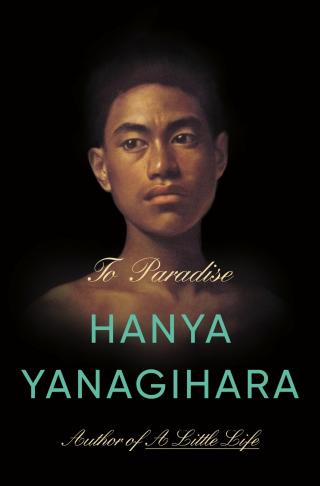
To Paradise
- Автор: Yanagihara Hanya
- Год: 2022
- Язык: английский
- Год: Knopf Doubleday Publishing Group
- Жанр: Современная русская и зарубежная проза

Электронная книга - «To Paradise». Краткое содержание книги:
In an alternate version of 1893 America, New York is part of the Free States, where people may live and love whomever they please (or so it seems). The fragile young scion of a distinguished family resists betrothal to a worthy suitor, drawn to a charming music teacher of no means. In a 1993 Manhattan besieged by the AIDS epidemic, a young Hawaiian man lives with his much older, wealthier partner, hiding his troubled childhood and the fate of his father. And in 2093, in a world riven by plagues and governed by totalitarian rule, a powerful scientist's damaged granddaughter tries to navigate life without him--and solve the mystery of her husband's disappearances.
These three sections are joined in an enthralling and...
Twice a year, the three of us would drive out to Lā‘ie, on the North Shore. Here there was a small coral-rock church for which my great-grandfather had been the benefactor since he was a young man, and it was from here that my father would distribute envelopes of money, twenty dollars for each adult, to celebrate my great-grandfather’s birthday and then the day of his death, by giving a gift to the people of the town his grandfather had loved. As we approached the church, turning off the road onto a dirt path, we would see the townspeople clumped around the door, and as my father climbed out and advanced toward the building, they would bow. “Your Highness,” they would murmur, these big dark people, their voices unnaturally soft, “welcome back, King.” My father would nod at them, offer his hands to be taken and squeezed, and inside, he would distribute the money and then would sit to listen to the best singer among them, who would sing a song, and then someone else, who would chant, and then we would get into the car and drive back to town.
These visits always made me uncomfortable. I felt, even as a young boy, as if I were a fraud—what had I done to be called “Prince,” to have an old woman, so old that she spoke only Hawaiian, bow before me, her hand clenching the head of her cane so she wouldn’t fall? On the ride home, my father was cheery, whistling the song that had just been performed for him, while my mother sat by his side, straight and silent and regal. After my father died, I had gone with her alone, and although the townspeople had been respectful, they had acknowledged only me, not her, and although she was always polite to them, she didn’t have my father’s good humor, or his ability to make people far poorer than he feel like his equal, and the occasion took on a strained quality. By the time I was eighteen, and expected to discharge this duty myself, the entire enterprise had begun to feel anachronistic and condescending, and from then on, my mother just sent an annual donation to the local community center, for it to distribute in whatever way benefited its members. Not that I was capable of being my father, anyway. That was what I had told her—that I wasn’t a substitute for him. “You don’t understand, Wika,” she had said, wearily, “you’re not his substitute. You’re his heir.” But she hadn’t contradicted me, either: We both knew I couldn’t equal my father.
Things changed after he died, of course. For my mother, the changes were more profound and threatening. Once his debts had been paid—he had liked to gamble and had liked cars—there was less money left than she had assumed. She had also lost with him a sense of security in who she was—he had legitimized who she always claimed to be, and without him, she would forever be defending her right to call herself nobility.
But the other change was that my mother and I were left with only each other, and it wasn’t until my father had left us that we both realized that it was he who had provided us our identities: She was Kawika Bingham’s wife; I was Kawika Bingham’s son. Even now that he was gone, we still defined ourselves in relation to him. But without him, our relation to each other seemed more capricious. She was now Kawika Bingham’s widow; I was Kawika Bingham’s heir. But Kawika Bingham himself no longer existed, and without him, we no longer knew how to relate to each other.
—
After my father’s death, my mother became increasingly involved with her society, Kaikamahine kū Hawai‘i. The group, whose members referred to themselves as the Daughters, was open to anyone who could prove noble lineage.
My mother’s own claim to noble blood was a complicated subject. Her adopted father, who was a distant cousin of my father’s, had been noble: He, like my father, could trace his family all the way back to before the Great King. But my mother’s origins were more opaque. As I grew older, I would hear various stories about who she was. The most common was that she was in fact her adopted father’s illegitimate child, and that her mother had been a fling, a haole cocktail waitress who’d returned home to America soon after giving birth. But there were other theories as well, including that she was not only not noble but not even of Hawaiian blood, that her mother had been her adoptive father’s secretary, and that her father had been her adoptive father’s manservant—her father had been known to prefer hiring haoles, because he liked to show off that he had the stature and money to have white people work for him. When she occasionally spoke about her adoptive father, she would say only that he was always kind to her, though from someone—who, I don’t know—I must have gotten the sense that, while he might have been kind to her, it was in a vague sort of way; he was strict with his own children, his daughter and his son, because he expected more from and for them. They had the power to disappoint him, but they also had the power to please him. They were embodiments of him in a way my mother was not.
Marrying my father had quieted most of the rumors—his origins were inarguable, unimpeachable—but with his death, I believe she felt she was once again on the defensive, alert and attuned to any challengers. It was why she did so much work with the Daughters—why she hosted their annual fund-raisers, why she led committees, why she chaired charity initiatives, why she tried, in all the ways appropriate for her imagination and her era, to be the ideal Hawaiian woman.
The problem, though, with trying to be the ideal anything is that eventually the definition changes, and you realize that what you’d been pursuing all along was not a single truth but a set of expectations determined by context. You leave that context, and you leave behind those expectations, too, and then you’re nothing once again.
When Edward first met my mother, he was careful and polite. It wasn’t until later, when we became close again as adults, that he became suspicious of her. She couldn’t speak Hawaiian, he pointed out (neither could I; aside from the few phrases and words we all knew, and a dozen songs and chants, I spoke only English and some French). She didn’t support the struggle. She didn’t support the return of the Hawaiian kingdom. But he never mentioned, as others had, how light-skinned she was; he was lighter still, and if you hadn’t grown up on the islands, you wouldn’t know to look past his hair and eyes to see his Hawaiianness, a secret hiding just beneath. By that point, he had grown envious of my own appearance, my own skin and hair and eyes. Sometimes I’d look up to catch him staring at me. “You should grow your hair out,” he said to me, once. “More authentic that way.” It bothered him that even then, when everyone was wearing their hair long, I still wore mine as my father had worn his—tidy and very short—because it was woolly and dense, and if it got too long, it puffed out around my head.