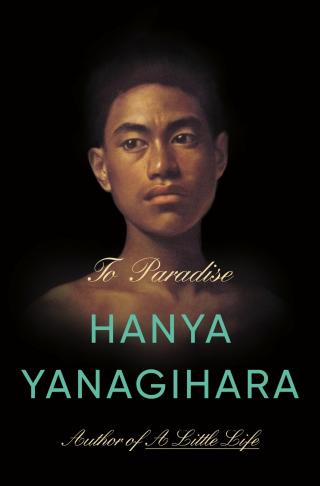
To Paradise
- Автор: Yanagihara Hanya
- Год: 2022
- Язык: английский
- Год: Knopf Doubleday Publishing Group
- Жанр: Современная русская и зарубежная проза

Электронная книга - «To Paradise». Краткое содержание книги:
In an alternate version of 1893 America, New York is part of the Free States, where people may live and love whomever they please (or so it seems). The fragile young scion of a distinguished family resists betrothal to a worthy suitor, drawn to a charming music teacher of no means. In a 1993 Manhattan besieged by the AIDS epidemic, a young Hawaiian man lives with his much older, wealthier partner, hiding his troubled childhood and the fate of his father. And in 2093, in a world riven by plagues and governed by totalitarian rule, a powerful scientist's damaged granddaughter tries to navigate life without him--and solve the mystery of her husband's disappearances.
These three sections are joined in an enthralling and...
I can’t tell you exactly where I am, because I don’t know. Sometimes I imagine I must be on Tantalus, high up in the forest, because it’s cool and rainy and very quiet, but I could also be in Nu‘uanu, or even in Manoa. I do know I’m not at our house, because this place doesn’t smell like our house. For a long time I thought I was in a hospital, but it doesn’t smell like a hospital, either. But there are doctors and nurses and orderlies, and they all take care of me.
For a long time I didn’t leave my bed at all, and then they started making me. “C’mon, Wika,” a man’s voice would say. “C’mon, bruddah.” And I could feel a hand on my back, helping me sit, and then four hands on me, two wrapped around my waist, lifting me up and setting me down again. Then I was being pushed, and I could feel that we had left the building, I could feel the sun on my neck. One of the hands tipped my chin up; I closed my eyes. “That feels good, doesn’t it, Wika?” said the voice. But then he let go of my chin and my head flopped forward again. Now when they take me around the building or out to the garden, they strap something around my forehead so that my head stays in place. Sometimes a woman comes and moves my arms and legs and talks to me. She bends and straightens each limb, and then she rubs me before turning me onto my stomach and kneading my back. There would have been a time when that would have made me embarrassed, to be lying there without any clothes on and with a strange woman touching me, but now I don’t mind. Her name is Rosemary, and as she massages me, she talks about her day and her family: her husband, who’s an accountant; her son and daughter, who’re still in elementary school. Occasionally, she’ll say something that makes me realize how much time has passed, but then, later, I get confused because—once again—I don’t know if she actually said it or if I just made it up. Did the Berlin Wall fall, or did it not? Are there now colonies on Mars, or are there not? Did Edward triumph after all, and has the monarchy been restored, and I named king of the Hawaiian islands, and my mother the queen regent, or has it not? One time she said something about you, about my son, and I became agitated and she had to buzz for help, and since then she’s never mentioned you again.
Today I thought of you as they were feeding me my dinner. Everything I eat is soft, because sometimes I think too much about swallowing and then I start panicking and gagging, but if I don’t have to chew I think about it less. Dinner was congee with preserved egg and scallions, which is one of the dishes I used to have Jane make you when you were sick—one of the dishes she made me when I was a child. It was one of my father’s favorites as well, although he liked his with boiled chicken.
I think Jane is dead. Matthew, too. No one has told me this, but I know, because they used to come visit me and now they don’t. Don’t ask me how long ago, or how; I wouldn’t be able to tell you. But they were old—older than your grandmother. I once overheard her telling you that her father had given her Jane and Matthew as a wedding present: two servants from her father’s household that would help her run her own. But that isn’t true. Jane and Matthew were in the house well before your grandmother joined it. And besides, by that point her father didn’t have the money for a single servant, much less two, much less two he could give away. And if he had, it’s unlikely he would have given them to her, when legally she wasn’t even related to him by blood.
I never knew what to do when I heard your grandmother tell you things that weren’t true. I didn’t want to contradict her. I knew better. And I wanted you to trust her, and to love her—I wanted things to be easier for you than they were for me, and that meant having a good relationship with her. I worked hard to make that happen, and I think I succeeded, which means I didn’t completely fail you; I made sure your grandmother loved you. But now you are grown, grown and safe and living in New York, and I feel I can tell you the truth.
I will say this for your grandmother: She took nothing she had for granted. What she had she had fought for and earned, and her life was dedicated to ensuring it never slipped away from her. She raised me to feel the opposite, and yet there were times I think she felt resentful that I did, even though it had been her intention. She never resented my father for it, and yet she resented me, because I was partially hers, and I should therefore be aware of how precarious my position was, because then her own anxiety would feel less lonely. We often end up resenting our children when they achieve what we’ve wished for them—although this isn’t my way of saying that I resent you, even though my only wish was that you grow up and leave me behind.
About my father I have little to say that you don’t already know. I was already eight, almost nine, when he died, and yet I have few memories of him—he is a blurred, jovial presence, sporty and hearty, swinging me up in the air when he came home from work, dangling me upside down as I squealed, trying and failing to teach me how to hit a ball. I wasn’t like him, but he didn’t seem dissatisfied with me, the way I knew my mother to be from almost the time I had a sense of her opinions at all; I liked reading, and he would call me “Professor,” never sarcastically, even though what I liked to read were just comic books. “This is Wika, the reader in the family,” he’d introduce me to acquaintances, and I would feel embarrassed, because I knew that I was reading nothing important, that I didn’t really have the right to call myself a reader. But it hadn’t mattered to him; if I had ridden horses, I would have been the Rider, and if I had played tennis I would have been the Athlete, and it wouldn’t have made a difference if I had distinguished myself or not.
Most of the money had been spent by the time my father joined the family firm, and he didn’t seem interested in replenishing its coffers. We’d spend weekends at the club, where we’d have lunch together—people stopping by our table to shake my father’s hand and smile at my mother; the slice of coconut layer cake, soapy-sweet and shagged like a carpet, that my father always ordered for me at the end, despite my mother’s protestations, placed in front of me—before my father joined his golf game and my mother sat with her stack of magazines beneath an umbrella near the pool, where she could watch me. Later, when Edward and I were becoming friends, I would stay quiet as he talked about going to the beach on the weekends with his mother; they would pack containers of food and spend all day there, his mother sitting on a blanket with her friends, Edward running into the water and then back out, in and then out, until the sky began to darken and they packed their things to leave. The club was near the ocean—when you were on the course, you could see stripes of it through the trees, a band of glinting blue—but we would never have thought of going there: It was too sandy, too wild, too poor. But I never said this to Edward; I said I loved going to the beach as well, even though, when we started going together, part of me was always thinking about when we could leave, when I could take a shower and become clean again.
It wasn’t until my father died that I realized we were rich, and by then, we were far less rich than we had been. But the kind of wealth my father had possessed wasn’t of an obvious kind—our house was large, but it was like everyone else’s, with a wide porch and a large, crowded sunroom, and a small kitchen. I had all the toys I wanted, but my first bike was secondhand, a hand-me-down from a boy on the next street. We had Jane and Matthew, but our meals were simple—rice and meat of some kind for dinner; rice and fish and eggs for breakfast; a metal bento box I took to school for lunch—and it was only when my parents entertained, and the candles were lit and the chandelier was cleaned, that the house looked grand, and that I was able to recognize that there was something stately in its simplicity: the dark, shining dining-room table; the smooth white wood of the walls and ceiling; the vases of flowers that were replaced every other day. This was in the late ’40s, when our neighbors were laying linoleum over their floors and replacing their dishware with plastic, but ours was not, as my mother said, a house of convenience. In our house, the floors were wood and the cutlery was silver and the plates and bowls were china. Not expensive china, but not plastic, either. The postwar years had brought new wealth to the islands, new things from the mainland, but here again our household did not indulge in what my mother considered trends. Why would you buy expensive oranges from Florida when the ones from our yard were even better? Why should you buy raisins from California when the lychee from our trees were even sweeter? “They’ve gone mainland mad,” she would say about our neighbors; she was dismissive of what she saw as their gullibility, in which she saw a kind of self-loathing for where we lived and who we were. Edward was never able to see that aspect of her, her fierce nationalism, her love for her home—he saw only the inconsistency with which that pride was expressed, the way she scorned other people for wanting the latest music and food from the mainland while also wearing the pearls she had bought in New York, the long cotton skirts that she ordered from her dressmaker in San Francisco, where she and my father had made annual trips, a habit she continued after his death.