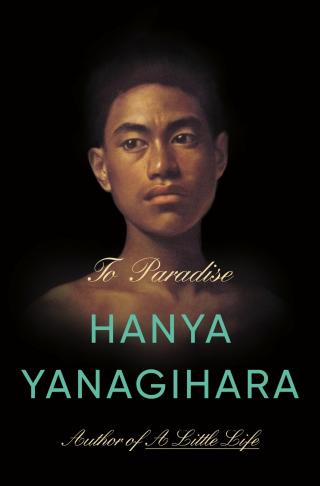
To Paradise
- Автор: Yanagihara Hanya
- Год: 2022
- Язык: английский
- Год: Knopf Doubleday Publishing Group
- Жанр: Современная русская и зарубежная проза

Электронная книга - «To Paradise». Краткое содержание книги:
In an alternate version of 1893 America, New York is part of the Free States, where people may live and love whomever they please (or so it seems). The fragile young scion of a distinguished family resists betrothal to a worthy suitor, drawn to a charming music teacher of no means. In a 1993 Manhattan besieged by the AIDS epidemic, a young Hawaiian man lives with his much older, wealthier partner, hiding his troubled childhood and the fate of his father. And in 2093, in a world riven by plagues and governed by totalitarian rule, a powerful scientist's damaged granddaughter tries to navigate life without him--and solve the mystery of her husband's disappearances.
These three sections are joined in an enthralling and...
I loved those walks of ours. I think you did, too. We had to stop them after you told your teacher about them—you were falling asleep in class, and your teacher asked why, and you told her it was because of our nighttime walks, and your teacher called me in to see her and I got in trouble. “He’s growing, Mr. Bingham,” she said, “he needs his sleep. You can’t be waking him up in the middle of the night to go on walks.” I felt foolish, but she was kind to me. She could have told your grandmother, but she didn’t. “I just want to spend more time with him,” I told the teacher, and she looked at me in the way that people often did, that made me realize I’d said something wrong, something queer, but finally she had nodded. “You love your son, Mr. Bingham,” she said, “and that’s a wonderful thing. But if you really love him, you’ll let him sleep.” I was embarrassed then, because of course she was right: You were just a child. I had no right to wake you and take you from your bed. The first time I did so, you were confused, but then you grew to expect it, and you would rub your eyes and yawn, but you never complained—you would put on your slippers and take my hand and follow me down the path. I never had to tell you not to tell your grandmother; you already knew not to. Later, I told Edward that I had gotten in trouble with the teacher, and why. “You dumbass,” he said, but in a way so that I knew he wasn’t mad, just frustrated. “They could’ve called Child Services and taken Kawika away for that.” “Could they have?” I asked. It was the worst thing I could imagine. “ ’Course they could’ve,” he said. “But don’t worry. When we go to Lipo-wao-nahele, you can raise Kawika however you want, and no one can say anything about it.”
What else do you remember? All I can do is remember. I can see, a little, but just light and darkness. Do you remember how we used to go to the Chinese cemetery and sit near the monkeypod tree at the top of the hill? We’d lie right on the grass, with our faces turned up to the sun. “Keep your eyes shut,” I’d tell you, but even though we did, we could still see a field of orange, little blobs of black flickering across it like flies. After I told you how vision worked, you asked me if you were seeing the back of your eye, and I told you that maybe you were. Anyway, it’s like that—I can see color and those blobs, but not much else. When they take me outdoors, though, they put sunglasses on me first. This is because, according to one of the doctors here, I should still be able to see—there’s nothing wrong with my eyes, as such, and so they need to be protected. Until recently, your grandmother used to bring pictures of you, which she’d hold in front of me, so close that the paper tickled against my nose. “Look at him, Wika,” she’d say. “Look at him. Stop this nonsense. Don’t you want to see pictures of your son?” Of course I did, and I tried, I tried hard. But I could never see more than the outline of the square of paper, maybe the dark of your hair. Or maybe it wasn’t a picture of you at all that she was showing me. Maybe it was a picture of a cat, or a mushroom. I couldn’t tell the difference. The point is that I never see everything new; everything I see I’ve seen before.
But although I can’t see, I can hear. Most of it doesn’t make much sense to me, not because I can’t understand it, exactly, but because I’m so often asleep that it’s difficult for me to keep track of what I’m actually hearing and what I’m imagining. And sometimes when I’m trying to figure it out, I fall asleep again, and then, when I wake next, I’m more confused—assuming I can recall what I was trying to sort out before I fell asleep, I by then don’t know whether I really heard what I thought I heard, or whether I had been hallucinating. Your being in New York, for example: I woke with the strong feeling you were there. But were you, really? Had someone told me that, or had I invented it? I thought and thought, so hard that I could hear myself begin to whimper with frustration and confusion, and then someone came into my room, and then there was blankness. When I woke again, I remembered only that I had been upset, and it wasn’t until later that I remembered why. I had no way to ask whether you were in New York or not, of course, and so I just had to wait until someone—your grandmother—came to visit me again, and hope that she would mention you. And eventually, she did come, and said that she’d gotten a letter from you, and that the weather in New York was hot, hot and rainy, and that you wanted me to get better. Now I suppose you’re wondering how I knew that this was actually happening, that I wasn’t dreaming it, and the answer is because that day I could smell the flowers your grandmother was wearing. Do you remember how, when the pakalana vine was in bloom, she’d send you to the side of the house to pick a few clusters, and then she’d put them in that little silver brooch she had, the one shaped like a vase that could actually hold a few blossoms? That was how I knew it was real, and also that it was summer, because pakalana only blooms in summer. It’s also why, whenever I think of you, and New York, I smell pakalana.
I don’t know how long you’ve been away. I think it must be a very long time. Years. Maybe even a decade. But then I realize that, if that’s so, it means that I’ve been here, in this place, for years, maybe even a decade. And then I can hear myself beginning to moan, louder and louder, and thrash my arms and legs, and piss myself, and then I can hear the sound of people running toward me, and sometimes I hear them say my name: “Wika. Wika, you need to calm down. You need to calm down, Wika.” Wika: They only call me Wika. No one here calls me Mr. Bingham unless your grandmother is visiting. But that’s fine. It never felt right, being called Mr. Bingham.
But I can’t calm down, because now I’m thinking about how I’ll never get out of here, about how my life—my entire life—has been spent in places I can’t escape: Your grandmother’s house. Lipo-wao-nahele. And now here. This island. I could never really leave. But you did. You got away.
And so I keep making the sounds I can, slapping away their hands, wailing over their attempts to soothe me, and I keep doing it until I feel the medication entering my veins, warming my body, calming my heart, delivering me back to a state of forgetting.
—
I want to talk to you, my son, my Kawika, though I know you will never hear me, as I will never be able to say any of this aloud to you, not anymore. But I want to talk to you about everything that happened, and try to explain to you why I did what I did.
You have never visited me. I know this, and yet I also don’t. Sometimes I’m able to pretend that you have visited me, that I’m just confused. But I know you haven’t. I don’t know what your voice sounds like anymore; I don’t know what you smell like. The image I have of you is from when you were fifteen, and leaving me after one of our weekends together, and I didn’t know—maybe you didn’t, either, maybe you still loved me a little then, despite everything—that I would never see you again. Of course this makes me sad. Not just for my sake—but for yours as well. Because you have a father who is both alive and yet not, and yet you are still a young man, and a young man needs his father.