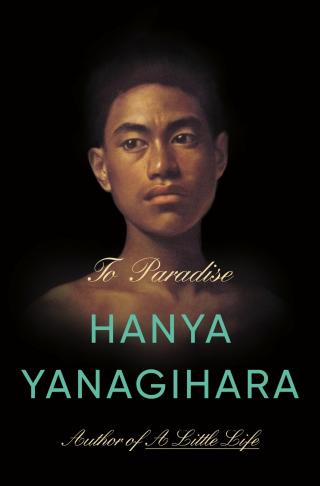
To Paradise
- Автор: Yanagihara Hanya
- Год: 2022
- Язык: английский
- Год: Knopf Doubleday Publishing Group
- Жанр: Современная русская и зарубежная проза

Электронная книга - «To Paradise». Краткое содержание книги:
In an alternate version of 1893 America, New York is part of the Free States, where people may live and love whomever they please (or so it seems). The fragile young scion of a distinguished family resists betrothal to a worthy suitor, drawn to a charming music teacher of no means. In a 1993 Manhattan besieged by the AIDS epidemic, a young Hawaiian man lives with his much older, wealthier partner, hiding his troubled childhood and the fate of his father. And in 2093, in a world riven by plagues and governed by totalitarian rule, a powerful scientist's damaged granddaughter tries to navigate life without him--and solve the mystery of her husband's disappearances.
These three sections are joined in an enthralling and...
They were silent for a long time, and although David was thinking many things, he mostly thought about how good this moment was, lying next to Charles in a warm room, with snow outside. He thought that he should tell Charles that he would hold the air pump for him, but he couldn’t. He wanted so much to give Charles something, some measure of the consolation that Charles had given him, but he couldn’t. Much later, he would wish, again and again, that he had said something, anything, no matter how clumsy. In those years, fear—of sounding dumb, of being inadequate—kept him from the generosity he should have shown, and it was not until he had accumulated many regrets that he had learned that his comfort could have taken any form, that what had been important was that it was offered at all.
“I came down here,” Charles finally said, “I came down here and found you. And”—he took a breath—“and you were asleep, with a letter on your chest, beneath your hand. And—I took it from you, and I read it. I don’t know why. I’m sorry, David.” He was quiet. “And I’m sorry for what’s in it. How come you never told me?”
I don’t know, he said, at last. But he wasn’t angry that Charles had read his letter. He was relieved—that Charles knew, that, once again, Charles’s decisiveness had made a difficult task easier.
“So—your father. He’s still alive.”
Barely, he said. For now.
“Yes. And your grandmother wants you to come see him.”
Yes.
“And that place he lived in—”
It wasn’t what you were thinking, he interrupted Charles. I mean, it was. But it wasn’t. How could he tell Charles? How could he make him understand? How could he make Lipo-wao-nahele sound like something different, something better, something saner than what it was? Not a folly, not make-believe, not an impossibility, but something his father—and even he—had once believed in with all the hopefulness they had, a place where history was meaningless, a place that would finally feel like home, a place where his father had gone in anticipation as much as in fear. He couldn’t. His grandmother had never understood it; Charles certainly wouldn’t, either.
I can’t explain it, he said at last. You wouldn’t understand.
“Try me,” said Charles.
Well, maybe, he said, but he knew he would. Charles knew how to help everyone—what if he knew how to help David, too? What was the point of loving him, of being loved back, if he wasn’t going to try?
But first, he had to eat something; he was hungry. He wriggled himself off the sofa, and held out his hand for Charles, and as they went to the kitchen, he thought of his father again. Not as he was in the care home he lived in now; not as he had been in the last days of his stay at Lipo-wao-nahele, his eyes vacant, his face streaked with dirt; but as he had been when they lived together in their house, when he was four, five, six, seven, eight, nine, when they were a father and a son, and he had never had to consider anything other than the fact that his father would always take care of him, or at least would always try, because he had promised he always would, and because he knew his father loved him, and because that was the way of things. Loss, loss—he had lost so much. How would he ever feel complete again? How could he make up for all those years? How could he forgive? How could he be forgiven?
“Let’s see,” said Charles, as they stood in the kitchen together, surveying their options. On the counter, there was a loaf of sourdough bread wrapped in brown paper that Adams had set aside for them, and Charles sawed off slices for both of them before holding his aloft. “To your father,” he said.
To Peter, he responded.
“An early New Year’s toast,” Charles announced: “Six more years until the twenty-first century.”
They touched their pieces of bread against each other, solemnly, and ate. Behind them, the windows rattled from the wind, but they couldn’t feel it themselves—the house was too well made. “Let’s see what Adams saved for us,” Charles said after they had finished, and opened the refrigerator, removing a jar of mayonnaise, a container of cold steak, a jar of mustard, a wedge of cheese. “Jarlsberg,” he said, and then, almost to himself, “Peter’s favorite.”
He put his arms around Charles, and Charles leaned against him, and for a moment they were quiet. It was then that he had a sudden vision of the two of them many years later, in some undated time far into the future. Outside, the world had changed: The streets had been overgrown with weeds, and the cobblestones in the courtyard were shaggy with pampas grass, and the sky was a viscous green, and a creature with rubbery, webbed wings glided past them. A car puffed south down Fifth Avenue, hovering a few inches above the ground, hissing air as it went. The garage was a ruin, half decayed, its bricks soft and cakey, and in the middle of it, thrusting its way through the crumbling roof, grew a mango tree, just like the one that had grown in the front yard of the house where he had once lived with his father, its branches bulbous with fruit. If it wasn’t quite the end of things, then it was close—the fruit was too poisoned to eat; the car was windowless; the air shimmered with oily smoke; the creature had settled atop the building across the street, its talons gripping the parapet, its black eyes searching for something to swoop down upon and devour.
But inside, he and Charles were somehow the same as they were: still healthy, still there, still magically themselves. They were two people in love, and they were making themselves something to eat, and there was plenty of food, and as long as they stayed indoors, together, no harm would come to them. And to their right, at the far end of the kitchen, was a door, and if they opened that door and walked through it, they would find themselves in a replica of this house, except in that house would be Peter, alive and sarcastic and intimidating, and in the house to the right of his would be John and Timothy and Percy, and in the house to the right of theirs, Eden and Teddy, and on and on and on, an unbroken chain of houses, the people they loved resurrected and restored, an eternity of meals and conversations and arguments and forgivenesses. Together they’d walk through these houses, opening doors, greeting friends, closing doors behind them, until, at last, they’d come to what they somehow knew was the final door. And here they’d pause a moment, squeezing each other’s hands, before turning the knob and entering a kitchen just like their own, the same jade-green walls, the same gilt-edged china in the cupboards, the same framed etchings on the walls, the same soft linen dish towels hung on the same ash-carved pegs, but in which a mango tree was growing, its leaves brushing the ceiling.
And here, sitting on a chair and patiently waiting, would be his father, and when he saw David, he would spring to his feet, his face alight, crying with joy. “My Kawika,” he’d say, “you’ve come for me! You’ve finally come for me!” He wouldn’t hesitate, but would run toward him, while behind him, Charles stood and beamed, watching this final reunion, a father and son finding each other at last.
PART II
My son, my Kawika—what are you doing today? I know where you are, because Mama told me: New York. But where in New York, I wonder? And what are you doing there? She said you were working in a law firm, though not a lawyer, but you mustn’t think I’m any less proud of you for that. I visited New York once, did you know that? Yes, it’s true—your papa has some secrets of his own.
I think about you often. When I’m awake, but also when I’m asleep. All of my dreams are about you in one way or another. Sometimes I dream about the time before we went to Lipo-wao-nahele, when we were together in your grandmother’s house, and we used to take our midnight walks. Do you remember those? I would wake you up, and we’d sneak outside. Up O‘ahu Avenue to East Manoa Road we’d go, and then up Mohala Way, because one of the houses there had a trumpet bush in its front yard that fascinated you, do you remember this? It had pale-yellow flowers, the color of ivory, that grew upside down and looked like the bell of a cornet. At least that’s what people said. You didn’t agree, however. “The upside-down tulip tree,” you used to call it, and I could never see it any other way after that. Then down Lipioma Way we’d go, and over to Beckwith, and then down Manoa Road, and then home. It’s funny—of all the things I was scared of, I was never scared of the dark. In the dark, everyone was helpless, and, knowing that, that I was just like everyone else, no less, made me feel braver.