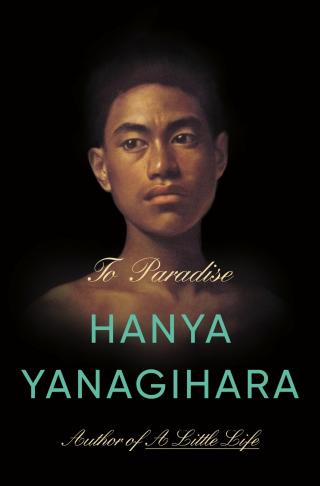
To Paradise
- Автор: Yanagihara Hanya
- Год: 2022
- Язык: английский
- Год: Knopf Doubleday Publishing Group
- Жанр: Современная русская и зарубежная проза

Электронная книга - «To Paradise». Краткое содержание книги:
In an alternate version of 1893 America, New York is part of the Free States, where people may live and love whomever they please (or so it seems). The fragile young scion of a distinguished family resists betrothal to a worthy suitor, drawn to a charming music teacher of no means. In a 1993 Manhattan besieged by the AIDS epidemic, a young Hawaiian man lives with his much older, wealthier partner, hiding his troubled childhood and the fate of his father. And in 2093, in a world riven by plagues and governed by totalitarian rule, a powerful scientist's damaged granddaughter tries to navigate life without him--and solve the mystery of her husband's disappearances.
These three sections are joined in an enthralling and...
But suppose they were forced to? Suppose the earth were to shift in space, only an inch or two but enough to redraw their world, their country, their city, themselves, entirely? What if Manhattan was a flooded island of rivers and canals, and people traveled in wooden longboats, and you yanked nets of oysters from the cloudy waters beneath your house, which was held aloft on stilts? Or what if they lived in a glittering, treeless metropolis rendered entirely in frost, in buildings made from stacked blocks of ice, and rode polar bears and kept seals as pets, against whose jiggling sides you’d press at night for warmth? Would they still recognize each other, passing each other in different boats, or crunching through the snow, hurrying home to their fires?
Or what if New York looked just as it did, but no one he knew was dying, no one was dead, and tonight’s party had been just another gathering of friends, and there was no pressure to say anything wise, anything conclusive, because they would have hundreds more dinners, thousands more nights, dozens more years, to figure out what they wanted to tell one another? Would they still be together in that world, where there was no need to cling together from fear, where their knowledge of pneumonia, of cancers, of fungal infections, of blindness, would be obscure, useless, ridiculous?
Or what if, in this planetary shift, they were knocked sideways, west and south, and returned to consciousness somewhere else entirely, in Hawai‘i, and in that Hawai‘i, that other Hawai‘i, there was no reason for Lipo-wao-nahele, that place to which his father had removed him so long ago, because what it had tried to conjure was in fact real? What if, in this Hawai‘i, the islands were still a kingdom, not part of America at all, and his father was the king, and he, David, was the crown prince? Would they still know each other? Would they still have fallen in love? Would David still have need for Charles? There, he would be the more powerful of the two—he would no longer be in need of another’s largesse, another’s protection, another’s education. Who would Charles be to him there? Would David still find something to love in him? And what of his father—who would he be? Would he be more confident, more self-assured, less scared, less lost? Would he still have had use for Edward? Or would Edward be a speck, a servant, a nameless functionary his father passed, unseeing, on his way to his study to sign documents and treaties, his handsome face aglow as he walked barefoot across the gleaming floors, the wood polished every morning with macadamia oil?
He would never know. For in the world in which they lived, he and his father, they were only who they were: two men, both of whom had sought succor from another man, one each hoped might save him from the smallness of his life. His father had chosen poorly. David had not. But in the end, they were both dependents, disappointed by their past and frightened by their present.
He turned to watch Charles wrap a scarf around Peter’s throat. They were silent, and David had the feeling, as he often had when watching them, but which he had most acutely that evening, that he was a trespasser, that their intimacy was never his to witness. He didn’t move, but he didn’t need to—they had forgotten he was even there. Peter had originally thought he might spend the night in the house with Charles, but the day before had decided against it. His nurse had been called, and was coming with an assistant to pick him up and escort him home.
It was time to say goodbye. “Just give me a second,” Charles announced to them both in a strangled voice, and left the room, and they could both hear him running up the stairs.
And then David was alone with Peter. Peter was in his wheelchair, swaddled in his coat and hat; the top and bottom of his face were obscured by layers of wool, as if he wasn’t dying but mutating, as if the wool were creeping over him like a skin, turning him into something cozy and soft—a couch, a cushion, a bundle of yarn. Charles had been sitting on the sofa to talk to him, and Peter’s chair was still angled toward what was now an empty seat in an empty room.
He went to the sofa and sat where Charles had sat, the cushions still warm beneath him. Charles had been holding Peter’s hands, but he did not. And still—stilclass="underline" Even as Peter gazed at him, he could think of nothing to say, nothing that was not impossible. It would have to be Peter who spoke first, and, finally, he did, David leaning toward him to hear what he would say.
“David.”
Yes.
“Take care of my Charles. Will you do that for me?”
Yes, he promised, relieved that more hadn’t been asked from him, and that Peter hadn’t taken the opportunity to deliver some devastating observation he’d made, some truth about himself that David would never be able to forget. Of course I will.
Peter made a soft dismissive noise. “ ‘Of course,’ ” he murmured.
I will, he told Peter, fiercely. I will. It was important that Peter believed him. But as David was promising him, Peter was already looking away, toward the sound of Charles’s reentry, reaching his arms toward his friend in a gesture so childlike, so loving, that forever after, David was unable to imagine him in any other way: Peter, his arms open and empty, bundled like a toddler about to go out and play in the snow, and walking toward them, to fill them with his presence, Charles, his face crumpling, looking only at Peter, as if nobody else existed in the world.
They lay in bed that night, he and Charles, not touching, not speaking, their preoccupation so complete that, had anyone seen them, he would have mistaken them for strangers.
Peter was gone, lifted downstairs by his nurse and the assistant and accompanied by David and Charles, fed into a car that Charles had called for him. And then the car had driven away, back to Peter’s warm, cluttered second-floor apartment in an old house on Bethune Street near the river, with its crumbling staircase and painted brick facade, and David and Charles had remained on the sidewalk in the cold. He had always known that the end of the evening would be the end of Peter in their lives—in Charles’s life—and now that it had actually happened, it seemed too abrupt, too abbreviated, like something out of a fairy tale: a clock striking midnight and the world being misted with gray, potential lives together dissolving into nothingness.
They had stood there, together, long after the car had vanished from sight. It wasn’t so late, but the cold had kept almost everyone indoors, and only a few stray people, wrapped in black, passed before them. Across the street, the park glittered with snow. Finally, he had taken Charles’s arm. It’s chilly, he said. Let’s go back inside. “Yes,” Charles agreed, his voice faint.
Back inside, they shut off the living-room lights, Charles did a check of the back-door locks as he always did, and then they climbed the stairs to their room, undressed and dressed, and brushed their teeth in silence.
Around them, the night thickened and settled. Eventually, after what felt like an hour, he heard Charles’s breathing change, grow slow and deep, and when he did, he got out of bed and went quietly to the closet, retrieved the letter from his bag, and crept downstairs.