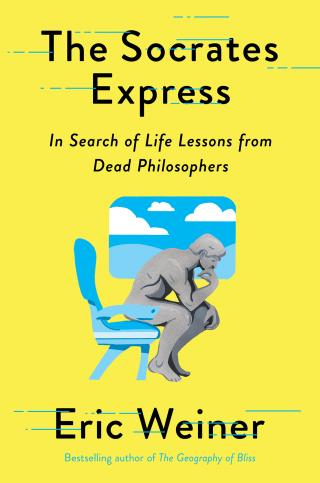
The Socrates Express
- Автор: Вейнер Эрик
- Год: 2020
- Язык: английский
- Год: Avid Reader Press / Simon & Schuster
- Жанр: География, путевые заметки

Электронная книга - «The Socrates Express». Краткое содержание книги:
We contemplate for the same reasons we travel: to see the world from a different perspective, to unearth hidden beauty and find new ways of being. We want to learn how to embrace wonder. Face regrets. Sustain hope.
Eric Weiner, *New York Times* bestselling author of *The Geography of Bliss* , combines his twin passions for philosophy and global travel in a pilgrimage that uncovers surprising life lessons from philosophers around the world, from Marcus Aurelius to Arthur Schopenhauer, Confucius to Montaigne. Traveling by train (the most thoughtful mode of transport) he traversed thousands of miles, making stops in Athens, Delhi,...
Marcus Aurelius, Roman emperor, commanded an army of nearly half a million men, and ruled over an empire that comprised one-fifth of the world’s population and stretched from England to Egypt, from the shores of the Atlantic to the banks of the Tigris. But Marcus (we’re on a first-name basis) was not a morning person. He lingered in bed, doing most of his work in the afternoon, after a siesta. This routine put him at odds with his fellow Romans, most of whom rose before dawn. On the streets of Rome, bleary-eyed children walked to school in the predawn darkness. Marcus, thanks to his elite background, had been homeschooled. He could sleep in. And he did, throughout his life.
Marcus and I don’t seem to have much in common. Centuries separate us, not to mention a not-insignificant power differential. Marcus controlled an empire that covered an area equal to roughly half the continental United States. I control an area roughly half the size of my desk and, truth be told, even that is a struggle. I’m forever deflecting revolts by rebellious business cards, magazine subscription notices, cat hair, three-day-old tuna sandwiches, the cat, Buddhist trinkets, coffee mugs, back issues of Philosophy Now, the dog, 1099 forms, the cat again, and for reasons not entirely clear, given that I live 150 miles from the nearest ocean, sand.
Yet I read Marcus and these differences dissolve. We are brothers, Marcus and I. He, running an empire and wrestling with his demons; and me, feeding the cat and wrestling with my demons. We have a common enemy: mornings.
Mornings set the tone for the day. Bad days follow bad mornings. Not always, but more often than not. Under the covers on a cold and gray Monday morning, rank and privilege count for nothing. Wealth, so helpful in other aspects of life, is useless. If anything, affluence conspires with the duvet to detain you in the horizontal position.
Mornings provoke powerful, conflicting emotions. On the one hand, morning smells of hope. Every dawn is a rebirth. Ronald Reagan didn’t campaign on a slogan of “Late Afternoon in America.” It was his promise of “Morning in America” that catapulted him to the White House. Likewise, great ideas don’t dusk on us. They dawn on us.
For some of us, though, mornings smell of simmering despair. If you don’t like your life, chances are you don’t like your mornings. Mornings are to an unhappy life what the opening scene is to The Hangover Part III. A taste of the awfulness to come.
Mornings are a time of transition, and transitions are never easy. We’re leaving one state of consciousness, sleep, and entering another, wakefulness. To put it in geographic terms, mornings are the border town of consciousness. A Tijuana of the mind. Disorienting, with vague hints of danger.
Philosophers are as divided about mornings as they are everything else. Nietzsche woke at dawn, splashed cold water on his face, drank a glass of warm milk, then worked until 11:00 a.m. Immanuel Kant made Nietzsche look like a slacker. He woke at 5:00 a.m., the Königsberg sky still ink-black, drank a cup of weak tea, smoked a pipe—only one, never more—then got to work. Simone de Beauvoir, bless her, didn’t wake until 10:00 a.m., and lingered over her espresso. Marcus, alas, had no such luxury: he was born some 1,200 years before the invention of coffee.
Suicide, said the French existentialist Albert Camus, is the “one truly serious philosophical problem.” Is life worth living or not? The rest was just so much metaphysical claptrap. Simply put, if there is no philosopher, there is no philosophy.
Camus’s proposition is logically sound but, in my mind, incomplete. Once you’ve wrestled with his suicide question, and concluded that, yes, life is worth living (for now; existential conclusions are always contingent), you confront another, even more vexing question: Should I get out of bed? This question, I believe, is the one truly serious philosophical problem. If a philosophy can’t extract us from under the covers, what good is it?
The Great Bed Question, like all great questions, is actually many questions disguised as one. Let’s pull back the comforter and examine it. On one level, we’re asking can I get out of bed. Unless you are disabled, the answer is yes, you can. We are also asking whether it is beneficial to get out of bed, and crucially, should you get out of bed. This is where it gets tricky.
The Scottish philosopher David Hume thought a lot about these sorts of questions, though rarely from bed. He divided any inquiry into two parts: an “is” and an “ought.” The “is” part is observational. We observe, without judgment, the empirical benefits of getting out of bed: increased blood flow, for instance, and earning potential.
The “ought” part contains a moral judgment. Not what are the benefits of getting out of bed but why we ought to do so. Hume thought we jumped too quickly from “is” to “ought.” A moral “ought” never follows directly from a factual “is.” (That’s why the “is-ought problem” is also known as “Hume’s Guillotine,” since he cleaves “is” from “ought” and insists on a gap between the two.) Embezzling money from your employer is likely to lead to negative outcomes; therefore you ought not to embezzle.
Not necessarily, says Hume. You can’t move from a statement of fact to a statement of ethics. Getting out of bed may be healthy and lucrative, but that doesn’t mean we “ought” to do so. Maybe we don’t want better blood flow and increased earning potential. Maybe we like it just fine here, under the covers. It is this pesky “ought” that, I think, explains our predicament. We feel we ought to get out of bed, and if we don’t there must be something wrong with us.
To rise or not to rise? Under the covers, warm and coddled, competing impulses duke it out with the vigor of a Socratic dialogue, or a cable news show. The stay-in-bed camp makes a strong case. It is warm and safe in bed, not womblike but close. Life is good, and no less a philosopher than Aristotle said the good life was all that mattered. Conversely, it is cold out there. Bad things happen out there. Wars. Pandemics. Easy-listening music.
It seems like a slam dunk for the stay-in-bed camp. Yet nothing in philosophy is ever clear-cut. There is always a “yet.” Entire philosophical systems, cognitive superstructures, towering edifices of thought, have been built upon that one monosyllabic word: yet.
Yet life out there beckons. We have precious little time on this planet. Do we really want to spend it horizontally? No, we don’t. Surely the life force, pulsing through our weary veins, is powerful enough to wrest a middle-aged man, slightly overweight but not obese, from bed. Isn’t it?
This conversation, in some form, has been taking place under the covers for as long as there have been covers and people to hide under them. We’ve made significant advances since Roman times, but the Great Bed Question remains essentially unchanged. No one is immune. President or peasant, celebrity chef or Starbucks barista, Roman emperor or neurotic writer, we’re all subject to the same laws of inertia. We’re all bodies at rest, waiting for an outside force to act upon us.
I close my eyes and Marcus materializes, as real as the day-old Styrofoam coffee cup perched on the edge of my tiny bed. I can picture him cocooned in his private tent in the Roman encampment along the River Gran, a tributary of the Danube. I imagine the day is cold and damp, his spirits low. The war is not going well. The Germanic tribes have ambushed Roman supply lines. Morale among Marcus’s troops is low, and who can blame them? More than fifty thousand Roman soldiers have been killed.