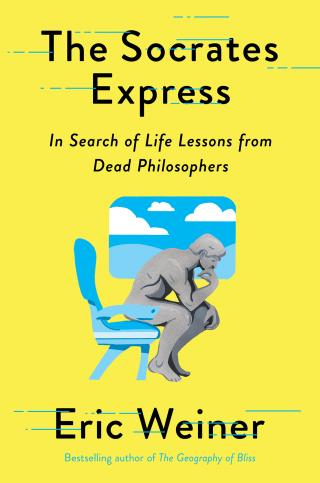
The Socrates Express
- Автор: Вейнер Эрик
- Год: 2020
- Язык: английский
- Год: Avid Reader Press / Simon & Schuster
- Жанр: География, путевые заметки

Электронная книга - «The Socrates Express». Краткое содержание книги:
We contemplate for the same reasons we travel: to see the world from a different perspective, to unearth hidden beauty and find new ways of being. We want to learn how to embrace wonder. Face regrets. Sustain hope.
Eric Weiner, *New York Times* bestselling author of *The Geography of Bliss* , combines his twin passions for philosophy and global travel in a pilgrimage that uncovers surprising life lessons from philosophers around the world, from Marcus Aurelius to Arthur Schopenhauer, Confucius to Montaigne. Traveling by train (the most thoughtful mode of transport) he traversed thousands of miles, making stops in Athens, Delhi,...
Philosophy is therapeutic but not the way a hot-stone massage is therapeutic. Philosophy is not easy. It is not nice. It is not palliative. Less spa than gym.
The French philosopher Maurice Merleau-Ponty called philosophy “radical reflection.” I like how he imbues philosophy with the edginess and whiff of danger it deserves. Philosophers once captured the world’s imagination. They were heroic. They were willing to die for their philosophy, and some, like Socrates, did. Now all that is heroic about philosophy is the epic struggle for academic tenure.
Most schools today don’t teach philosophy. They teach about philosophies. They don’t teach students how to philosophize. Philosophy is different from other subjects. It is not a body of knowledge but a way of thinking—a way of being in the world. Not a “what” or a “why” but a “how.”
How. The word doesn’t get much respect these days. In the literary world, how-to books are an embarrassment, the successful but uncouth cousin. Serious writers don’t write how-to books, and serious readers don’t read them. (At least they don’t admit reading them.) Yet most of us don’t stay up at night wondering “what is the nature of reality?” or “why is there something rather than nothing?” It is a how question—how to live?—that grabs hold of us and won’t let go.
Philosophy, unlike science, is proscriptive. It not only describes the world as it is but as it could be, opening our eyes to possibility. The author Daniel Klein said of the ancient Greek philosopher Epicurus what could be said of all the good ones: read them not so much as philosophy but as “life-enhancing poetry.”
I’ve spent the past few years imbibing that poetry, slowly, at the speed of thought, cocooned in a window seat on a train. I have taken trains wherever and whenever possible. I traveled to where some of history’s greatest thinkers thought. I braved Stoic Camp in Wyoming and the Indian Railways bureaucracy in Delhi. I rode New York City’s F train for longer than anyone should. These journeys were my intermission, a chance to stretch my legs, and mind, between philosophical acts. They gave me pause, in the best sense of the word.
Google “philosophers” and you will find hundreds, perhaps thousands. I’ve chosen fourteen. How? Carefully. They are all wise, though in different ways. Different flavors of wisdom. They cover a vast span of time—Socrates lived in the fifth century BC, Simone de Beauvoir in the twentieth century—and of space, too: from Greece to China, Germany to India. All fourteen are dead, but good philosophers never really die; they live on in the minds of others. Wisdom is portable. It transcends space and time, and is never obsolete.
My list includes many Europeans but not exclusively. The West has no monopoly on wisdom. Some of my philosophers, such as Nietzsche, were remarkably prolific. Others, such as Socrates and Epictetus, didn’t pen a single word. (Fortunately, their students did.) Some achieved great fame in their lifetimes. Others died unknown. Some you will recognize as philosophers; others, such as Gandhi, you probably don’t think of as a philosopher. (He was.) A few names, like that of the Japanese courtier and author Sei Shōnagon, may be new to you. That’s okay. In the end, my criteria boiled down to this: Did these thinkers love wisdom and is that love contagious?
We usually think of philosophers as disembodied minds. Not this bunch. They were corporeal, active beings. They trekked and rode horses. They fought wars and drank wine and made love. And they were, to a man and woman, practical philosophers. It was not the meaning of life that interested them but leading meaningful lives.
They were not perfect. They had their peccadilloes. Socrates lapsed into trances that sometimes lasted hours. Rousseau exposed his buttocks in public on more than one occasion. Schopenhauer talked to his poodle. (Don’t even get me started on Nietzsche.) So be it. Wisdom rarely wears a Brooks Brothers suit, though you never know.
We always need wisdom, but we need different kinds of wisdom at different stages of our lives. The “how to” questions that matter to a fifteen-year-old are not the ones that matter to a thirty-five-year-old—or a seventy-five-year-old. Philosophy has something vital to say about each stage.
The stages, I’m learning, fly by. Too many of us hum along, cluttering our minds with the trivial and the silly, as if we have all the time in the world. We don’t. I don’t. I like to think of myself as middle-aged. My teenage daughter, a math whiz, recently pointed out that unless I live to the age of 110, I am technically not middle age.
So, despite the slowpoke train I’m riding as I write these words, a sense of urgency propels my pen. It is the urgency of someone who does not want to die having not lived. I can’t point to any singular crisis: no health scare or financial comeuppance. No Hollywood crescendo, only the usual melody of annoyances, disappointments, and a nagging suspicion that I am misliving. Life is not a problem for me, not yet, but I feel the hot breath of time on my neck, and a little stronger every day. I want—no, need—to know what matters and what doesn’t, and before it’s too late.
“Sooner or later, life makes philosophers of us all,” said the French thinker Maurice Riseling.
I read that and think, “Why wait?” Why wait until life becomes a problem for me? Why not let life make a philosopher of me today, right now, while there is still time?
PART ONE
DAWN
1. How to Get Out of Bed like Marcus Aurelius
7:07 a.m. Somewhere in North Dakota. Aboard Amtrak’s Empire Builder, en route from Chicago to Portland, Oregon.
Morning light slants across my cabin window. I’d like to say it wakes me gently, but the truth is I was not asleep. My head feels as if it’s been tumble-dried. A dull pain radiates from my temples to the rest of my body. A fog, thick and toxic, clouds my brain. Mine is a body at rest but not a rested body.
When it comes to sleep, there are two types of people. The first type views slumber as a bothersome interruption of life, an inconvenience. The second considers sleep one of life’s unalloyed pleasures. I fall into the latter category. I have few ironclad rules, but one is this: do not mess with my sleep. Amtrak has, and I am not happy.
The relationship between train travel and sleep is, like most relationships, complicated. Yes, the rocking motion lulled me to sleep, but soon other kinetic sensations—including, but not limited to, the Lateral Lurch, the Sudden Jolt, and the Undulating Roll (aka the Wave)—jarred me awake repeatedly throughout the night.
The sun summons me from bed with all the sweetness of a drill sergeant. Our demons do not haunt us at nighttime. They strike in the morning. We are at our most vulnerable when we wake, for that is when the memory of who we are, and how we got here, returns.
I roll over, pulling the baby-blue Amtrak blanket against my body. Sure, I could get out of bed—really I could—but why bother?
“Good morning, everyone!”
I had dozed off but am awakened, not by a Lateral Lurch or an Undulating Roll, but by a voice. It is crisp and perky.
Who is that?
“My name is Miss Oliver, your café car attendant. Your café car is open and serving. But if you want service from Miss Oliver you must always wear shoes, shirts—and kindness!”
Good Lord. There’s no going back to sleep now. I reach into my backpack and fumble for a book, careful not to disrupt my blanket. There it is. Meditations. A thin volume. Not more than 150 pages, and with wide margins. The jacket cover features a relief of a man, bearded and muscular, astride a horse. His eyes possess the quiet power of someone with nothing to prove.