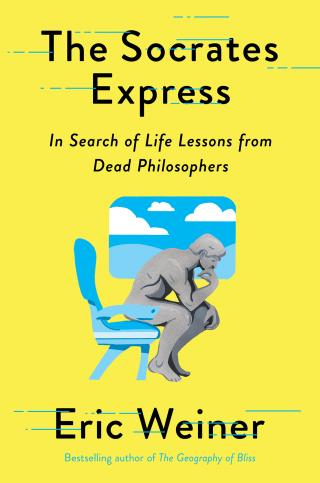
The Socrates Express
- Автор: Вейнер Эрик
- Год: 2020
- Язык: английский
- Год: Avid Reader Press / Simon & Schuster
- Жанр: География, путевые заметки

Электронная книга - «The Socrates Express». Краткое содержание книги:
We contemplate for the same reasons we travel: to see the world from a different perspective, to unearth hidden beauty and find new ways of being. We want to learn how to embrace wonder. Face regrets. Sustain hope.
Eric Weiner, *New York Times* bestselling author of *The Geography of Bliss* , combines his twin passions for philosophy and global travel in a pilgrimage that uncovers surprising life lessons from philosophers around the world, from Marcus Aurelius to Arthur Schopenhauer, Confucius to Montaigne. Traveling by train (the most thoughtful mode of transport) he traversed thousands of miles, making stops in Athens, Delhi,...
Amid the waves of pain, Rob managed to recall the words of Epictetus: “You are nothing to me.” He repeated that, over and over, addressing the waves of pain crashing into him. You are nothing to me. He felt better—not a lot better, but better. “My body is not under my control—any illusions of that were stripped away.”
Rob’s world shrank: the hospital room, the doctors and nurses. And his pain. Five tubes protruded from his body. He hadn’t bathed in six days. He faced a difficult surgery, one that might leave him dependent on a colostomy bag for the rest of his life. He made his choice the Stoic way, rationally. “If I don’t do this, I’m going to die, so let’s do it.”
The surgery was a success. No bag. His recovery was slow but steady. His insurance company sprang for a first-class seat for the flight home. The Stoics call this sort of bonbon a “preferred indifferent,” something nice to enjoy occasionally but not central to our happiness.
Looking back at the episode, Rob knows his Stoic attitude didn’t change the outcome, but it did change how he endured it. He suffered but he did not compound his suffering by wishing life were otherwise.
Epictetus was born a slave in AD 55 in what is today Turkey. His master, an advisor to Emperor Nero, beat him. Epictetus bore the mistreatment stoically. One day, the story goes, Epictetus’s owner began to torture him by twisting his leg. “If you keep that up, you’re going to break it,” said Epictetus calmly. The owner continued twisting Epictetus’s leg until it broke. “Didn’t I tell you it would break?” said Epictetus matter-of-factly. He was lame for the rest of his life.
Eventually freed from slavery, he moved to Rome, where he studied philosophy and soon gained a reputation as a dedicated and effective teacher. When, in AD 93, Emperor Domitian banished all philosophers from Rome, Epictetus moved to Nicopolis, a thriving coastal city in western Greece. There he attracted even more students, famous ones, like Hadrian, a future emperor, but mostly ordinary young men who traveled far to reach Nicopolis. Many were homesick. All were eager to learn.
Epictetus admired Socrates, and in many ways emulated him. Like Socrates, he lived simply, in a hut, with only a mattress as furniture. Like Socrates, Epictetus had no interest in metaphysics; his was a rigorously practical philosophy. Like Socrates, Epictetus valued ignorance as a necessary step on the road to true wisdom. Philosophy begins with “consciousness of our own weakness,” he said.
Much of life lies beyond our control, but we command what matters most: our opinions, impulses, desires, and aversions. Our mental and emotional life. We all possess Herculean strength, superhero powers, but it is the power to master our interior world. Do this, the Stoics say, and you will be “invincible.”
Too often we place our happiness in the hands of others: a tyrannical boss, a mercurial friend, our Instagram followers. Epictetus, the former slave, likens our predicament to self-imposed bondage. Only the man or woman who wants nothing is free.
Imagine, says Epictetus, you handed over your body to a stranger on the street. Absurd, right? Yet that’s what we do with our mind every day. We cede our sovereignty to others, allowing them to colonize our mind. We need to evict them. Now. It’s not so difficult. It is far easier to change ourselves than to change the world. This is one problem with trigger warnings, so prevalent on college campuses. They reinforce the presumption that college students are unable to control their reactions to potentially disturbing content. It disempowers them. It is not the Stoic way.
Think of an archer, says Cicero. He pulls the bow, as expertly as his abilities allow, but once released, exhales, knowing the arrow’s trajectory is no longer in his hands. As the Stoics say: “Do what you must; let happen what may.” We can inoculate ourselves against the bite of disappointment by switching from external to internal goals: not winning the tennis match but playing our best game; not seeing our novel published but writing the best, most honest one we are capable of writing. Nothing more, nothing less.
The fire has dwindled to hot ash, the coffee grown cold, but no one notices. We’re knee-deep into Stoicism and ready to dive deeper. One by one, we read the crisp entries from Epictetus’s Handbook. Some merit lengthy discussion, others a simple nod. Then we come across this line: “What upsets people is not things themselves but their judgments about things.” We sit there in silence, absorbing this two-thousand-year-old nugget, as obvious as it is profound.
The Stoics believe our emotions are the product of rational thought, but it is flawed thought. We can change the way we feel by changing the way we think. The Stoic aims not to feel nothing but to feel correctly. I realize that sounds odd. We don’t think of our emotions as either correct or incorrect. They just are. We have no control over them.
Not true, say the Stoics. Emotions don’t wash over us like waves on the beach. They happen for a reason. As the classicist A. A. Long explains, “We don’t typically get angry or jealous for no reason, but precisely because we think that someone is treating us badly or someone is achieving success that we, rather than he, deserves.” We are as responsible for our emotions as we are for our thoughts and actions. They are the result of judgments we make, and these judgments are often faulty. They are not misguided, or muddled, the Stoics say, but empirically wrong.
Imagine a traffic jam. Two drivers sit bumper-to-bumper. One is frazzled and angry, banging on the steering wheel and cursing. The other sits calmly, listening to NPR and recalling a meal of lobster ravioli he enjoyed recently. Clearly, the Stoics say, both drivers can’t be “right.” And they aren’t. The frazzled driver is incorrect, as incorrect as if he had concluded that two plus two equals three. To wish life is otherwise represents an egregious failure of reason.
Let’s examine how a faulty emotion is born. It starts with a reflexive reaction (called “pre-emotions” or “proto-passions”) to an external event (an “impression” in Stoic-speak). We stub our toe, then scream. We get stuck in traffic, then curse. This is natural. We are human after all. That initial shock is not an emotion but a reflex, like blushing when you’re embarrassed. It becomes an emotion when you “assent” to it, the Stoics say. When you assent, you elevate its status from reflex to passion.
All of this happens quickly, in a flash, but none of it happens without our permission. Every time we choose to honor, and amplify, these negative proto-passions we are choosing unhappiness. Why in the world, ask the Stoics, would you want to do that?
We must sever the link between impression and assent. This is where the Socratic pause—the “Mighty Pause,” I call it—comes in handy. Says Epictetus: “Be not swept off your feet by the vividness of the impression, but say, ‘Impression, wait for me a little. Let me see what you are and what you represent. Let me try you.’ ” Only when we realize our reaction to hardship is not automatic but a choice can we begin to make better choices.
But doesn’t everyone get upset when they’re stuck in traffic or stub their toe? No, they don’t, and, besides, says Rob, “Just because lots of people get upset when they stub their toes doesn’t mean you should, too.” We are always free to withhold assent. That is fully up to us.
If you must assent to these proto-passions, assent in a different direction, suggests Epictetus. Relabel them. If you’re alone, relabel your solitude as tranquility. If you are stuck in a crowd, relabel it a festival, “and so accept all contentedly.” Another mind trick? Sure, but a helpful one. Your mind is always playing tricks with reality anyway. Why not put those tricks to good use?